MCQ
Let $X=\left\{(x, y) \in \mathbb{Z} \times \mathbb{Z}: \frac{x^2}{8}+\frac{y^2}{20}<1\right.$ and $\left.y^2<5 x\right\}$. Three distinct points $P, Q$ and $R$ are randomly chosen from $X$. Then the probability that $P, Q$ and $R$ form a triangle whose area is a positive integer, is
  • A
    $\frac{71}{220}$
  •  $\frac{73}{220}$
  • C
    $\frac{79}{220}$
  • D
    $\frac{83}{220}$

Answer

Correct option: B.
 $\frac{73}{220}$
b
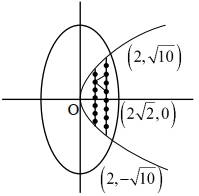
$\frac{x^2}{8}+\frac{y^2}{20}<1 y^2<5 x$

Solving corresponding equations

$\frac{x^2}{8}+\frac{y^2}{20}=1 y^2=5 x$

$x=2$

$y= \pm \sqrt{10}$

$X=\{(1,1),(1,0),(1,-1),(1,2),(1,-2),(2,3),(2,2),(2,1),(2,0),(2,-1),(2,-2),(2,-3)\}$

(image)

Let $\mathrm{S}$ be the sample space $\mathrm{E}$ be the event $\mathrm{n}(\mathrm{S})={ }^{12} \mathrm{C}_3$

For $E$

Selecting $3$ points in which $2$ points are either or $\mathrm{x}=1$  $\mathrm{x}=2$ but distance $\mathrm{b} / \mathrm{w}$ then is even

Triangles with base $2$ :

$=3 \times 7+5 \times 5=46$

Triangles with base $4$ :

$=1 \times 7+3 \times 5=22$

Triangles with base $6$ :

$=1 \times 5=5$

$P(E)=\frac{46+22+5}{{ }^{12} C_3}=\frac{73}{220}$

Need a full question paper?

Generate a complete, print-ready paper with questions like this in minutes — across 16+ boards, with answer keys.

Start Generating Free

Similar questions

If $x = {\log _2}\left( {\sqrt {56 + \sqrt {56 + \sqrt {56 +  .... + \infty } } } } \right)$ then 
If $\text{y}=\text{a}\cos(\log_\text{e}\text{x})+\text{b}\sin(\log_\text{e}\text{x})$ then $\text{x}^2\text{y}^2+\text{xy}_1=$
  1. 0
  2. y
  3. -y
  4. None of these
A spherical balloon is being inflated at the rate of $35\,cc/min$. The rate of increase in the surface area (in $cm^2/min.$) of the balloon when its diameter is $14\, cm$, is
The function $f(x)=[x]$, where $[x]$ denotes the greatest integer less than or equal to $x$, is continuous at
Choose the correct answer from given four options in each of the Exercise:
If A, B and C are angles of a triangle, then the determinant $ \begin{vmatrix}-1&\cos\text{C}&\cos\text{B}\\\cos\text{C}&-1&\cos\text{A}\\\cos\text{B}&\cos\text{A}&-1\end{vmatrix}$ is equal to:
  1. 0
  2. -1
  3. 1
  4. None of these.
If $\text{y}=\text{a}\cos(\log_\text{e}\text{x})+\text{b}\sin(\log_\text{e}\text{x})$ then $\text{x}^2\text{y}^2+\text{xy}_1=$
  1. 0
  2. y
  3. -y
  4. None of these
A line $AB$ in three-dimensional space makes angles $45^o $ and  $120^o $ with the positive $x-$ axis and the positive $y-$ axis respectively. If $AB$ makes an acute angle $\theta$ with the positive $z-$axis, then $\theta$ equals
$\int\text{e}^{\text{x}}\{\text{f(x)}+\text{f}'(\text{x})\}\text{dx}=$
  1. $\text{e}^{\text{x}}\text{f(x)}+\text{C}$
  2. $\text{e}^{\text{x}}+\text{f(x)}$
  3. $2\text{e}^{\text{x}}\text{f(x)}$
  4. $\text{e}^{\text{x}}-\text{f(x)}$
Consider the function $f:(0, \infty) \rightarrow R$ defined by $f(x)=e^{-\left|\log _e x\right|}$. If $m$ and $n$ be respectively the number of points at which $f$ is not continuous and $f$ is not differentiable, then $\mathrm{m}+\mathrm{n}$ is
The feasible region is :