Question
Let $\text{X}=\overline{\text{ABC}}+\overline{\text{BCA}}+\overline{\text{CAB}}.$ Evaluate X for:
  1. $\text{A}=1,\text{B}=0,\text{C}=1$
  2. $\text{A}=\text{B}=\text{C}=1$
  3. $\text{A}=\text{B}=\text{C}=0$

Answer

Given, Output $\text{X}=\overline{\text{ABC}}+\overline{\text{BCA}}+\overline{\text{CAB}}$
  1. $\text{A}=1,\text{B}=0,\text{C}=1$
$\text{X}=1.\Big(\overline{0.1}\Big)+0\Big(\overline{1.1}\Big)+1\Big(\overline1.0\Big)$
$=1.\bar{0}+0.\bar{1}+1.\bar{0}$
$=1.1+0.0+1.1$
$=1+0+1$
$=1+1$
$=1$
  1. $\text{A}=\text{B}=\text{C}=1$
$\text{X}=1\Big(\overline{1.1}\Big)+1\Big(\overline{1.1}\Big)+1\Big(\overline{1.1}\Big)$
$=1.\bar{1}+1.\bar{1}+1.\bar{1}$
$=1.0+1.0+1.0$
$=0+0+0$
$=0$
  1. $\text{A}=\text{B}=\text{C}=0$
$\text{X}=0\Big(\overline{0.0}\Big)+0\Big(\overline{0.0}\Big)+0\Big(\overline{1.1}\Big)$
$=0.\bar{0}+0.\bar{0}+0.\bar{0}$
$=0.1+0.1+0.1$
$=0+0+0$
$=0.$

Need a full question paper?

Generate a complete, print-ready paper with questions like this in minutes — across 16+ boards, with answer keys.

Start Generating Free

Similar questions

How are fundamental logic gates OR, AND and NOT obtained from NOR gates ?
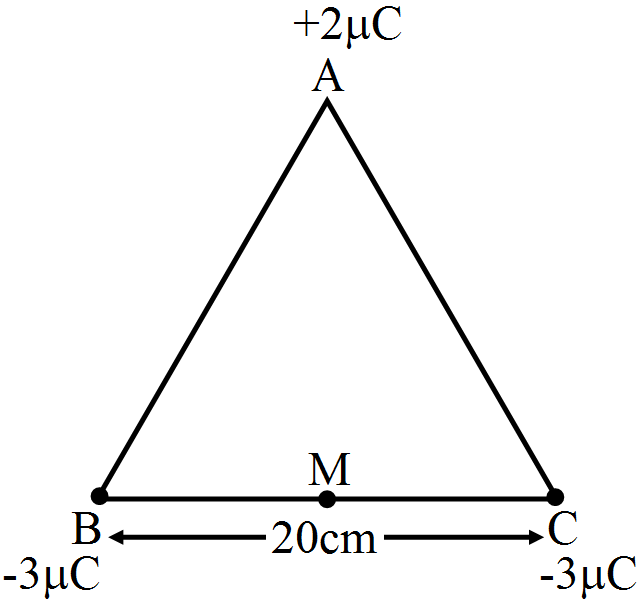
Three point charges of $+2\mu\text{C}, -3\mu\text{C}$ and $-3\mu\text{C}$ are kept at the vertices $A, B$ and $C$ respectively of an equilateral triangle of side $20\ cm$ as shown in figure. What should be the sign and magnitude of charge to be placed at the midpoint $M$ of side $BC$ so that charge at $A$ remains in equilibrium?
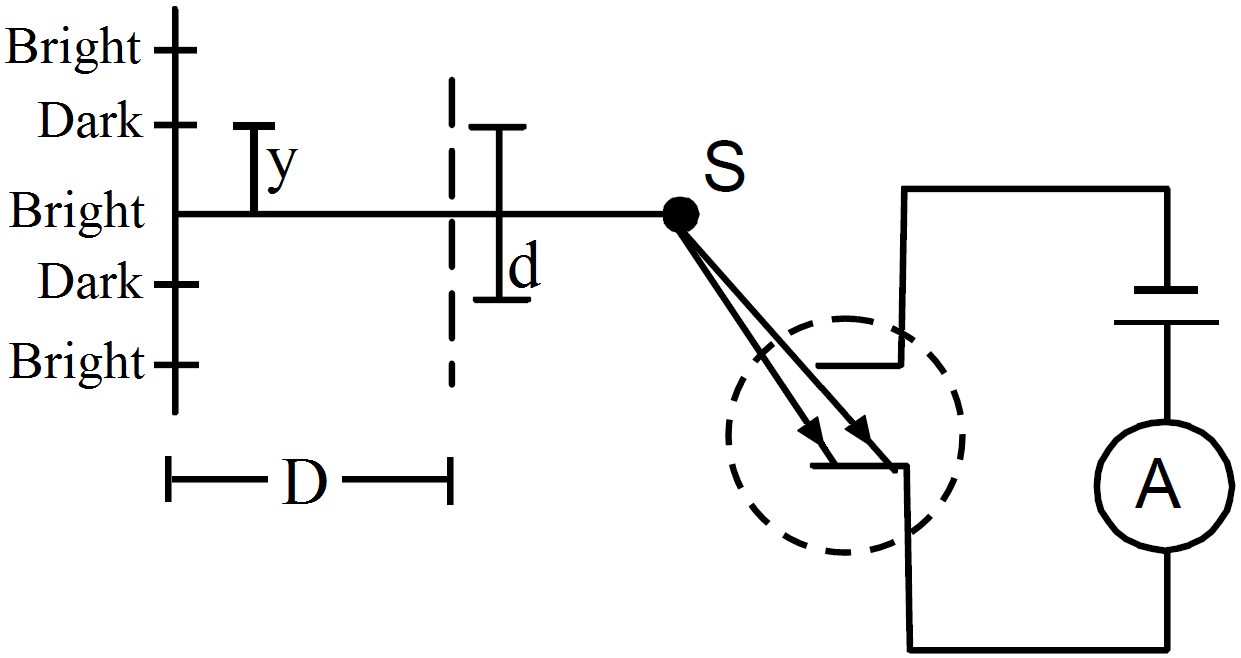
In the arrangement shown in figure $y = 1.0\ mm. d = 0.24\ mm$ end $D = 1.2m.$ The work function of the materiel of the emitter is $2.2eV.$ Find the stopping potential V needed to stop the photocurrent.
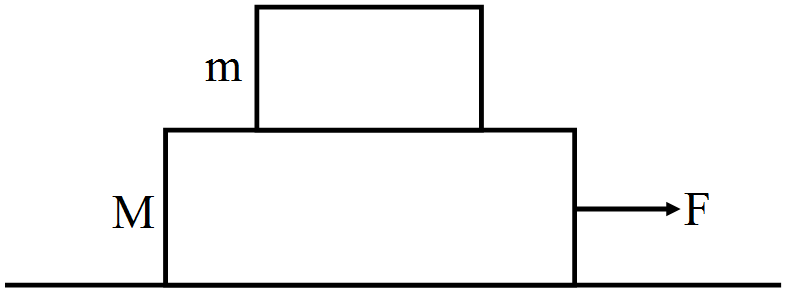
A block of mass m is kept over another block of mass M and the system rests on a horizontal surface figure. A constant horizontal force F acting on the lower block produces an acceleration $\frac{\text{F}}{2(\text{m+M})}$ in the system, the two blocks always move together.
  1. Find the coefficient of kinetic friction between the bigger block and the horizontal surface.
  2. Find the frictional force acting on the smaller block.
  3. Find the work done by the force of friction on the smaller block by the bigger block during a displacement d of the system.
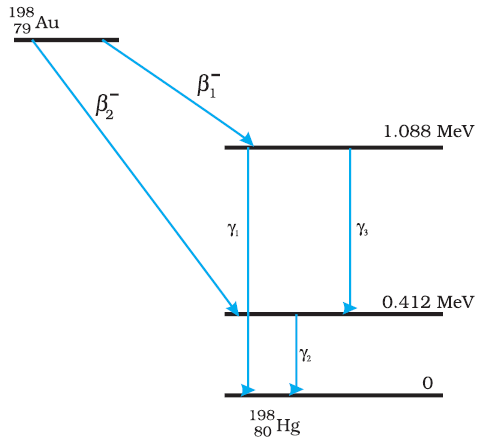
Obtain the maximum kinetic energy of $\beta-$ particles, and the radiation frequencies of $\gamma$ decays in the decay scheme shown in Fig. $13.6$. You are given that:
$\text{m}(^{198}\text{Au})=197.968233\text{ u}$
$\text{m}(^{198}\text{Hg})=197.9667602\text{ u}$
Calculate force pair required to deflect a bar magnet by $\theta^{\circ}$ in a uniform magnetic field and on this basis define magnetic moment and calculate torque at $\theta=0^{\circ}$ and $\theta=90^{\circ}$.###Calculate moment of force acting on a bar magnet which is deflected by an angle in a uniform magnetic field by drawing a diagram and on this basis define magnetic moment and calculate torque at $\theta=0^{\circ}$ and $\theta$ $=90^{\circ}$.
$(I) (a)$ A giant refracting telescope at an observatory has an objective lens of focal length $15 m$. If an eyepiece of focal length $1.0 \ cm$ is used, what is angular magnification of the telescope in normal adjustment?
$(b)$ If this telescope is used to view the moon, what is the diameter of the image of the moon formed by the objective lens? The diameter of the moon is $3.48 \times 10^6 m$ and the radius of lunar orbit is $3.8 \times 10^8 m$.
Obtain the binding energy of the nuclei $^{56}_{26}\text{Fe }$ and $\ ^{209}_{83}\text{Bi}$ in units of $\text{MeV}$ from the following data:
$\text{m}(^{56}_{26}\text{Fe})=55.934939\text{ u }$ $\text{ m}(^{209}_{83}\text{Bi})=208.980388\text{ u}$
The magnetic field in a region is given by $\vec{\text{B}}=\vec{\text{k}}\frac{\text{B}_0}{\text{L}}\text{y}$ where L is a fixed length. A conductihg rod of of length lies along the Y-axis between the origin and the point (0, L, 0). If the rod moves with a velocity $\text{v}=\text{v}_0\vec{\text{i}},$ find the emf induced between the ends of the rod.
  1. An electron moves along a circle of radius 1m in a perpendicular magnetic field of strength 0.50T. What would be its speed? Is it reasonable?
  2. If a proton moves along a circle of the same radius in the same magnetic field, what would be its speed?