MCQ
Let $y$ be the function which passes through $(1, 2)$ having slope $(2x + 1)$. The area bounded between the curve and $x -$ axis is
  • A
    $6\,\, sq. \,unit$
  • B
    $5/6\,\, sq. \,unit$
  • $1/6\,\, sq. \,unit$
  • D
    None of these

Answer

Correct option: C.
$1/6\,\, sq. \,unit$
c
(c) $\frac{{dy}}{{dx}} = 2x + 1$ 

==> $y = {x^2} + x + c$

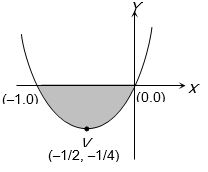
==> $y = {x^2} + x$, [ $\because$ $c = 0$ by putting $x = 1, y = 2$)

==> ${\left( {x + \frac{1}{2}} \right)^2} = y + \frac{1}{4}$, 

which is a equation of parabola, whose vertices is, $V \left( {\frac{{ - 1}}{2},\,\frac{{ - 1}}{4}} \right)$

$\therefore $ Required area $ = \left. {\left| {\int_{ - 1}^0 {({x^2} + x)\;dx} } \right.} \right|$

$ = \left( {\frac{{{x^3}}}{3} + \frac{{{x^2}}}{2}} \right)_{ - 1}^0$

$\left. { = \left| {\frac{{ - 1}}{3} + \frac{1}{2}} \right.} \right| = \frac{1}{6}\,\, sq. \,unit$.
Need a full question paper?

Generate a complete, print-ready paper with questions like this in minutes — across 16+ boards, with answer keys.

Start Generating Free

Similar questions

Let $a, b, c, p, q$ be real numbers. Suppose $\alpha, \beta$ are the roots of the equation $x^2+2 p x+q=0$ and $\alpha, \frac{1}{\beta}$ are the roots of the equation $\mathrm{ax}^2+2 b \mathrm{x}+c=0$, where $\beta^2 \notin\{-1,0,1\}$.

$STATEMENT-1$ $:\left(\mathrm{p}^2-\mathrm{q}\right)\left(\mathrm{b}^2-\mathrm{ac}\right) \geq 0$ and

$STATEMENT$ $-2: \mathrm{b} \neq \mathrm{pa}$ or $\mathrm{c} \neq \mathrm{qa}$

Let $A=\{1,6,11,16, \ldots\}$ and $B=\{9,16,23,30, \ldots\}$ be the sets consisting of the first 2025 terms of two arithmetic progressions. Then $\mathrm{n}(\mathrm{A} \cup \mathrm{B})$ is
The derivative of the function, $f(x)=cos^{-1} \left\{ \,\frac{1}{{\sqrt {13} }}(2\cos x - 3\sin x)\,\,\,\right\}$

$ + sin^{-1} \left\{ \,\frac{1}{{\sqrt {13} }}(2\cos x + 3\sin x)\,\,\,\right\} $ w.r.t. at $x = \frac{3}{4}$ is :

$\mathop {\lim }\limits_{x \to 0} \,{(\cos mx)^{n/{x^2}}}$ equals
$36$  factorize into two factors in such a way that sum of factors is minimum, then the factors are
The function $f(x)=2 x+3(x)^{\frac{2}{3}}, x \in R,$ has
$\mathop {\lim }\limits_{x \to 1} \frac{{x + {x^2} + ...... + {x^n} - n}}{{x - 1}}$ is equal to
Let  ${\tan ^{ - 1}}\left( {\tan \frac{{5\pi }}{4}} \right) = \alpha ,{\tan ^{ - 1}}\left( { - \tan \frac{{2\pi }}{3}} \right) = \beta $ Then :-
${{2x} \over {{x^4} + {x^2} + 1}} = $
Let $y=y(x)$ be the solution of the differential equation

$\left(x^2+4\right)^2 d y+\left(2 x^3 y+8 x y-2\right) d x=0 \text {. If } y(0)=0 \text {, }$ then $y(2)$ is equal to