MCQ
Lewis acid are those substances
  • Which accept electron pair
  • B
    Which provide ${H^ + }$ion in the solution
  • C
    Which give electron pair
  • D
    Which accept $O{H^ - }$ion

Answer

Correct option: A.
Which accept electron pair
(a)According to the Lewis concept.

Need a full question paper?

Generate a complete, print-ready paper with questions like this in minutes — across 16+ boards, with answer keys.
Start Generating Free

Similar questions

Acid used for making permanent marking on the glass surface is
In which of the following pair, both the species are isoelectronic but the first one is  large in size than the second?
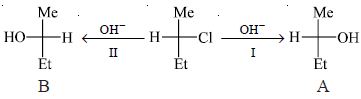
Steps $I$ and $II$ are
A reaction of $0.1$ mole of Benzylamine with bromomethane gave $23\, g$ of Benzyl trimethyl ammonium bromide. The number of moles of bromomethane consumed in this reaction are $n \times 10^{-1},$ when $n =\ldots...$ (Round off to the Nearest Integer).

(Given : Atomic masses: $C$ : $12.0\, u$, $H : 1.0\, u , N : 14.0\, u , Br : 80.0\, u ]$

$5\,ml$ of $N\,HCl, \,\,20\,ml$  of $N/2$ ${H_2}S{O_4}$ and $30\,ml $ of $N/3\,\,HNO_3$  are mixed together and volume made to one litre. The normally of the resulting solution is
In the dehydrohalogenation of $2$ -bromobutane; which conformation leads to the  formation of $cis-2$ -butene ?
When $1\ gm$ equivalent of strong acid reacts with strong base heat released is $13.5\ Kcal$ .  when $1\ gm$ equivalent $H_2A$ is completely neutralised against strong base $13\ Kcal$ is released. When $1\ gm$ equivalent $B(OH)_2$ is  completely neutralised against strong acid $10\ Kcal$ heat is released. Calculate enthalpy change when $1\ mole\ H_2A$ is completely neutralised by $B(OH)_2$........$K\,cal$
The correct observation in the following reactions is :

Sucrose $\xrightarrow[{Cleavage\,\,(Hydrolysis)}]{{Gly\cos idic\,bond}}A + B\xrightarrow[{{\text{reagent}}}]{{{\text{Seliwanoff 's}}}}?$

Sulphonation is most favourable at the carbon number ...
For the reaction at equilibrium 

${N_2}\left( g \right) + 3{H_2}\left( g \right) \rightleftharpoons \,2N{H_3}\left( g \right)$ 

On addition of an inert gas at constant pressure & constant temperature which of the following change is $NOT$ observed