MCQ
Lewis has pictured the atom in terms of kernel and the outermost shell that could accommodate a maximum of:
- A6 electrons.
- B10 electrons.
- C8 electrons.
- D2 electrons.
Generate a complete, print-ready paper with questions like this in minutes — across 16+ boards, with answer keys.
$x g$ and $y g$ are mass of $R$ and $U$, respectively.
(Use : Molar mass (in $g mol { }^{-1}$ ) of $H , C$ and $O$ as $1,12$ and $16$ , respectively)
($1$) The value of $x$ is
($2$) The value of $y$ is
Give thwe answer or quetion ($1$) and ($1$)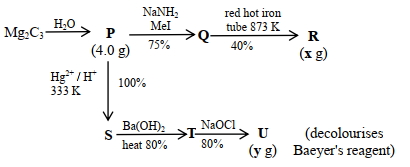
$ 2 \mathrm{~S}_2 \mathrm{O}_3^{2-}+\mathrm{I}_2 \rightarrow \mathrm{S}_4 \mathrm{O}_6^{2-}+2 \mathrm{I}^{-}$
$\mathrm{S}_2 \mathrm{O}_3^{2-}+5 \mathrm{Br}_2+5 \mathrm{H}_2 \mathrm{O} \rightarrow 2 \mathrm{SO}_4^{2-}+4 \mathrm{Br}^{-}+10 \mathrm{H}^{+}$
Which of the following statement justifies the above dual behaviour of thiosulphate?