MCQ
$LiAl{H_4}$ converts acetic acid into
  • A
    Acetaldehyde
  • B
    Methane
  • Ethyl alcohol
  • D
    Methyl alcohol

Answer

Correct option: C.
Ethyl alcohol
c
(c)$C{H_3}COOH + 4H\mathop {\xrightarrow{{LiAIH_4}}}\limits C{H_3}C{H_2}OH + {H_2}O$ 

Need a full question paper?

Generate a complete, print-ready paper with questions like this in minutes — across 16+ boards, with answer keys.

Start Generating Free

Similar questions

For the diazonium ions the order of reactivity towards diazo-coupling with phenol  in the presence of dilute $NaOH $ is
'A' salt which gives green flame with bunsen burner, on reaction with dil. $H_2SO_4$ produces gas $(2)$ and white turbidity $(Z)$. The saturated solution of gas $(2)$ on reaction with $H_2S$ gas produces '$Z$' then select $CORRECT$ statement
The addition of a polar solvent to a solid electrolyte results in
The limiting molar conductivities ${ \wedge ^0}$ for $ NaCl,\,KBr$  and $ KCl$  are $126,\,152 $ and $150\,\,S\;c{m^2}mo{l^{ - 1}}$ respectively. The ${ \wedge ^0}$ for $NaBr$ is ............ ${\rm{S}}\,{\rm{c}}{{\rm{m}}^2}{\rm{mo}}{{\rm{l}}^{ - 1}}$
Consider the half-cell reduction reaction

$Mn^{2+} + 2e^- \rightarrow Mn,\, $$E^o = - 1.18\, V$

$Mn^{2+} \rightarrow  Mn^{3+} + e^-,$ $ E^o = - 1.51 \,V$

The $E^o$ for the reaction $3Mn^{2+} \rightarrow  Mn^o + 2Mn^{3+},$

and possibility of the forward reaction are respectively

Number of products in the given reaction :

${C_6}{H_5}CHO + C{H_3} - CHO\xrightarrow{{\mathop O\limits^\Theta  H}}$ Product

will be

Which of the following complex ion is not expected to absorb visible light ?
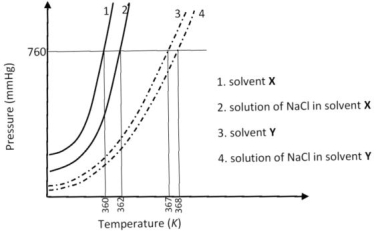
The plot given below shows $P - T$ curves (where $P$ is the pressure and $T$ is the temperature) for two solvents $X$ and $Y$ and isomolal solutions of $NaCl$ in these solvents. $NaCl$ completely dissociates in both the solvents.

On addition of equal number of moles of a non-volatile solute $S$ in equal amount (in $kg$ ) of these solvents, the elevation of boiling point of solvent $X$ is three times that of solvent $Y$. Solute $S$ is known to undergo dimerization in these solvents. If the degree of dimerization is $0.7$ in solvent $Y$, the degree of dimerization in solvent $X$ is. . . . . . .
Alkyl halides are prepared from alcohol by treating with
Ethyl alcohol on oxidation with ${K_2}C{r_2}{O_7}$ gives