MCQ
Ligands, in complex compounds
  • A
    Accept ${e^ - }$ - pair
  • Donate ${e^ - }$ - pair
  • C
    Neither accept ${e^ - }$ - pair nor donate
  • D
    All of these happen

Answer

Correct option: B.
Donate ${e^ - }$ - pair
b
It’s obvious.

Need a full question paper?

Generate a complete, print-ready paper with questions like this in minutes — across 16+ boards, with answer keys.
Start Generating Free

Similar questions

The value of $\Delta H - \Delta E$ for the following reaction at ${27\,^o}C$ will be $2N{H_3}(g)\, \to \,{N_2}(g) + 3{H_2}(g)$
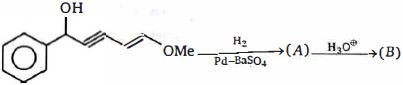
Product $(B)$ is
Assign $A, B, C, D$ from given type of reaction. $CuO + {H_2} \longrightarrow Cu \downarrow  + {H_2}O$
On heating glucose with Fehling's solution we get a precipitate whose colour is
In $[Fe(CO)_5],$ the $Fe-C$ bond has
In a constant volume calorimeter, $3.5 \mathrm{~g}$ of a gas with molecular weight $28$ was burnt in excess oxygen at $298.0 \mathrm{~K}$. The temperature of the calorimeter was found to increase from $298.0 \mathrm{~K}$ to $298.45 \mathrm{~K}$ due to the combustion process. Given that the heat capacity of the calorimeter is $2.5 \mathrm{~kJ} \mathrm{~K}^{-1}$, the numerical value for the enthalpy of combustion of the gas in $\mathrm{kJ} \mathrm{mol}^{-1}$ is
Match List $I$ with List $II$. Choose the correct answer from the options given below:

List $-I$ List $-II$

$A.$ Melting point $[\mathrm{K}]$ 

$I.$ $\mathrm{Tl}>\mathrm{In}>\mathrm{Ga}>\mathrm{Al}>\mathrm{B}$

$B.$ Ionic Radius $\left[\mathrm{M}^{+3} / \mathrm{pm}\right]$

$II.$ $\mathrm{B}>\mathrm{Tl}>\mathrm{Al} \approx \mathrm{Ga}>\mathrm{In}$
$C.$ $\Delta_{\mathrm{i}} \mathrm{H}_1 $ $ [\mathrm{~kJ} \mathrm{~mol}^{-1}]$ $III.$ $\mathrm{Tl}>\mathrm{In}>\mathrm{Al}>\mathrm{Ga}>\mathrm{B}$
$D.$ Atomic Radius $[pm]$ $IV.$ $\mathrm{B}>\mathrm{Al}>\mathrm{Tl}>\mathrm{In}>\mathrm{Ga}$
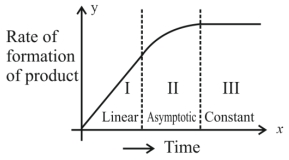
For certain chemical reaction $X \rightarrow Y$, the rate of formation of product is plotted against the time as shown in the figure. The number of Correct statement/s from the following is $.......$.

$(A)$ Over all order of this reaction is one

$(B)$ Order of this reaction can't be determined

$(C)$ In region$-I$ and $III$, the reaction is of first and zero order respectively

$(D)$ In region$-II$, the reaction is of first order

$(E)$ In region$-II$, the order of reaction is in the range of $0.1$ to $0.9$.
For ${N_2} + 3{H_2}$ $\rightleftharpoons$ $2N{H_3}$ equilibrium constant is $k$ then equilibrium constant for $2N_2 + 6H_2 $ $\rightleftharpoons$ $ 4NH_3$ is
Which decolorize aqueous bromine and gives white fumes of $HCl$ on reaction with $PC{l_5}$