MCQ
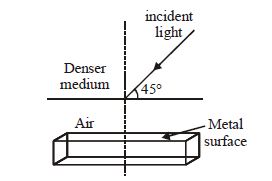
Light comprising three wavelength $310$, $455$, $620$  $nm$ is incident on a surface separating two media at an angle of $45^o $ and given refractive index for $455$  $nm$ light is $\sqrt 2 $ . If a metal plate of work function $1.2$  $eV$ is placed in this medium then maximum kinetic energy of the electron emitted from metallic plate is.......$eV$
  • $0.8$
  • B
    $2.8$
  • C
    $1.8$
  • D
    $1.5$

Answer

Correct option: A.
$0.8$
a

Need a full question paper?

Generate a complete, print-ready paper with questions like this in minutes — across 16+ boards, with answer keys.

Start Generating Free

Similar questions

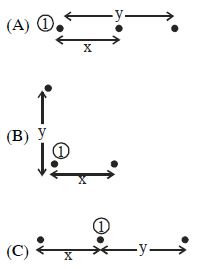
There are three arrangement of three point masses (each of mass $m$). In which of the following three arrangements they are arranged in order of increasing magnitude of gravitational force on point mass marked as $1$ ?
Maximum kinetic energy of the positive ion in the cyclotron is
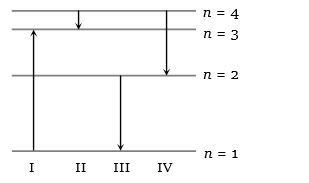
The diagram shows-the energy levels for an electron in a certain atom. Which transition shown represents the emission of a photon with the most energy
A sample of $1$ mole gas at temperature $\mathrm{T}$ is adiabatically expanded to double its volume. If adiabatic constant for the gas is $\gamma=\frac{3}{2}$, then the work done by the gas in the process is:
For $a$ gas $C_{p}-C_{V}=R$ in a state $P$ and $C_{p}-C_{V}=1.10 R$ in a state $Q, T_{p}$ and $T_{Q}$ are the temperatures in two different states $P$ and $Q$ respectively. Then
A car goes around uniform circular track of radius $R$ at a uniform speed $v$ once in every $T$ seconds. The magnitude of the centripetal acceleration is $a_c$. If the car now goes uniformly around a larger circular track of radius $2 R$ and experiences a centripetal acceleration of magnitude $8 a_c$. Then, its time period is
In Maxwell's speed distribution curve, for $N_2$ gas, the average of $\mid$ relative velocity (in $m/s$) $\mid$ between two molecules at $300 \,K$ will be
Two point charges $q_1\,(\sqrt {10}\,\,\mu C)$ and $q_2\,(-25\,\,\mu C)$ are placed on the $x-$ axis at $x = 1\,m$ and $x = 4\,m$ respectively. The electric field (in $V/m$ ) at a point $y = 3\,m$ on $y-$ axis is, [ take ${\mkern 1mu} {\mkern 1mu} \frac{1}{{4\pi {\varepsilon _0}}} = 9 \times {10^9}{\mkern 1mu} {\mkern 1mu} N{m^2}{C^{ - 2}}{\rm{ }}$ ]
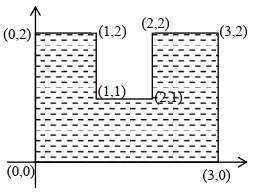
A uniform thin metal plate of mass $10 \mathrm{~kg}$ with dimensions is shown. The ratio of $x$ and $y$ coordinates of center of mass of plate in $\frac{n}{9}$. The value of $n$ is $\qquad$
A large drop of oil (density $0.8\,g / cm ^3$ and viscosity $\eta_0$) floats up through a column of another liquid (density $1.2\,g / cm ^3$ and viscosity $\eta_L$ ). Assuming that the two liquids do not mix, the velocity with which the oil drop rises will depend on.