Question

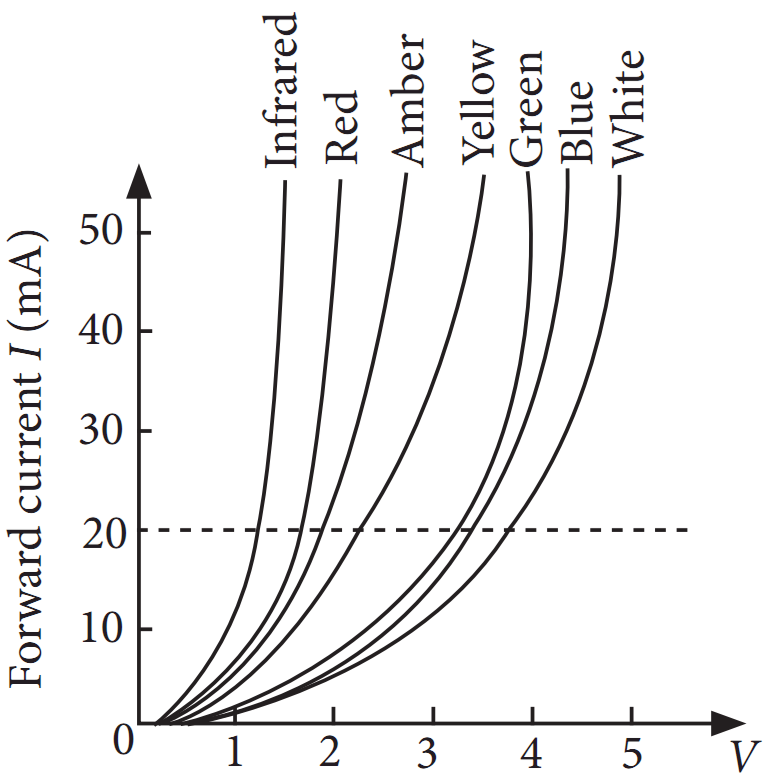
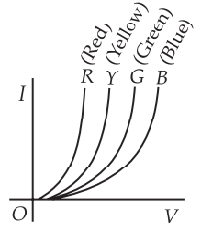
Light emitting diode is a photoelectric device which converts electrical energy into light energy. It is a heavily doped p-n junction diode which under forward biased emits spontaneous radiation. The general shape of the I-V characteristics of an LED is similar to that of a normal p-n junction diode, as shown. The barrier potentials are much higher and slightly different for each colour.
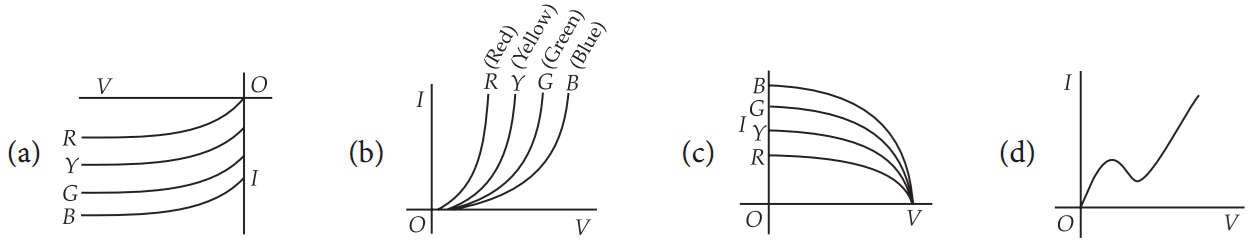
  1. The I-V characteristic of an LED is:
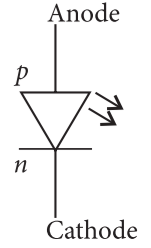
  1. The schematic symbol of light emitting diode is (LED).

  1. An LED is constructed from a p-n junction based on a certain Ga-As-P semiconducting material whose energy gap is 1.9eV. Identify the colour of the emitted light.
  1. Blue.
  2. Red.
  3. Violet.
  4. Green.
  1. Which one of the following statement is not correct in the case of light emitting diodes?
  1. It is a heavily doped p-n junction.
  2. It emits light only when it is forward biased.
  3. It emits light only when it is reverse biased.
  4. The energy of the tight emitted is less than the energy gap of the semiconductor used.
  1. The energy of radiation emitted by LED is:
  1. Greater than the band gap of the semiconductor used.
  2. Always less than the band gap of the semiconductor used.
  3. Always equal to the band gap of the semiconductor used.
  4. Equal to or less than the band gap of the semiconductor used.
Answer

  1. (b)

Explanation:
The I-V characteristics of an LED is similar to that of a Si junction diode. But the threshold voltages are much higher and slightly different for each colour.
  1. (b)
  1. (b) Red.
Explanation:
As $\text{E}_\text{g}=\frac{\text{hc}}{\lambda}$
$\therefore\lambda=\frac{\text{hc}}{\text{E}_\text{g}}$
Here, $E_g= 1.9ev, hc = 1240eVnm$
$\therefore\lambda=\frac{1240\text{eVnm}}{1.9\text{eV}}=652.6\text{nm}$
Hence, the emitted light is of red colour.
  1. (c) It emits light only when it is reverse biased.
Explanation:
A light emitting diode is a heavily doped p-n junction diode which emits light only when it is forward biased.
  1. (d) Equal to or less than the band gap of the semiconductor used.

Need a full question paper?

Generate a complete, print-ready paper with questions like this in minutes — across 16+ boards, with answer keys.

Start Generating Free

Similar questions

A moving-coil galvanometer has a 50-turn coil of size 2cm × 2cm. It is suspended between the magnetic poles producing a magnetic field of 0.5T. Find the torque on the coil due to the magnetic field when a current of 20mA passes through it.
(a) What will be the charge on $12.5 \times 10^8$ electrons?(b) Which is larger between 1 Coulomb charge and 1 electron charge? How many electronic charges will there be in one Coulomb charge?
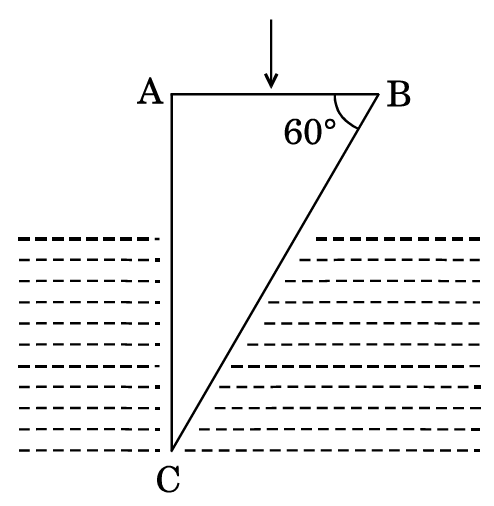
  1. A ray of light is incident normally on the face AB of a right-angled glass prism of refractive index $_{a}\mu_{g} =1.5$The prism is partly immersed in a liquid of unknown refractive index. Find the value of refractive index of the liquid so that the ray grazes along the face BC after refraction through the prism.
  1. Trace the path of the rays if it were incident normally on the face AC.
In the study of Geiger-Marsdon experiment on scattering of α particles by a thin foil of gold, draw the trajectory ofα−particles in the Coulomb field of target nucleus. Explain briefly how one gets the information on the size of the nucleus from this study. From the relation $R = R_0\ A^{1/3},$ where $R_0$ is constant and A is the mass number of the nucleus, show that nuclear matter density is independent of A.
To keep valuable instruments away from the earth's magnetic field, they are enclosed in iron boxes. Explain.
A hot body is placed in a closed room maintained at a lower temperature. Is the number of photons in the room increasing?
A magnetic dipole of magnetic moment $0.72\sqrt{2}\text{ A-m}^2$ -is placed horizontally with the north pole pointing towards east. Find the position of the neutral point if the horizontal component of the earth's magnetic field is $18\mu\text{T.}$
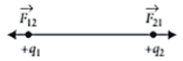
Coulomb's law states that the electrostatic force of attraction or repulsion acting between two stationary point charges is given by
Image

where $F$ denotes the force between two charges $q _1$ and $q _2$ separated by a distance $r$ in free space, $\varepsilon_0$ is a constant known as the permittivity of free space. Free space is a vacuum and may be taken to be air practically. If free space is replaced by a medium, then $\varepsilon_0$ is replaced by $\left(\varepsilon_0 k\right)$ or $\left(\varepsilon_0 \varepsilon_r\right)$ where $k$ is known as dielectric constant or relative permittivity.
$(i)$ In coulomb's law, $F =k \frac{q_1 q_2}{r^2}$, then on which of the following factors does the proportionality constant $k$ depends?
$(a)$ Nature of the medium between the two charges
$(b)$ Distance between the two charges
$(c)$ Electrostatic force acting between the two charges
$(d)$ Magnitude of the two charges
$(ii)$ Dimensional formula for the permittivity constant $\varepsilon_0$ of free space is
$(a) \left[ M ^{-1} L^3 T^2 A^2\right]$
$(b) \left[ ML ^{-3} T^4 A^2\right]$
$(c) \left[ M ^{-1} L^{-3} T^4 A^2\right]$
$(d) \left[ ML ^{-3} T^4 A^{-2}\right]$
$(iii)$ The force of repulsion between two charges of $1 C$ each, kept $1m$ apart in vaccum is
$(a) \frac{1}{9 \times 10^9} N$
$(b) \frac{1}{9 \times 10^{12}} N$
$(c) 9 \times 10^7 N$
$(d) 9 \times 10^9 N$
$(iv)$ Two identical charges repel each other with a force equal to $10$ mgwt when they are $0.6 m$ apart in air.
$(g =10 m s ^{-2} ).$ The value of each charge is
$(a) 2 mC$
$(b) 2 \times 10^{-7} mC$
$(c) 2 \mu C$
$(d) 2 nC$
OR
Coulomb's law for the force between electric charges most closely resembles with
$(a)$ law of conservation of energy
$(b)$ Newton's $2^{nd}$ law of motion
$(c)$ law of conservation of charge .
$(d)$ Newton's law of gravitation
Two submarines are approaching each other in a calm sea. The first submarine travels at a speed of 36km/h and the other at 54km/h relative to the water. The first submarine sends a sound signal (sound waves in water are also called sonar) at a frequency of 2000Hz.
  1. At what frequency is this signal received by the second submarine?
  2. The signal is reflected from the second submarine. At what frequency is this signal received by the first submarine. Take the speed of the sound wave in water to be 1500m/s.