Question
Light is an electromagnetic wave. Its speed in vacuum is given by the expression
|
(a) |
(b) |
(c) |
(d) |
Light is an electromagnetic wave. Its speed in vacuum is given by the expression
|
(a) |
(b) |
(c) |
(d) |
(d) 
Generate a complete, print-ready paper with questions like this in minutes — across 16+ boards, with answer keys.
A positively charged particle moving due east enters a region of uniform magnetic field directed vertically upwards. The particle will
|
(a) Get deflected vertically upwards |
|
(b) Move in a circular orbit with its speed increased |
|
(c) Move in a circular orbit with its speed unchanged |
|
(d) Continue to move due east |
The rest mass of an electron as well as that of positron is 0.51 MeV. When an electron and positron are annihilate, they produce gamma-rays of wavelength(s)
|
(a) 0.012 Å |
(b) 0.024 Å |
(c) 0.012 Å to ¥ |
(d) 0.024 Å to ¥ |
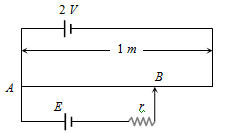
In the given figure, battery E is balanced on 55 cm length of potentiometer wire but when a resistance of 10 W is connected in parallel with the battery then it balances on 50 cm length of the potentiometer wire then internal resistance r of the battery is
|
(a) 1 W |
(b) 3 W |
(c) 10 W |
(d) 5 W |
When an electron in hydrogen atom is excited, from its 4th to 5th stationary orbit, the change in angular momentum of electron is (Planck’s constant: h = 6.6 
|
(a) 4.16 |
(b) 3.32 |
|
(c) 1.05 |
(d) 2.08 |
Plane polarised light is passed through a polaroid. On viewing through the polaroid we find that when the polariod is given one complete rotation about the direction of the light, one of the following is observed
|
(a) The intensity of light gradually decreases to zero and remains at zero |
|
(b) The intensity of light gradually increases to a maximum and remains at maximum |
|
(c) There is no change in intensity |
|
(d) The intensity of light is twice maximum and twice zero |
A permanent magnet
|
(a) Attracts all substances |
|
(b) Attracts only magnetic substances |
|
(c) Attracts magnetic substances and repels all non-magnetic substances |
|
(d) Attracts non-magnetic substances and repels magnetic substances |


