Question
Light is incident normally on a diffraction grating through which the first order diffraction is seen at $32^\circ$. The second order diffraction will be seen at

Answer

(d) For a grating $(e + d)\sin {\theta _n} = n\lambda $
where $(e + d) = $ grating element
$\sin {\theta _n} = \frac{{n\lambda }}{{(e + d)}}$
For $n = 1,$ $\sin {\theta _1} = \frac{\lambda }{{(e + d)}} = \sin 32^\circ $
This is more than $0.5$ . Now $\sin {\theta _2}$ will be more than $2 \times 0.5,$ which is not possible.

Need a full question paper?

Generate a complete, print-ready paper with questions like this in minutes — across 16+ boards, with answer keys.

Start Generating Free

Similar questions

A student is performing an experiment using a resonance column and a tuning fork of frequency $244 s ^{-1}$. He is told that the air in the tube has been replaced by another gas (assume that the column remains filled with the gas). If the minimum height at which resonance occurs is $(0.350 \pm 0.005) m$, the gas in the tube is

(Useful information) : $\sqrt{167 R T}=640 j^{1 / 2} mole ^{-1 / 2} ; \sqrt{140 RT }=590 j ^{1 / 2} mole ^{-1 / 2}$. The molar masses $M$ in grams are given in the options. Take the value of $\sqrt{\frac{10}{ M }}$ for each gas as given there.)
If the speed of light in vacuum is $C$ $m/\sec ,$ then the velocity of light in a medium of refractive index $1.5$
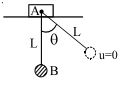
$A$ small ball $B$ of mass $m$ is suspended with light inelastic string of length $L$ from $a$ block $A$ of same mass $m$ which can move on smooth horizontal surface as shown in the figure. The ball is displaced by angle $\theta$ from equilibrium position & then released. Tension in string when it is vertical, is
If a star is moving towards the earth, then the lines are shifted towards
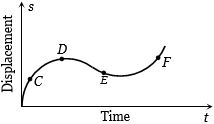
The displacement-time graph of moving particle is shown below. The instantaneous velocity of the particle is negative at the point
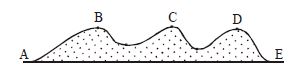
A particle of mass $3\  kg$ is taken through $ABCDE$ from $A$ to $E$ height of $B$ , $C$ & $D$ are $5\ m$ , $4\ m$ , $6\ m$ respectively. Total path length $20\ m$ $AE$ = $10\ m$ , $\mu $ = $0.6$ . ........ $J$ work done to slowly move mass from $A$ to $E$ . ( $g = 10 \ m/s^2$ )
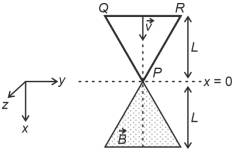
A region in the form of an equilateral triangle (in $x-y$ plane) of height $L$ has a uniform magnetic field $\vec{B}$ pointing in the $+z$-direction. A conducting loop $P Q R$, in the form of an equilateral triangle of the same height $L$, is placed in the $x-y$ plane with its vertex $P$ at $x=0$ in the orientation shown in the figure. At $t=0$, the loop starts entering the region of the magnetic field with a uniform velocity $\vec{v}$ along the $+x$-direction. The plane of the loop and its orientation remain unchanged throughout its motion.

Which of the following graph best depicts the variation of the induced emf $(E)$ in the loop as a function of the distance $(x)$ starting from $x=0$ ?
A point traversed half of the distance with a velocity $v_0$. The remaining part of the distance was covered with velocity $v_1$ for half the time and with velocity $v_2$ for the other half of the time. The mean velocity of the point averaged over the whole time of motion is
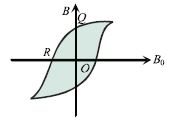
The figure illustrate how $B$, the flux density inside a sample of unmagnetised ferromagnetic material varies with $B_0$, the magnetic flux density in which the sample is kept. For the sample to be suitable for making a permanent magnet
A metallic sphere weighing $3 \,kg$ in air is held by a string so as to be completely immersed in a liquid of relative density $0.8$. The relative density of metallic is $10$. The tension in the string is ........  $N$