MCQ
Light of wavelength $\lambda$ falls on a metal having work function $\frac{\text{h}_\text{c}}{\lambda_0}.$ Photoelectric effect will take place only if:
  • A
    $\lambda\geq\lambda_0$
  • B
    $\lambda\geq2\lambda_0$
  • C
    $\lambda\leq\lambda_0$
  • D
    $\lambda<\frac{\lambda_ 0}{2}.$

Answer

  1. $\lambda\leq\lambda_0$

Explanation:

As the work-function of the metal is $\frac{\text{hc}}{\lambda_0}$, its threshold wavelength is $\lambda_0.$

For photoelectric effect, the wavelength of the incident light should be less than or equal to the threshold wavelength of the metal on which light is incident.

Need a full question paper?

Generate a complete, print-ready paper with questions like this in minutes — across 16+ boards, with answer keys.

Start Generating Free

Similar questions

If the mass number of an atom is A = 40 and its electron configuration is  , the number of neutrons and protons in its nucleus will be

(a) 22, 18

(b) 18, 22

(c) 20, 20

(d) 18, 18

Two bulbs each marked 100 W, 220 V are connected in series across 220 V supply. The power consumed by them, when lit, is
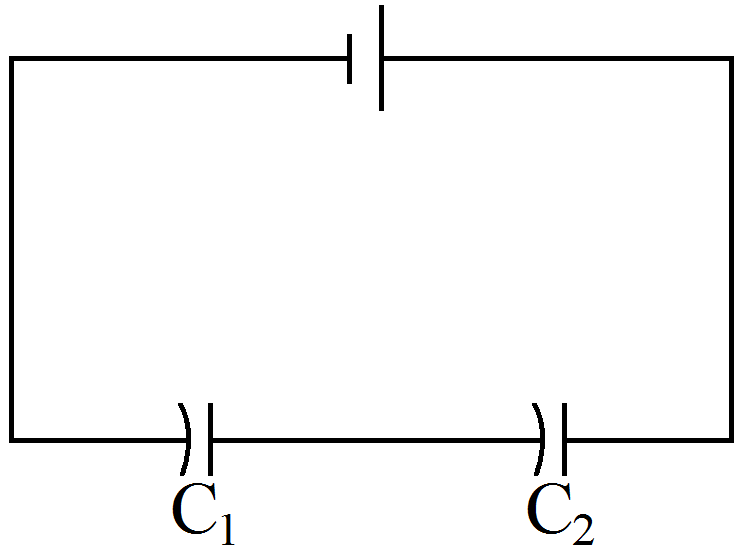
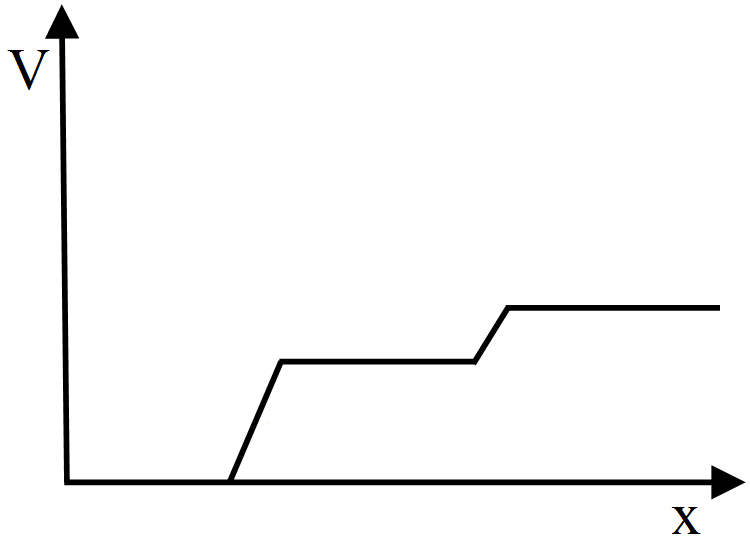
Figure shows two capacitors connected in series and joined to a battery. The graph shows the variation in potential as one moves from left to right on the branch containing the capacitors:


A radioactive reaction is  → . How many α and β particles are emitted

(a) 10α, 6β

(b) 4 protons, 8 neutrons

(c) 6 electrons, 8 protons

(d) 6β, 8α

Assertion  : The number of electrons in a P-type silicon semiconductor is less than the number of electrons in a pure silicon semiconductor at room temperature.

Reason      : It is due to law of mass action.

(a) If both assertion and reason are true and the reason is the correct explanation of the assertion.

(b) If both assertion and reason are true but reason is not the correct explanation of the assertion.

(c) If assertion is true but reason is false.

(d) If the assertion and reason both are false.

The accepter impurity in following is -
Two identical charges q are placed at a distance d from each other. The potential at a point situated at a distance between them will be:

A beam of light of wavelength λ  and with illumination L falls on a clean surface of sodium. If N photoelectrons are emitted each with kinetic energy E, then

(a) N and E L

(b)  N L and E  

(c) N    and E L

(d) N    and E  

The energy of a photon of a characteristic X-ray from a Coolidge tube comes from:
  1. The kinetic energy of the striking electron.
  2. The kinetic energy of the free electrons of the target.
  3. The kinetic energy of the ions of the target.
  4. An atomic transition in the target.

The energy of a photon of wavelength  is given by

(a) h      

(b) ch 

(c)   

(d)