- A$\lambda' < \lambda/2$
- B$\lambda' > \lambda/2$
- ✓$\lambda > \lambda' > \lambda/2$
- D$\lambda' = \lambda/2$
$\frac{\mathrm{hc}}{\lambda}=\varepsilon+\phi$
Dividing them, $\frac{\lambda^{\prime}}{\lambda}=\frac{\varepsilon+\phi}{2 \varepsilon+\phi}$
or $\frac{{{\lambda ^\prime }}}{\lambda } < 1,$ so ${\lambda ^\prime } < \lambda $
Also, $\frac{{\lambda '}}{\lambda } = \frac{1}{2}\left[ {\frac{{\varepsilon + \phi }}{{\varepsilon + \frac{\phi }{2}}}} \right]$
$\frac{{\lambda '}}{\lambda } > \frac{1}{2}$ or $\lambda > {\lambda ^\prime } > \lambda /2$
Generate a complete, print-ready paper with questions like this in minutes — across 16+ boards, with answer keys.
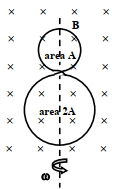
axis with a constant angular velocity $\omega$ in the magnetic field. Which of the following options is/are correct?
(image)
[$A$] The rate of change of the flux is maximum when the plane of the loops is perpendicular to plane of the paper.
[$B$] The net emf induced due to both the loops is proportional to $\cos \omega t$.
[$C$] The emf induced in the loop is proportional to the sum of the areas of the two loops.
[$D$] The amplitude of the maximum net emf induced due to both the loops is equal to the amplitude of maximum emf induced in the smaller loop alone.