Question
Light wave enters from medium $1$ to medium $2.$ Its velocity in $2^{nd}$ medium is double from $1^{st}$. For total internal reflection the angle of incidence must be greater than.......$^o$

Answer

(a) $\frac{{{\mu _2}}}{{{\mu _1}}} = \frac{{{v_1}}}{{{v_2}}} = \frac{1}{2} \Rightarrow \frac{{{\mu _1}}}{{{\mu _2}}} = 2({\mu _1} > {\mu _2})$
For total internal reflection $_2{\mu _1} = \frac{1}{{\sin C}} \Rightarrow \frac{{{\mu _1}}}{{{\mu _2}}}$
$ = \frac{1}{{\sin C}} \Rightarrow 2 = \frac{1}{{\sin C}} \Rightarrow C = {30^o}$
So, for total (Internal reflection angle of incidence must be greater than $30°.$

Need a full question paper?

Generate a complete, print-ready paper with questions like this in minutes — across 16+ boards, with answer keys.
Start Generating Free

Similar questions

A particle of mass $200 \,g$ is moving in a circle of radius $2 \,m$. The particle is just 'looping the loop'. The speed of the particle and the tension in the string at highest point of the circular path are $\left(g=10 \,ms ^{-2}\right)$
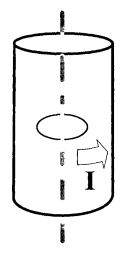
A long circular tube of length $10 \ m$ and radius $0.3 \ m$ carries a current $I$ along its curved surface as shown. A wire-loop of resistance $0.005$ ohm and of radius $0.1 \ m$ is placed inside the tube with its axis coinciding with the axis of the tube. The current varies as $I=I_0 \cos (300 t)$ where $I_0$ is constant. If the magnetic moment of the loop is $N \mu_0 I_0 \sin (300 t)$, then ' $N$ ' is
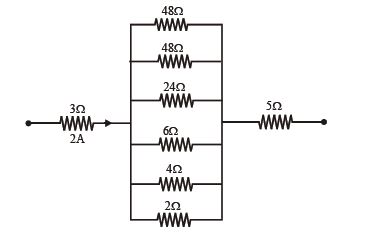
Find potential difference across $24\,\Omega $ ............. $\mathrm{volt}$
A body weighs $72\; N$ on the surface of the earth. What is the gravitational force on it, at a height equal to half the radius of the earth ?
Charge of $2Q$ and $-Q$ are placed on two plates of a parallel plate capacitor. If capacitance of capacitor is $C$, potential difference between the plates is
Unit vector parallel to the resultant of vectors $\vec A = 4\hat i - 3\hat j$and $\vec B = 8\hat i + 8\hat j$ will be
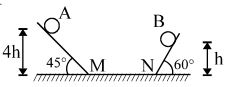
Two identical balls $A$ and $B$ are released from the positions shown in figure. They collide elastically on horizontal portion $MN$. All surfaces are smooth. The ratio of heights attained by $A$ and $B$ after collision will be(Neglect energy loss at $M$ & $N$)
For an ideal monoatomic gas, the universal gas constant R is n times the molar heat capacity at constant pressure $C _{ p }$. Here n is:
List-$I$ List-$II$
$(a)$ $MI$ of the rod (length ${L}$, Mass ${M}$, about an axis $\perp$ to the rod passing through the midpoint) $(i)\;\frac {8 {ML}^{2}}{3}$
$(b)$ MI of the rod (length $L$, Mass $2 M$, about an axis $\perp$ to the rod Passing through one its end) $(ii)\;\frac {{ML}^{2}}{3}$
$(c)$ MI of the rod (length $2 {L}$, Mass ${M}$, about an axis $\perp$ to the rod  Passing through its midpoint) $(iii)\;\frac {{ML}^{2}}{12}$
$(d)$ MI of the rod (length $2 {L}$, Mass $2 {M}$, about an axis $\perp$ to the rod  passing through one of its end) $(iv)\;\frac {2 {ML}^{2}}{3}$

 Choose the correct answer from the options given below

In toroid magnetic field on axis will be the radius $=0.5\, cm ,$ current $=1.5\, A ,$ turns $=250,$ permeability $=700$ (in Tesla)