MCQ
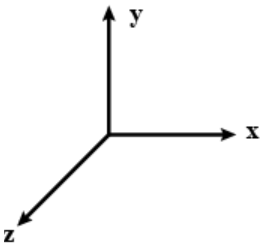
Light wave is travelling along y - direction. If the corresponding E vector at any time along the x - axis, the direction of B vector at that time is along.
- Ay - axis
- Bx - axis
- Cz - axis
- D-z - axis
Explanation:
Light wave is an electromagnetic wave in which E and B are at right angles to each other as well as at right angles to the direction of wave propagation. So from the given information in the question, the direction of B vector is in positive z direction.
Generate a complete, print-ready paper with questions like this in minutes — across 16+ boards, with answer keys.
Assertion : V-i characteristic of P-N junction diode is same as that of any other conductor.
Reason : P-N junction diode behave as conductor at room temperature.
|
(a) If both assertion and reason are true and the reason is the correct explanation of the assertion. |
|
(b) If both assertion and reason are true but reason is not the correct explanation of the assertion. |
|
(c) If assertion is true but reason is false. |
|
(d) If the assertion and reason both are false. |
Plate resistance of two triode valves is 2 KW and 4 KW, amplification factor of each of the valves is 40. The ratio of voltage amplification, when used with 4 KW load resistance, will be
|
(a) 10 |
(b) |
(c) |
(d) |
Two coherent sources of light can be obtained by
|
(a) Two different lamps |
|
(b) Two different lamps but of the same power |
|
(c) Two different lamps of same power and having the same colour |
|
(d) None of the above |
The maximum current that can be measured by a galvanometer of resistance 40 W is 10 mA. It is converted into a voltmeter that can read upto 50 V. The resistance to be connected in series with the galvanometer is ... (in ohm)
|
(a) 5040 |
(b) 4960 |
(c) 2010 |
(d) 4050 |
Three glass prisms A, B and C of same refractive index are placed in contact with each other as shown in figure, with no air gap between the prisms. Monochromatic ray of light OP passes through the prism assembly and emerges as QR. The conditions of minimum deviation is satisfied in the prisms

|
(a) A and C |
(b) B and C |
|
(c) A and B |
(d) In all prisms A, B and C |
A nuclear reaction given by  represents
|
(a) g-decay |
(b) Fusion |
(c) Fission |
(d) b-decay |


