MCQ
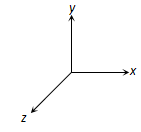
Light wave is travelling along $y-$direction. If the corresponding $\overrightarrow{\mathrm{E}}$  vector at any time is along the $x-$axis, the direction of $\overrightarrow{\mathrm{B}}$  vector at that time is along
  • A
    $y-$axis
  • B
    $x-$axis
  • C
    $+ z-$axis
  • $– z$ axis

Answer

Correct option: D.
$– z$ axis
$– z$ axis

Need a full question paper?

Generate a complete, print-ready paper with questions like this in minutes — across 16+ boards, with answer keys.

Start Generating Free

Similar questions

Light passes successively through two polarimeters tubes each of length $0.29 m .$ The first tube contains dextro rotatory solution of concentration $60 \ \mathrm{kgm}^{-3}$ and specific rotation $0.01 \ \mathrm{rad} \mathrm{m}^2 \mathrm{~kg}^{-1}$. The second tube contains laevo rotatory solution of concentration $30 \mathrm{~kg} / \mathrm{m}^3$ and specific rotation $0.02 \ \mathrm{rad} \mathrm{m}^2 \mathrm{~kg}^{-1}$. The net rotation produced is
How many NAND gates are used to form an AND gate(a) 1 (b) 2(c) 3  (d) 4
       
A plane glass slab is kept over various coloured letters, the letter which appears least raised is(a) Blue (b) Violet(c) Green (d) Red
       
A $1 \mu \mathrm{A}$ beam of protons with a cross$-$sectional area of $0.5 \ \mathrm{sq} . \mathrm{mm}$ is moving with a velocity of $3 \times 10^4 \mathrm{~ms}^{-1}.$ Then charge density of beam is
Light of wavelength $4000 \mathring A$  falls on a photosensitive metal and a negative $2V$ potential stops the emitted electrons. The work function of the material $($in $eV)$ is approximately $(h = 6.6 \left.\times 10^{-34} \mathrm{Js}, \mathrm{e}=1.6 \times 10^{-19} \mathrm{C}, \mathrm{c}=3 \times 10^8 \mathrm{~ms}^{-1}\right)$
For the post office box arrangement to determine the value of unknown resistance the unknown resistance should be connected between
Albert Einstein used corpuscular theory to explain:
Light waves exhibit polarization but sound waves do not exhibit polarization because they are not:
What kind of image is obtained always for concave lens?
If a proton is projected in a direction perpendicular to a uniform magnetic field with velocity v and an electron is projected along the lines of force, what will happen to proton and electron(a) The electron will travel along a circle with constant speed and the proton will move along a straight line(b) Proton will move in a circle with constant speed and there will be no effect on the motion of electron(c) There will not be any effect on the motion of electron and proton(d) The electron and proton both will follow the path of a parabola