MCQ
$\lim _{x \rightarrow \frac{\pi}{4}} \frac{\int_2^{\sec ^2 x} f(t) d t}{x^2-\frac{\pi^2}{16}}$ equals
  • $\frac{8}{\pi} f(2)$
  • B
    $\frac{2}{\pi} f(2)$
  • C
    $\frac{2}{\pi} f\left(\frac{1}{2}\right)$
  • D
    $4 \mathrm{f}(2)$

Answer

Correct option: A.
$\frac{8}{\pi} f(2)$
a
$\lim _{x \rightarrow \frac{\pi}{4}} \frac{\int_2^{\sec ^2 x} f(t) d t}{x^2-\frac{\pi^2}{16}} \quad\left(\frac{0}{0} \text { form }\right)$

Let $L=\lim _{x \rightarrow \frac{\pi}{4}} \frac{f\left(\sec ^2 x\right) 2 \sec x \sec x \tan x}{2 x}$

$\therefore \mathrm{L}=\frac{2 \mathrm{f}(2)}{\pi / 4}=\frac{8 \mathrm{f}(2)}{\pi} \text {. }$

Need a full question paper?

Generate a complete, print-ready paper with questions like this in minutes — across 16+ boards, with answer keys.
Start Generating Free

Similar questions

The equation of the chord, of the ellipse $\frac{\mathrm{x}^{2}}{25}+\frac{\mathrm{y}^{2}}{16}=1$, whose mid-point is $(3,1)$ is :
Let $\vec{a}$ be a vector which is perpendicular to the vector $3 \hat{ i }+\frac{1}{2} \hat{ j }+2 \hat{ k }$. If $\overrightarrow{ a } \times(2 \hat{ i }+\hat{ k })=2 \hat{ i }-13 \hat{ j }-4 \hat{ k }$, then the projection of the vector $\vec{a}$ on the vector $2 \hat{ i }+2 \hat{ j }+\hat{ k }$ is
If the non-zero vectors $ a $ and $b$  are perpendicular to each other, then the solution of the equation $r \times a = b$ is given by
Let $\mathrm{M}$ and $\mathrm{m}$ respectively be the maximum and minimum values of the function $f(x)=\tan ^{-1}(\sin x+\cos x)$ in $\left[0, \frac{\pi}{2}\right]$, Then the value of $\tan (\mathrm{M}-\mathrm{m})$ is equal to:
The differential equation of all the lines in the $xy$-plane is
If $\sum_{ k =1}^{10} K ^{2}\left(10_{ C _{ K }}\right)^{2}=22000 L$, then $L$ is equal to $.....$
Consider any set of observations ${x_1},\,{x_2},\,.{x_3},.\,...,{x_{101}}$; it being given that ${x_1} < {x_2} < {x_3} < .... < {x_{100}} < {x_{101}}$; then the mean deviation of this set of observations about a point $k$ is minimum when $k$ equals..
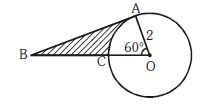
In the given figure, $AB$ is tangent to the circle with centre $O$ , the ratio of the shaded region to the unshaded region of the triangle $OAB$ is
Let for a differentiable function $f:(0, \infty) \rightarrow R$, $f(x)-f(y) \geq \log _e\left(\frac{x}{y}\right)+x-y, \forall x, y \in(0, \infty) \text {. }$ Then $\sum_{\mathrm{n}=1}^{20} \mathrm{f}^{\prime}\left(\frac{1}{\mathrm{n}^2}\right)$ is equal to
If ${x^{x\root 3 \of x }} = {(x\,.\,\root 3 \of x )^x},$ then $x =$