MCQ
Line spectrum was first of all theoretically explained by
  • A
    Swan
  • B
    Fraunhofer
  • C
    Kirchoff
  • Bohr

Answer

Correct option: D.
Bohr
d
Bohr's Model was first to theoretically explain the Line Spectrum of Hydrogen atom and single electron species based on the assumption that electrons can only occupy certain orbits of fixed energy, with energy radiated or absorbed in discrete packets(quanta) during electronic transition, and angular momentum of electron in a orbit is quantized.

Need a full question paper?

Generate a complete, print-ready paper with questions like this in minutes — across 16+ boards, with answer keys.
Start Generating Free

Similar questions

A $2\, W$ carbon resistor is color coded with green, black, red and brown respectively. The maximum current which can be passed through this resistor is .............. $mA$
Light of frequency $v$ falls on a material of threshold frequency $v_0$. Maximum kinetic energy of emitted electron is proportional to
A stone ties to the end of a string $1\,m$ long is whirled in a horizontal circle with a constant speed. If the stone makes $22$ revolution in $44$ seconds, what is the magnitude and direction of acceleration of the stone
The potential energy function for the force between two atoms in a diatomic molecule is approximately given by $U(x)=$ $\;\frac{a}{{{x^{12}}}} - \frac{b}{{{x^6}}}$ where a and b are constants and $x $ is the distance between the atoms. If the dissociation energy of the molecule is $D = [ U ( x = \infty) - U_{ at\ equilibrium}], D$ is
The approximate height from the surface of earth at which the weight of the body becomes $\frac{1}{3}$ of its weight on the surface of earth is $..........km$ : [Radius of earth $R =6400 \,km$ and $\sqrt{3}=1.732]$
The graph showing the dependence of intensity of transmitted light on the angle between polariser and analyser is ($I_0$ is intensity of plane polarised light)
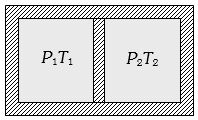
Following figure shows on adiabatic cylindrical container of volume ${V_0}$ divided by an adiabatic smooth piston (area of cross-section = $A$ ) in two equal parts. An ideal gas $({C_P}/{C_V} = \gamma )$ is at pressure $P_1$ and temperature $T_1$ in left part and gas at pressure $P_2$ and temperature $T_2$ in right part. The piston is slowly displaced and released at a position where it can stay in equilibrium. The final pressure of the two parts will be (Suppose $ x$ = displacement of the piston)
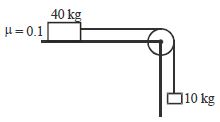
For the given figure find acceleration of $40\, kg$ block ........ $m/s^2$ 
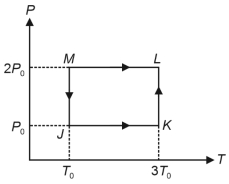
One mole of a monatomic ideal gas undergoes the cyclic process $J \rightarrow K \rightarrow L \rightarrow M \rightarrow J$, as shown in the $P - T$ diagram.

Match the quantities mentioned in $List-I$ with their values in $List-II$ and choose the correct option. [ $R$ is the gas constant]

$List-I$ $List-II$
($P$) Work done in the complete cyclic process ($1$) $R T_0-4 \ R T_0 \ln 2$
($Q$) Change in the internal energy of the gas in the process $JK$ ($2$) $0$
($R$) Heat given to the gas in the process $KL$ ($3$) $3 \ R T_0$
($S$) Change in the internal energy of the gas in the process $MJ$ ($4$) $-2 \ R T_0 \ln 2$
  ($5$) $-3 \ R T_0 \ln 2$

In a semiconducting material the mobilities of electrons and holes are $\mu$$e$ and $\mu$$h$ respectively. Which of the following is true