Question
Linear programming is a method for finding the optimal values (maximum or minimum) of quantities subject to the constraints when relationship is expressed as linear equations or inequations. Based on the above information, answer the following questions.
  1. The optimal value of the objective function is attained at the points:
  1. On X-axis.
  2. On Y-axis.
  3. Which are comer points of the feasible region.
  4. None of these.
  1. The graph of the inequality 3x + 4y < 12 is:
  1. Half plane that contains the origin.
  2. Half plane that neither contains the origin nor the points of the line 3x + 4y = 12.
  3. Whole XOY-plane excluding the points on line 3x + 4y = 12.
  4. None of these.
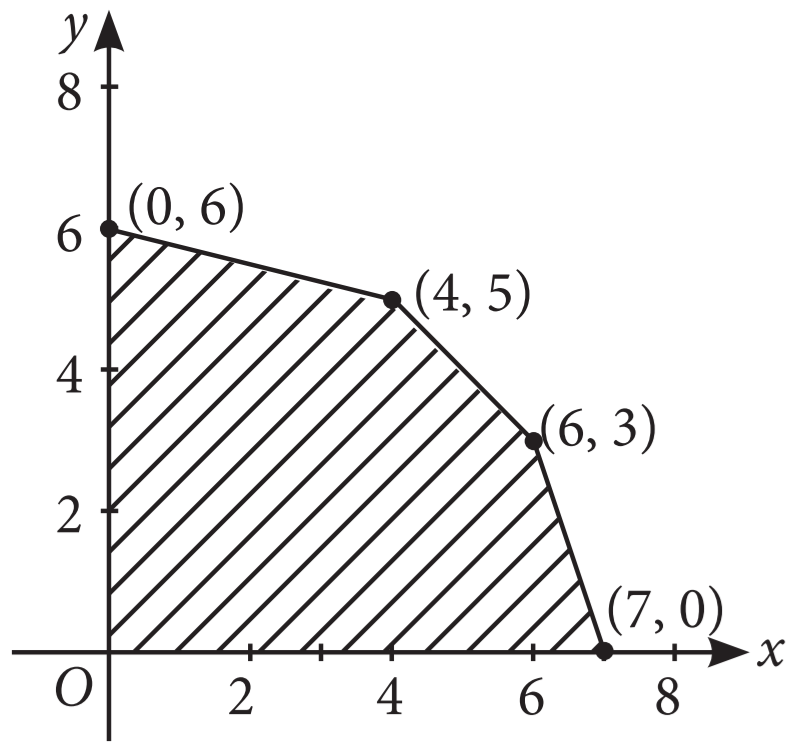
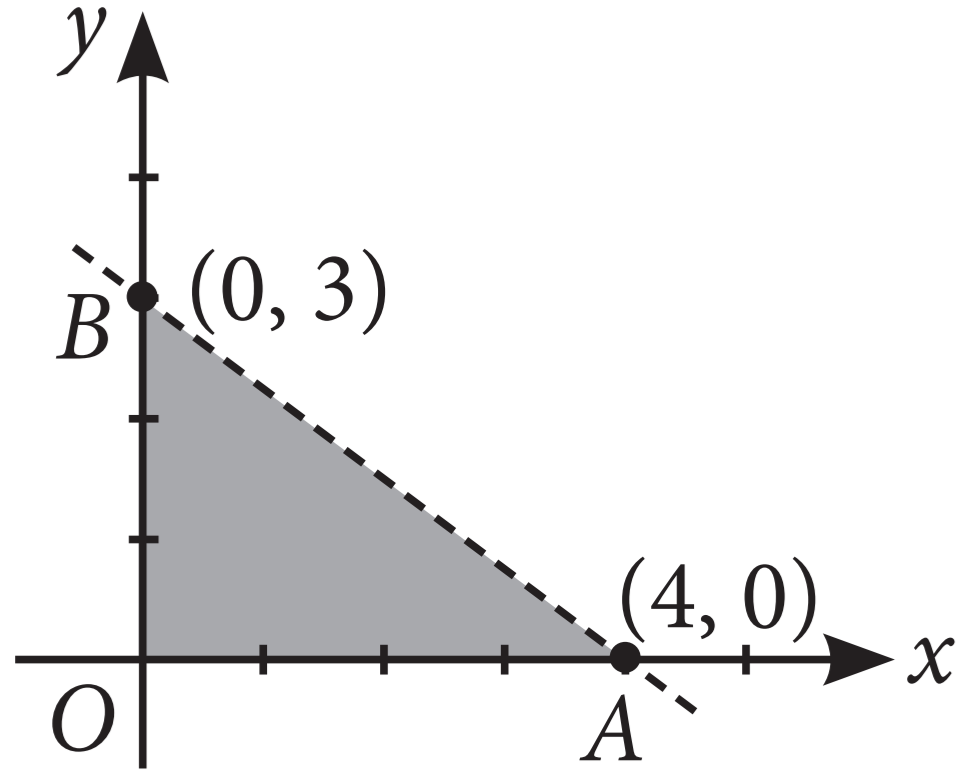
  1. The feasible region for an LPP is shown in the figure. Let Z = 2x + 5y be the objective function. Maximum of Z occurs at:
  1. (7, 0)
  2. (6, 3)
  3. (0, 6)
  4. (4, 5)
  1. The corner points of the feasible region determined by the system of linear constraints are (0, 10), (5, 5), (15, 15), (0, 20). Let Z = px + qy, where p, q > 0. Condition on p and q so that the maximum of Z occurs at both the points ( 15, 15) and (0, 20) is:
  1. p = q
  2. p = 2q
  3. q = 2p
  4. q = 3p
  1. The comer points of the feasible region determined by the system of linear constraints are (0, 0), (0, 40), (20, 40), (60, 20), (60, 0). The objective function is Z = 4x + 3y.
Compare the quantity in Column A and Column B
Column A
Column B
Maximum of Z
325
  1. The quantity in column A is greater.
  2. The quantity in column Bis greater.
  3. The two quantities are equal.
  4. The relationship cannot be determined on the basis of the information supplied.
Answer

  1. (c) Which are comer points of the feasible region.
Solution:
When we solve an L.P.P. graphically, the optimal (or optimum) value of the objective function is attained at comer points of the feasible region.
  1. (d) None of these.
Solution:
From the graph of 3x + 4y < 12, it is clear that it contains the origin but not the points on the line 3x + 4y = 12.
  1. (d) (4, 5)
Solution:
Maximum of objective function occurs at corner points.
Corner Points
Value of Z = 2x + 5y
(0, 0)
0
(7, 0)
14
(6, 3)
27
(4, 5)
$33\leftarrow\text{Maximum}$
(0, 6)
30
  1. (d) q = 3p
​​​​​​​​​​​​​​Solution:
Value of Z = px + qy at ( 15, 15)= 15p + 15q and that at (0, 20) = 20q. According to given condition, we have 15p + 15q = 20q ⇒ 15p = Sq ⇒ q = 3p.
  1. (b) The quantity in column Bis greater.
​​​​​​​​​​​​​​​​​​​​​​​​​​​​​​​​​​​Solution:
Construct the following table of values of the objective function:
Corner Points
Value of Z = 4x + 3y
(0, 0)
4 × 0 + 3 × 0 = 0
(0, 40)
4 × 0 + 3 × 40 = 120
(20, 40)
4 × 20 + 3 × 40 = 200
(60, 20)
$4\times60+3\times20=300\leftarrow\text{Maximum}$
(60, 0)
4 × 60 + 3 × 0 = 240

Need a full question paper?

Generate a complete, print-ready paper with questions like this in minutes — across 16+ boards, with answer keys.

Start Generating Free

Similar questions

Read the following text carefully and answer the questions that follow:
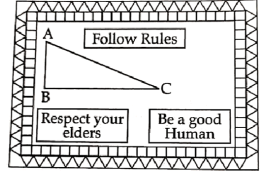
The slogans on chart papers are to be placed on a school bulletin board at the points $A, B$ and $C$ displaying $A ($follow Rules$), B ($Respect your elders$)$ and $C ($Be a good human$)$. The coordinates of these points are $(1, 4, 2), (3, -3, -2)$ and $(-2, 2, 6),$ respectively.
Image
$i.$ If $\vec{a}, \vec{b}$ and $\vec{c}$ be the position vectors of points $A, B, C,$ respectively, then find $|\vec{a}+\vec{b}+\vec{c}|$.
$ii.$ If $\vec{a}=4 \hat{i}+6 \hat{j}+12 \hat{k}$, then find the unit vector in direction of $\vec{a}. (1)$
$iii.$ Find area of $\triangle ABC. (2)$
OR
Write the triangle law of addition for $\triangle ABC$. Suppose, if the given slogans are to be placed on a straight line, then the value of $|\vec{a} \times \vec{b}+\vec{b} \times \vec{c}+\vec{c} \times \vec{a}|. (2)$
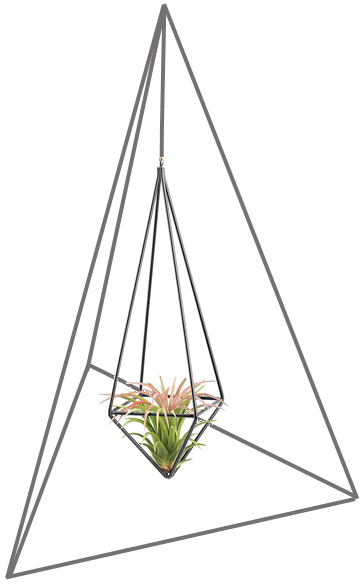
Ginni purchased an air plant holder which is in the shape of a tetrahedron.
Let A, B, C, and Dare the coordinates of the air plant holder where $\text{A}\equiv(1,1,1),\text{B}\equiv(2,1,3),\text{C}\equiv(3,2,2)$ and $\text{D}\equiv(3,3,4).$

Based on the above information, answer the following questions.
  1. Find the position vector of $\overline{\text{AB}}.$
  1. $-\hat{\text{i}}-2\hat{\text{k}}$
  2. $2\hat{\text{i}}+\hat{\text{k}}$
  3. $\hat{\text{i}}+2\hat{\text{k}}$
  4. $-2\hat{\text{i}}-\hat{\text{k}}$
  1. Find the position vector of $\overline{\text{AC}}.$
  1. $2\hat{\text{i}}-\hat{\text{j}}-\hat{\text{k}}$
  2. $2\hat{\text{i}}+\hat{\text{j}}+\hat{\text{k}}$
  3. $-2\hat{\text{i}}-\hat{\text{j}}+\hat{\text{k}}$
  4. $\hat{\text{i}}+2\hat{\text{j}}+\hat{\text{k}}$
  1. Find the position vector of $\overline{\text{AD}}.$
  1. $2\hat{\text{i}}-2\hat{\text{j}}-3\hat{\text{k}}$
  2. $\hat{\text{i}}+\hat{\text{j}}-3\hat{\text{k}}$
  3. $3\hat{\text{i}}+2\hat{\text{j}}+2\hat{\text{k}}$
  4. $2\hat{\text{i}}+2\hat{\text{j}}+3\hat{\text{k}}$
  1. Area of $\triangle\text{ABC}=$
  1. $\frac{\sqrt{11}}{2}\text{sq}.\text{units}$
  2. $\frac{\sqrt{14}}{2}\text{sq}.\text{units}$
  3. $\frac{\sqrt{13}}{2}\text{sq}.\text{units}$
  4. $\frac{\sqrt{17}}{2}\text{sq}.\text{units}$
  1. Find the unit vector along $\overline{\text{AD}}.$
  1. $\frac{1}{\sqrt{17}}(2\hat{\text{i}}+2\hat{\text{j}}+3\hat{\text{k}})$
  2. $\frac{1}{\sqrt{17}}(3\hat{\text{i}}+3\hat{\text{j}}+2\hat{\text{k}})$
  3. $\frac{1}{\sqrt{11}}(2\hat{\text{i}}+2\hat{\text{j}}+3\hat{\text{k}})$
  4. $(2\hat{\text{i}}+2\hat{\text{j}}+3\hat{\text{k}})$
Consider the following equations of curves $\text{y}=\cos\text{x},\text{y}=\text{x}+1$ and y = 0.
On the basis of above information, answer the following questions.
  1. The curves $\text{y}=\cos\text{x}$ and y = x + 1 meet at:
  1. (1, 0)
  2. (0, 1)
  3. (1, 1)
  4. (0, 0)
  1. $\text{y}=\cos\text{x}$ meet the x-axis at:
  1. $\Big(\frac{-\pi}{2},0\Big)$
  2. $\Big(\frac{\pi}{2},0\Big)$
  3. Both (a) and (b).
  4. None of these.
  1. Value of the integral $\int\limits_{-1}^{0}(\text{x}+1)\text{dx}$ is:
  1. $\frac{1}{2}$
  2. $\frac{2}{3}$
  3. $\frac{3}{4}$
  4. $\frac{1}{3}$
  1. Value of the integral $\int\limits_{0}^{\frac{\pi}{2}}\cos\text{x dx}$ is:
  1. 0
  2. -1
  3. 2
  4. 1
  1. Area bounded by the given curves is:
  1. $\frac{1}{2}\text{ sq}.\text{units}$
  2. $\frac{3}{2}\text{ sq}.\text{units}$
  3. $\frac{3}{4}\text{ sq}.\text{units}$
  4. $\frac{1}{4}\text{ sq}.\text{units}$
Consider 2 families A and B. Suppose there are 4 men, 4 women and 4 children in family A and 2 men, 2 women and 2 children in family B. The recommended daily amount of calories is 2400 for a man, 1900 for a woman, 1800 for children and 45 grams of proteins for a man, 55 grams for a woman and 33 grams for children.

Image

(i) Represent the requirement of calories and proteins for each person in matrix form.

(ii) Find the requirement of calories of family A and requirement of proteins of family B.

(iii) Represent the requirement of calories and proteins If each person increases the protein intake by $5 \%$ and decrease the calories by $5 \%$ in matrix form.

OR

If $\mathrm{A}$ and $\mathrm{B}$ are two matrices such that $\mathrm{AB}=\mathrm{B}$ and $\mathrm{BA}=\mathrm{A}$, then find $\mathrm{A}^2+\mathrm{B}^2$ in terms of $\mathrm{A}$ and $\mathrm{B}$.

Between students of class $XII$ of two schools $A$ and $B$ basketball match is organised. For which, a team from each school is chosen, say $T_1$ be the team of school $A$ and $T_2$ be the team of school $B.$ These teams have to play two games against each other. It is assumed that the outcomes of the two games are independent. The probability of $T_1$ winning, rawmg an osrng a game against $T_2$ are $\frac{1}{2},\ \frac{3}{10}$ and $\frac{1}{5}$ respecnvely. Each team gets $2$ points for a win, $1$ point for a draw and $0$ point for a loss in a game. Let $X$ and $Y$ denote the total points scored by team $A$ and
$B$ respectively, after two games. Based on the above information, answer the following questions.
  1. $P(T_2$ winning a match against $T_1)$ is equal to:
  1. $\frac{1}{5}$
  2. $\frac{1}{6}$
  3. $\frac{1}{3}$
  4. None of these
  1. $P(T_2$ drawing a match against $T_1)$ is equal to:
  1. $\frac{1}{2}$
  2. $\frac{1}{3}$
  3. $\frac{1}{6}$
  4. $\frac{3}{10}$
  1. $P(X > Y)$ is equal to:
  1. $\frac{1}{4}$
  2. $\frac{5}{12}$
  3. $\frac{1}{20}$
  4. $\frac{11}{20}$
  1. $P(X = Y)$ is equal to:
  1. $\frac{11}{100}$
  2. $\frac{1}{3}$
  3. $\frac{29}{100}$
  4. $\frac{1}{2}$
  1. $P(X + Y = 8)$ is equal to:
  1. $0$
  2. $\frac{5}{12}$
  3. $\frac{13}{36}$
  4. $\frac{7}{12}$
Logarithmic differentiation is a powerful technique to differentiate functions of the form $\text{f}(\text{x})=[\text{u}(\text{x})]^{\text{v}(\text{x})},$ where both $u(x)$ and $v(x)$ are differentiable functions and $f$ and $u$ need to be positive functions. Let function $\text{y}=\text{f}(\text{x})=(\text{u}(\text{x}))^{\text{v}(\text{x})},$ then $\text{y}\ '=\text{y}\Big[\frac{\text{v}(\text{x})}{\text{u}(\text{x})}\text{u}\ '(\text{x})+\text{v}\ '(\text{x})\cdot\log[\text{u}(\text{x})]\Big]$ On the basis of above information, answer the following questions.
  1. Differentiate $x^x \ w.r.t. x.$
  1. $\text{x}^\text{x}(1+\log\text{x})$
  2. $\text{x}^\text{x}(1-\log\text{x})$
  3. $-\text{x}^\text{x}(1+\log\text{x})$
  4. $\text{x}^\text{x}\log\text{x}$
  1. Differentiate $x^x + a^{x }+ x^a + a^a \ w.r.t. x.$
  1. $(1+\log\text{x})+(\text{a}^\text{x}\log\text{a}+\text{ax}^{\text{a}-1})$
  2. $\text{x}^\text{x}(1+\log\text{x})+\log\text{a}+\text{ax}^{\text{a}-1}$
  3. $\text{x}^\text{x}(1+\log\text{x})+\text{x}^\text{a}\log\text{x}+\text{ax}^{\text{a}-1}$
  4. $\text{x}^\text{x}(1+\log\text{x})+\text{a}^\text{x}\log\text{a}+\text{ax}^{\text{a}-1}$
  1. If $\text{x}=\text{e}^\frac{\text{x}}{\text{y}},$ then find $\frac{\text{dy}}{\text{dx}}.$
  1. $-\frac{(\text{x}+\text{y})}{\text{x}\log\text{x}}$
  2. $-\frac{(\text{x}-\text{y})}{\text{x}\log\text{x}}$
  3. $\frac{(\text{x}+\text{y})}{\text{x}\log\text{x}}$
  4. $\frac{\text{x}-\text{y}}{\text{x}\log\text{x}}$
  1. If $y = (2 - x)^3(3 + 2x)^5,$ then find $\frac{\text{dy}}{\text{dx}}.$
  1. $(2-\text{x})^3(3+2\text{x})^5\Big[\frac{15}{3+2\text{x}}-\frac{8}{2-\text{x}}\Big]$
  2. $(2-\text{x})^3(3+2\text{x})^5\Big[\frac{15}{3+2\text{x}}+\frac{3}{2-\text{x}}\Big]$
  3. $(2-\text{x})^3(3+2\text{x})^5\Big[\frac{10}{3+2\text{x}}-\frac{3}{2-\text{x}}\Big]$
  4. $(2-\text{x})^3(3+2\text{x})^5\cdot\Big[\frac{10}{3+2\text{x}}+\frac{3}{2-\text{x}}\Big]$
  1. If $\text{y}=\text{x}^\text{x}\cdot\text{e}^{(2\text{x}+5)},$ then find $\frac{\text{dy}}{\text{dx}}.$
  1. $\text{x}^\text{x}\text{e}^{2\text{x}+5}$
  2. $\text{x}^\text{x}\text{e}^{2\text{x}+5}(3-\log\text{x})$
  3. $\text{x}^\text{x}\text{e}^{2\text{x}+5}(1-\log\text{x})$
  4. $\text{x}^\text{x}\text{e}^{2\text{x}+5}\cdot(3+\log\text{x})$
Two farmers Shyam and Balwan Singh cultivate only three varieties of pulses namely Urad, Masoor and Mung. The sale (in ₹) of these varieties of pulses by both the farmers in the month of September and October are given by the following matrices A and B.

September sales (in ₹)
$\begin{matrix}\ \ \ \ \ \ \ \ \ \ \text{Urad}&\text{Masoor}&\text{Mung}\end{matrix}\\\text{A}=\begin{bmatrix}10000&20000&30000\\50000&30000&10000\end{bmatrix}\begin{matrix}\text{Shayam}\\\text{Balwan singh}\end{matrix}$
October sales (in ₹)
$\begin{matrix}\ \ \ \ \ \ \ \ \ \ \text{Urad}&\text{Masoor}&\text{Mung}\end{matrix}\\\text{B}=\begin{bmatrix}10000&20000&30000\\50000&30000&10000\end{bmatrix}\begin{matrix}\text{Shayam}\\\text{Balwan singh}\end{matrix}$
Using algebra of matrices, answer the following questions.
  1. The combined sales of Masoor in September and October, for farmer Balwan Singh, is:
  1. ₹ 80000
  2. ₹ 90000
  3. ₹ 40000
  4. ₹ 135000
  1. The combined sales of Urad in September and October, for farmer Shyam is:
  1. ₹ 20000
  2. ₹ 30000
  3. ₹ 36000
  4. ₹ 15000
  1. Find the decrease in sales of Mung from September to October, for the farmer Shyam.
  1. ₹ 24000
  2. ₹ 10000
  3. ₹ 30000
  4. No change
  1. If both farmers receive 2% profit on gross sales, compute the profit for each farmer and for each variety sold in October.
  1. $\begin{matrix} \ \text{Urad}&\text{Masoor}&\text{Mung}\end{matrix}\\\begin{bmatrix}100&\ \ \ \ \ \ 200&\ \ \ \ \ 220\\400&\ \ \ \ \ \ 300&\ \ \ \ \ 200\end{bmatrix}\begin{matrix}\text{Shayam}\\\text{Balwan singh}\end{matrix}$
  2. $\begin{matrix} \ \text{Urad}&\text{Masoor}&\text{Mung}\end{matrix}\\\begin{bmatrix}100&\ \ \ \ \ \ 200&\ \ \ \ \ 120\\400&\ \ \ \ \ \ 200&\ \ \ \ \ 200\end{bmatrix}\begin{matrix}\text{Shayam}\\\text{Balwan singh}\end{matrix}$
  3. $\begin{matrix} \ \text{Urad}&\text{Masoor}&\text{Mung}\end{matrix}\\\begin{bmatrix}150&\ \ \ \ \ \ 200&\ \ \ \ \ 220\\400&\ \ \ \ \ \ 200&\ \ \ \ \ 280\end{bmatrix}\begin{matrix}\text{Shayam}\\\text{Balwan singh}\end{matrix}$
  4. $\begin{matrix} \ \text{Urad}&\text{Masoor}&\text{Mung}\end{matrix}\\\begin{bmatrix}100&\ \ \ \ \ \ 200&\ \ \ \ \ 120\\250&\ \ \ \ \ \ 200&\ \ \ \ \ 220\end{bmatrix}\begin{matrix}\text{Shayam}\\\text{Balwan singh}\end{matrix}$
  1. Which variety of pulse has the highest selling value in the month of September for the farmer Balwan Singh?
  1. Urad
  2. Masoor
  3. Mung
  4. All of these have the same price
Area of a triangle whose vertices are $(x_1, y_1), (x_2, y_2)$ and $(x_3, y_3)$ is given by the determinant:
$\Delta=\frac{1}{2}\begin{vmatrix}\text{x}_1&\text{y}_1&1\\\text{x}_2&\text{y}_2&1\\\text{x}_3&\text{y}_3&1\end{vmatrix}$
Since, area is a positive quantity,
so we always take the absolute value of the determinant $\Delta.$ Also, the area of the triangle formed by three collinear points is zero.
Based on the above information, answer the following questions.
  1. Find the area of the triangle whose vertices are $(-2, 6), (3, -6)$ and $(1, 5).$
  1. $30\ \text{sq. units}$
  2. $35\ \text{sq. units}$
  3. $40\ \text{sq. units}$
  4. $15.5\ \text{sq. units}$
  1. If the points $(2, -3), (k, -1)$ and $(0, 4)$ are collinear, then find the value of 4k.
  1. $4$
  2. $\frac{7}{140}$
  3. $47$
  4. $\frac{40}{7}$
  1. If the area of a triangle $\text{ABC},$ with vertices $A(1, 3), B(0, 0)$ and $C(k, 0)$ is $3$ sq. units, then a value of $k$ is:
  1. $2$
  2. $3$
  3. $4$
  4. $5$
  1. Using determinants, find the equation of the tine joining the points $A(1, 2)$ and $B(3, 6).$
  1. $y = 2x$
  2. $x = 3y$
  3. $y = x$
  4. $4x - y = 5$
  1. If $\text{A}\equiv(11,7),\text{B}\equiv(5,5)$ and $\text{C}\equiv(-1,3),$ then:
  1. $\Delta\text{ABC}$ is scalene triangle.
  2. $\Delta\text{ABC}$ is equilateral triangle.
  3. $A, B$ and $C$ are collinear.
  4. None of these.
A doctor is to visit a patient. From the past experience, it is known that the probabilities that he will come by cab, metro, bike or by other means of transport are respectively $0.3, 0.2, 0.1$ and $0.4.$ 'Tile probabilities that he will be late are $0.25, 0.3, 0.35$ and $0.1$ if he comes by cab, metro, bike and other means of
transport respectively. Based on the above information, answer the following questions.
  1. When the doctor arrives late, what is the probability that he comes by metro?
  1. $\frac{5}{14}$
  2. $\frac{2}{7}$
  3. $\frac{5}{21}$
  4. $\frac{1}{6}$
  1. When the doctor arrives late, what is the probability that he comes by cab?
  1. $\frac{4}{21}$
  2. $\frac{1}{7}$
  3. $\frac{5}{14}$
  4. $\frac{2}{21}$
  1. When the doctor arrives late, what is the probability that he comes by bike?
  1. $\frac{5}{21}$
  2. $\frac{4}{7}$
  3. $\frac{5}{6}$
  4. $\frac{1}{6}$
  1. When the doctor arrives late, what is the probability that he comes by other means of transport?
  1. $\frac{6}{7}$
  2. $\frac{5}{14}$
  3. $\frac{4}{21}$
  4. $\frac{2}{7}$
  1. What is the probability that the doctor is late by any means?
  1. $1$
  2. $0$
  3. $\frac{1}{2}$
  4. $\frac{1}{4}$
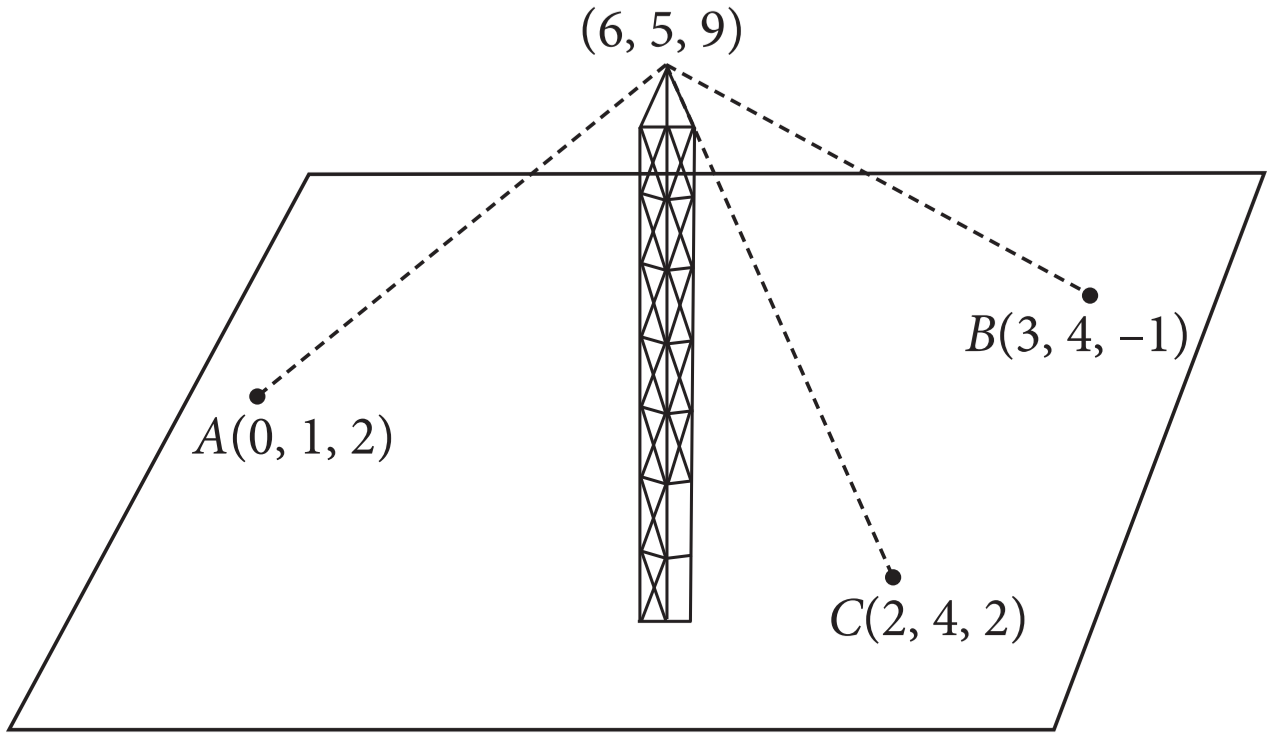
A mobile tower stands at the top of a hill. Consider the surface on which tower stand as a plane having points A(0, 1, 2), B(3, 4, -1), and C(2, 4, 2) on it. The mobile tower is tied with 3 cables from the point A, Band C such that it stand vertically on the ground. The peak of the tower is at the point ( 6, 5, 9), as shown in the figure. Based on the above information, answer the following questions.
  1. The equation of plane passing through the points A, Band C is:
  1. 3x - 4y + z = 0
  2. 3x - 2y + z = 0
  3. 3x - 2y + z = 0
  4. 4x - 3y + 3z = 0
  1. The height of the tower from the ground is:
  1. 6 units
  2. 5 units
  3. $\frac{17}{\sqrt{14}}\text{units}$
  4. $\frac{5}{\sqrt{14}}\text{units}$
  1. The equation of line of perpendicular drawn from the peak of tower to the ground is:
  1. $\frac{\text{x}-6}{3}=\frac{\text{y}-4}{-2}=\frac{\text{z}-9}{1}$
  2. $\frac{\text{x}-6}{3}=\frac{\text{y}-5}{-2}=\frac{\text{z}-9}{1}$
  3. $\frac{\text{x}-6}{3}=\frac{\text{y}-4}{2}=\frac{\text{z}-9}{1}$
  4. $\frac{\text{x}-6}{3}=\frac{\text{y}-5}{2}=\frac{\text{z}-9}{1}$
  1. The coordinates of foot of perpendicular drawn from the peak of tower to the ground are:
  1. $\Big(\frac{33}{14},\frac{104}{14},\frac{109}{14}\Big)$
  2. $\Big(\frac{33}{14},\frac{109}{14},\frac{104}{14}\Big)$
  3. $\Big(\frac{33}{14},\frac{105}{14},\frac{109}{14}\Big)$
  4. None of these
  1. The area of $\triangle\text{ABC}$ is:
  1. $\frac{1}{2}\sqrt{14}\text{sq}.\text{units}$
  2. $\frac{3}{2}\sqrt{14}\text{sq}.\text{units}$
  3. $\sqrt{14}\text{sq}.\text{units}$
  4. $2\sqrt{14}\text{sq}.\text{units}$