Question
Lines of force:

Answer

  1. Do not intersect each other.
Explanation:
lines of force do not intersect each other because at the point of intersection we will have two different direction of the force, as their will be two tangential direction corresponding to the two intersecting lines.

Need a full question paper?

Generate a complete, print-ready paper with questions like this in minutes — across 16+ boards, with answer keys.
Start Generating Free

Similar questions

The cathode rays have particle nature because of the fact that(a) They can propagate in vacuum(b) They are deflected by electric and magnetic fields(c) They produced fluorescence(d) They cast shadows


The solar spectrums is :
Diffraction of light can be explained by the following:
The frequency of $1^{st}$ line of Balmer series in $H_2$  atom is $V_0$. The frequency of line emitted by singly ionised $He$ atom is
A sine wave is travelling in a medium. A particular particle has zero displacement at a certain instant. The particle closest to it having zero displacement is at a distance:
  1. $\frac{\lambda}{4}$
  2. $\frac{\lambda}{3}$
  3. $\frac{\lambda}{2}$
  4. $\lambda.$
What is the area of the plates of a $3F$  parallel plate capacitor, if the separation between the plates is $5\ mm$
One end of a metal rod is dipped in boiling water and the other is dipped in melting ice:
  1. All parts of the rod are in thermal equilibrium with each other.
  2. We can assign a temperature to the rod.
  3. We can assign a temperature to the rod after steady state is reached.
  4. The state of the rod does not change after steady state is reached.
The focal length of the objective of a compound microscope if $f_o$ and its distance from the eyepiece is $L$. The object is placed at a distance $u$ from the objective. For proper working of the instrument:
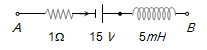
The network shown in the figure is a part of a complete circuit. If at a certain instant the current $i$ is $5 A$ and is decreasing at the rate of $10^3 A / s$  then $V_{A}-V_{B}$  is
The magnetic induction at a point $P$ which is distant $4 \ cm$ from a long current carrying wire is $10^{-18}$ Tesla. The field of induction at a distance $12 \ cm$ from the same current would be