MCQ
Liquid is filled in a vessel which is kept in a room with temperature ${20^o}C$. When the temperature of the liquid is ${80^o}C$, then it loses heat at the rate of $60\;cal/\sec $. What will be the rate of loss of heat when the temperature of the liquid is ${40^o}C$ ....... $cal/\sec $
  • A
    $180$
  • B
    $40$
  • C
    $30$
  • $20$

Answer

Correct option: D.
$20$
d
(d) Rate of loss of heat $\left( {\frac{{\Delta Q}}{t}} \right) \propto \,$temperature difference $\Delta \theta$
$\frac{{{{\left( {\frac{{\Delta Q}}{t}} \right)}_1}}}{{{{\left( {\frac{{\Delta Q}}{t}} \right)}_2}}} = \frac{{\Delta {\theta _2}}}{{\Delta {\theta _1}}}$

==> $\frac{{60}}{{{{\left( {\frac{{\Delta Q}}{t}} \right)}_2}}} = \frac{{80 - 20}}{{40 - 20}}$

==> ${\left( {\frac{{\Delta Q}}{t}} \right)_2} = \frac{{20\,cal}}{{sec}}$

Need a full question paper?

Generate a complete, print-ready paper with questions like this in minutes — across 16+ boards, with answer keys.

Start Generating Free

Similar questions

A motor cyclist travels a certain distance with a uniform speed of $30\, m/s$ and immediately turns back and returns to starting point with a uniform speed $20\, m/s$. Then the average speed of the motor cycle is ..........$m/s$ :-
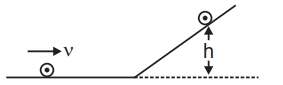
A disc of radius $R$ and mass $M$ is rolling horizontally without slipping with speed $v$. It then moves up an inclined smooth surface as shown in figure. The maximum height that the disc can go up the incline is:
A particle is moving on a circular path with constant speed $v$. It moves between two points $A$ and $B$. which subtends an angle $60^{\circ}$ at the centre of circle. The magnitude of change in its velocity and change in magnitude of its velocity during motion from $A$ to $B$ are respectively ..........
The minimum intensity of sound is zero at a point due to two sources of nearly equal frequencies, when
A rocket is fired vertically up from the ground with a resultant acceleration of $10\,m / s ^2$. The fuel is finished in $1 min$ and it continues to move up $\left(g=10\,m / s ^2\right)$
For a given velocity, a projectile has the same range $R$ for two angles of projection if $t_1$ and $t_2$ are the times of flight in the two cases then
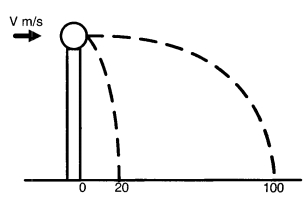
A ball of mass $0.2 \ kg$ rests on a vertical post of height $5 m$. A bullet of mass $0.01 \ kg$, traveling with a velocity $V / s$ in a horizontal direction, hits the centre of the ball. After the collision, the ball and bullet travel independently. The ball hits the ground at a distance of $20 \ m$ and the bullet at a distance of $100 \ m$ from the foot of the post. The initial velocity $V$ of the bullet is
A force of $(3\hat i + 4\hat j)\, N$ acts on a body and displaces it by $(3\hat i + 4\hat j)\,m$ . The work done by the force is ............. $\mathrm{J}$
The diameter of a sphere is measured using a vernier caliper whose $9$ divisions of main scale are equal to $10$ divisions of vernier scale. The shortest division on the main scale is equal to $1 \mathrm{~mm}$. The main scale reading is $2 \mathrm{~cm}$ and second division of vernier scale coincides with a division on main scale. If mass of the sphere is $8.635 \mathrm{~g}$, thedensity of the sphere $1 \mathrm{~s}$ :
Two discs having masses in the ratio $1: 2$ and radii in the ratio $1: 8$ roll down without slipping one by one from an inclined plane of height $h$. The ratio of their linear velocities on reaching the ground is ........