MCQ
Liquids and gases never exhibit:
- ADiamagnetic properties.
- BPara magnetic properties.
- CFerro magnetic properties.
- DElectro magnetic properties.
Explanation:
Ferromagnetic substances have high susceptibility to magnetisation. Liquid and gases aren't prone to be magnetised.
Generate a complete, print-ready paper with questions like this in minutes — across 16+ boards, with answer keys.
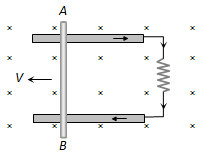
Consider the situation shown in the figure. The wire AB is sliding on the fixed rails with a constant velocity. If the wire AB is replaced by semicircular wire, the magnitude of the induced current will
| (a) Increase |
|
(b) Remain the same |
|
(c) Decrease |
|
(d) Increase or decrease depending on whether the semicircle bulges towards the resistance or away from it |
An arbitrary shaped closed coil is made of a wire of length L and a current I ampere is flowing in it. If the plane of the coil is perpendicular to magnetic field  , the force on the coil is
|
(a) Zero |
(b) IBL |
(c) 2IBL |
(d) |
When a 12 Ω resistor is connected with a moving coil galvanometer then its deflection reduces from 50 divisions to 10 divisions. The resistance of the galvanometer is
|
(a) 24 Ω |
(b) 36 Ω |
(c) 48 Ω |
(d) 60 Ω |
A lens of focal power 0.5 D is
|
(a) A convex lens of focal length 0.5 m |
|
(b) A concave lens of focal length 0.5 m |
|
(c) A convex lens of focal length 2 m |
|
(d) A concave lens of focal length 2 m |
The energy that should be added to an electron to reduce its de Broglie wavelength from one nm to 0.5 nm is
|
(a) Four times the initial energy |
(b) Equal to the initial energy |
|
(c) Twice the initial energy |
(d) Thrice the initial energy |
