Question
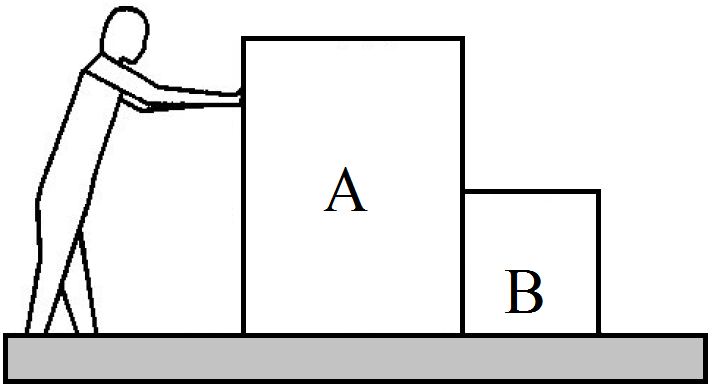
List all the forces acting on the block B in figure.

Answer

As inertial frame is used to understand unknown forces acting on body under motion, as in case of car when breaks are applied no apparent force is applied but still our body moves forward so to understand this frame of reference is used but actually this does not exit.

Need a full question paper?

Generate a complete, print-ready paper with questions like this in minutes — across 16+ boards, with answer keys.

Start Generating Free

Similar questions

In Exercise, let us take the position of mass when the spring is unstreched as x = 0, and the direction from left to right as the positive direction of x-axis. Give x as a function of time t for the oscillating mass if at the moment we start the stopwatch (t = 0), the mass is:
At the mean position.
In what way do these functions for SHM differ from each other, in frequency, in amplitude or the initial phase?
Without any torque, the angular velocity of an object change from 1 revolution per 25 second to 1 revolution per second. Find the ratio of the radii of rotation of the object in these two situations
Calculate the r.m.s velocity of oxygen molecule at 27°C. Given that atomic weight of oxygen is 16.
The transverse displacement of a string (clamped at its both ends) is given by
$\text{y}(\text{x, t})=0.06\sin\Big(\frac{2\pi}{3}\text{x}\Big)\cos(120\pi\text{ t})$
where x and y are in m and t in s. The length of the string is 1.5m and its mass is 3.0 × 10–2kg.
Answer the following:
Does the function represent a travelling wave or a stationary wave?
When a ball is thrown upward, its momentum first decreases and then increases. Does this violate the principle of conservation of momentum?
The dielectric strength of air is 3.0 × 10⁶V/m. A parallel-plate air-capacitor has area 20cm2 and plate separation 0.10mm. Find the maximum rms voltage of an AC source that can be safely connected to this capacitor.
A gas is suddenly compressed from its original volume to a volume of $1 / 4$. Estimate the temperature, the original temperature is 300 K and $\gamma= 1 . 5$.
Find the average frictional force needed to stop a car weighing 500kg in a distance of 25m if the initial speed is 72km/ h.
Does a vibrating source always produce sound?
Explain how an object could have zero average velocity but non-zero average speed?