Question
List any three important characteristics of a population and explain.

Answer

A population can be defined as a group of individuals of the same species, residing in a particular geographical area at a particular time and functioning as a unit. For example, all human beings living at a particular place at a particular time constitute the population of humans. Three important characteristics of a population are:
  • Birth rate (Natality): It is the ratio of live births in an area to the population of an area. It is expressed as the number of individuals added to the population with respect to the members of the population.
  • Death rate (Mortality): It is the ratio of deaths in an area to the population of an area. It is expressed as the loss of individuals with respect to the members of the population.
  • Age Distribution: It is the percentage of individuals of different ages in a given population. At any given time, a population is composed of individuals that are present in various age groups. The age distribution pattern is commonly represented through age pyramids.

Need a full question paper?

Generate a complete, print-ready paper with questions like this in minutes — across 16+ boards, with answer keys.
Start Generating Free

Similar questions

Explain the process of fertilization by defining the insemination.
Following the collision of two trains a large number of passengers are killed. A majority of them are beyond recognition. Authorities want to hand over the dead to their relatives. Name a modern scientific method and write the procedure that would help in the identification of kinship.
  1. List the two methodologies which were involved in human genome project. Mention how they were used.
  2. Expand ‘YAC’ and mention what was it used for.
What is Incomplete dominance. Explain the inheritance of colour in snapdragon flower up to $\mathrm{F}_{2}$ generation.
Given below are the events that are observed in artificial hybridisation programme. Arrange them in the correct sequential order in which they are followed in the hybridisation programme.
(a) Re-bagging; (b) Selection of parents; (c) Bagging; (d) Dusting the pollen on stigma; (e) Emasculation; (f) Collection of pollen from male parent.
What do you understand by biological control? How do micro-organisms act as biological control agents ?
  1. Mature seeds of legumes are non-albuminous.Then, can it be considered that double fertilization does not occur in legumes? Explain your answer.
  2. Write one similarity and one difference between autogamy and geitonogamy.
Mention the location and the function of Leydig cells in humans.
  1. Draw schematic diagrams of segments of a vector and a foreign DNA with the sequence of nucleotides recognised by EcoRI.
  2. Draw the vector DNA segment and foreign DNA segment after the action of EcoRI and label the sticky ends produced.
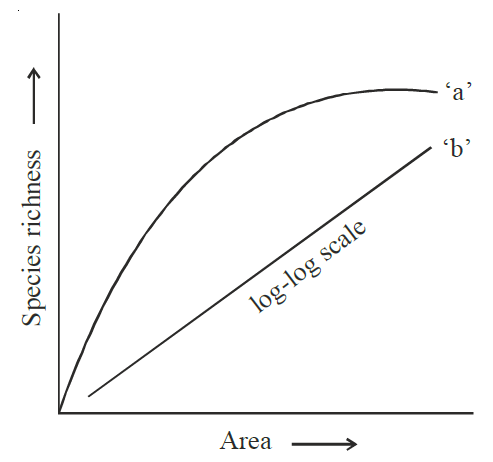
The following graph shows the species-area relationship. Answer the following question as directed.

  1. Name the naturalist who studied the kind of relationship shown in the graph. Write the observation made by him.
  2. Write the situations as discovered by the ecologists when the value of 'Z' (slope of the line) lies.
  1. 0.1 and 0.2
  2. 0.6 and 1.2

What does 'Z' stand for?

  1. When would the slope of the line 'b' become steeper?