The discovery of each of the five major groups of (Plant Growth Regulator = PGR) is a mere coincidence. It began with the observation of
Charles Darwin and his son
Francis Darwin when they observed that the
coleoptile of Canary grass responded to a lateral illumination and grew towards the source of light (phototropism). Auxin was discovered by
F.W. Went, it has been taken from the
phyllode apex of oat sprout.'Foolish seedling' is a disease of paddy plants caused by the pathogenic fungus
Gibberella fujikuroi. E. Kurosova (Japanese scientist) sprinkled the juice extracted from this fungus on disease-free paddy plants, which caused disease in them. This element was later identified as
gibberellic acid.F. Skoog and his co-workers observed that from the internodal segments of tobacco stems the callus (a mass of undifferentiated cells) proliferated only if, in addition to auxins the nutrients medium was supplemented with one of the following-extracts of vascular tissues, yeast extract, coconut milk or DNA. Miller et al. (1955), later identified and crystallised the cytokinesis promoting active substance that they termed kinetin.
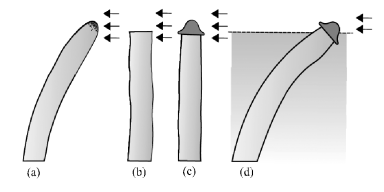 Fig.: Front part of coleoptile plant growth regulator origin of oxygen
During mid-1960s, three independent researches reported the purification and chemical characterisation of three different kinds of inhibitors-inhibitor-B, abscission II and dormin. Later all the three were proved to be chemically identical. It was named abscisic acid (ABA).
H.H. Cousins (1910) confirmed the release of a volatile substance from ripened oranges that hastened the ripening of stored unripened bananas. Later this volatile substance was identified as ethylene, a gaseous
PGR.
Physiological Effects of Plant Growth Regulators:Auxins: Auxins (from Greek 'auxein' to grow) was first isolated from
human urine. The term 'auxin' is applied to the indole-3-acetic acid (IAA), and to other natural and synthetic compounds having certain growth regulating properties. They are generally produced by the growing apices of the stems and roots, from where they migrate to the regions of their action. Auxins like IAA and indole butyric acid (IBA) have been isolated from plants. NAA (naphthalene acetic acid) and 2, 4-D (2. 4-dichlorophenoxyacetic) are synthetic auxins. All these auxins have been used extensively in agricultural and horticultural practices. They help to initiate
rooting in stem cuttings, an application widely used for plant propagation. Auxins promote flowering e.g. in
pineapples. They help to prevent fruit and leaf drop at early stages but promote the abscission of older mature leaves and fruits. In most higher plants, the growing apical bud inhibits the growth of the lateral (axillary) buds, a phenomenon called apical dominance. Removal of shoot tips (decapitation) usually results in the growth of lateral buds. It is widely applied in tea plantations, hedge-making. Auxins also induce
parthenocarpy, e.g.. in tomatoes. They are widely used as herbicides. 2, 4-D, widely used to kill
dicotyledonous weeds, does not affect mature monocotyledonous plants. It is used to prepare weed-free lawns by gardeners. Auxin also controls xylem differentiation and helps in cell division.
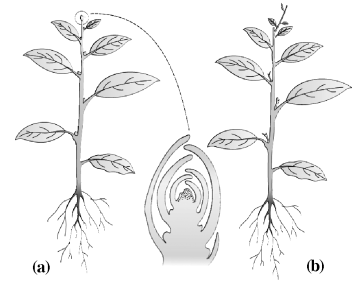 Fig. Apical dominance in plantysGibberellins:
 Gibberellins are another kind of promotory PGR. There are more than 100 gibberellins reported from widely different organisms such as fungi and higher plants. They are denoted as GA1, GA2, GA3 and so on. However,
Gibberellic acid (GA3) was one of the first gibberellins to be discovered and remains the most intensively studied form. All GAs are acidic. They produce a wide range of physiological responses in the plants. Their ability to cause an increase in length of axis is used to increase the length of grapes stalks.
Gibberellins, cause fruits like apple to elongate and improve its shape. They also delay senescence. Thus. the fruits can be left on the tree longer so as to extend the market period.
GA3 is used to speed up the
malting process in brewing industry. Sugarcane stores carbohydrate as sugar in their stems. Spraying sugarcane crop with gibberellins increases the length of the stem. thus increasing the yield by as much as
20 tonnes per acre. Spraying juvenile conifers with GAs hastens the maturity period, thus leading to early seed production. Gibberellins also promotes bolting (internode elongation just prior to flowering) in beet, cabbages and many plants with rosette habit
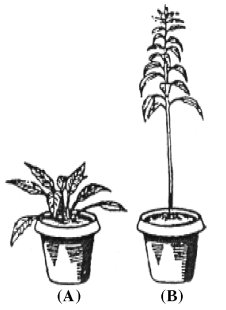 Cytokinins:
 Cytokinins have specific effects on cytokinesis, and were discovered as kinetin (a modified form of adenine, a purine) from the
autoclaved herring sperm DNA. Kinetin does not occur naturally in plants. Search for natural substances with cytokinin-like activities led to the isolation of zeatin from
corn-kernels and coconut milk. Since the discovery of zeatin, several naturally occurring cytokinins, and some synthetic compounds with cell division promoting activity, have been identified. Natural cytokinins are synthesised in regions where rapid cell division occurs, for example, root apices, developing shoot buds, young fruits etc. It helps to produce new leaves, chloroplasts in leaves, lateral shoot growth and adventitious shoot formation.
Cytokinins help overcome the
apical dominance. They promote nutrient mobilisation which helps in the delay of leaf senescence.
Ethylene: It is a simple
gaseous PGR. It is synthesized in large quantities by ageing tissues and ripening fruits. Ethylene affects the transverse growth of plants, swelling in axes and bud formation in dicotyledonous seedlings. Ethylene increases aging and senescence mainly in leaves and flowers. It is very effective in ripening fruits. It increases the rate of
respiration during ripening of fruits. This increase in speed of respiratory increase is called
climactic respiration.Ethylene breaks seed and bud dormancy, initiates
germination in
peanut seeds and germinates potato tubers. Ethylene encourages rapid elongation of petioles in deep water rice plants. It helps in keeping the leaves and the upper part of the shoot above water. Ethylene stimulates root growth and root hairs, thus helping to provide the plant with more absorption area. Helps in flowering and fruit synchrony of pineapple. Increases the speed of ripening of tomato and apple fruits and accelerates the ripening of flowers and fruits. In cucumbers the
female flowers grow.Abscisic acid: It acts as an inhibitor of normal plant growth and plant metabolism. ABA inhibits seed germination, promotes closure of stomata and plants and provides the ability to tolerate various types of stresses. ABA plays an important role in seed development, maturity, dormancy etc. Water protects the seeds from drying and other adverse conditions for growth.