MCQ
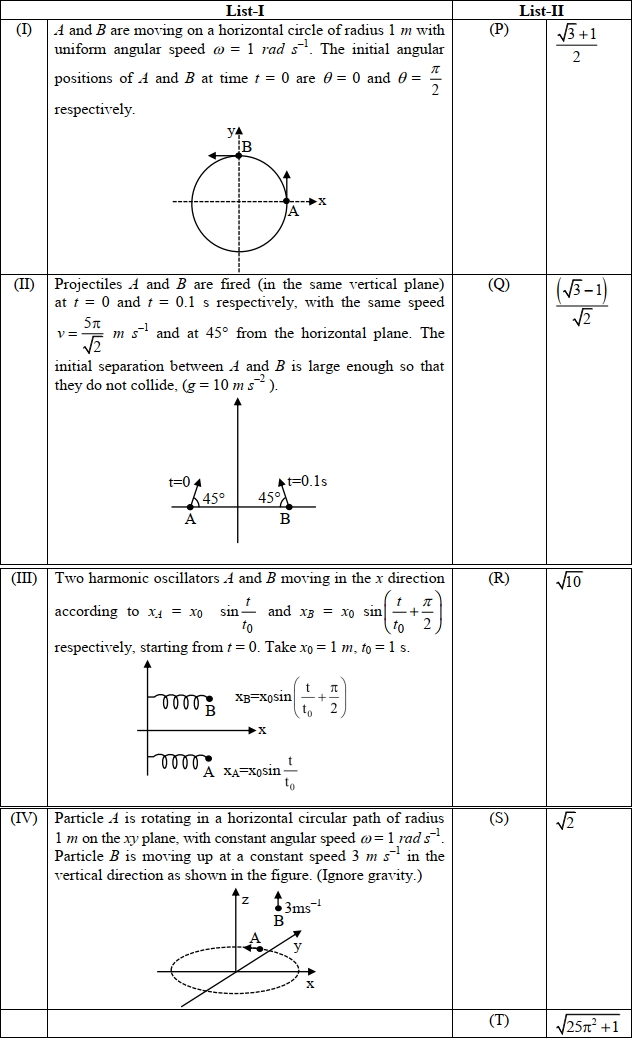
$List I$ describes four systems, each with two particles $A$ and $B$ in relative motion as shown in figure. $List II$ gives possible magnitudes of then relative velocities (in $ms ^{-1}$ ) at time $t=\frac{\pi}{3} s$.

Which one of the following options is correct?
  • A
    $I \rightarrow R , II \rightarrow T , III \rightarrow P , IV \rightarrow S$
  • B
    $I \rightarrow S , II \rightarrow P , III \rightarrow Q , IV \rightarrow R$
  • $I \rightarrow S , II \rightarrow T , III \rightarrow P , IV \rightarrow R$
  • D
    $I \rightarrow T, II \rightarrow P, III \rightarrow R , IV \rightarrow S$
Answer

Correct option: C.
$I \rightarrow S , II \rightarrow T , III \rightarrow P , IV \rightarrow R$
c
$(I)$ $v_{ BA }^2=v_A^2+v_{ B }^2-2 v_{A B} \cos \theta$

As $\omega_{\hat{A}}=\omega_{ B }, \theta=90^{\circ}$ remains constant.

Also, $v _{ A }= v _{ B }=1 m / s$

So, $v_{ BA }=\sqrt{2} m / s$

$(II)$ $\overrightarrow{ u }_{ A }=\frac{5 \pi}{2} \hat{ i }+\frac{5 \pi}{2} \hat{ j }$

$=\overrightarrow{ v }_A=\frac{5 \pi}{2} \hat{ i }+\left(\frac{5 \pi}{2}-10 \cdot \frac{\pi}{3}\right) \hat{ j }$

$=\frac{5 \pi}{2} \hat{ i }-\frac{5 \pi}{6} \hat{ j }$

$\overrightarrow{ u }_B=-\frac{5 \pi}{2} \hat{ i }+\frac{5 \pi}{2} \hat{ j }$

$\overrightarrow{ u }_{ B }=-\frac{5 \pi}{2} \hat{ i }-\left(\frac{5 \pi}{6}+1\right) \hat{ j }$

$\overrightarrow{ v }_{B . A}=-5 \pi \hat{ i }-\hat{ j }$

$v _{B A}=\sqrt{25 \pi^2+1}$

$(III)$ $x _{ A }=\sin t$

$v _{ A }=\cos t =\frac{1}{2} m / s$

$x _{ B }=\cos t$

$v _{ B }=-\sin t =-\frac{\sqrt{3}}{2} m / s$

$v _{ BA }=-\frac{\sqrt{3}}{2}-\frac{1}{2}$

$(IV)$ $\overrightarrow{ v }_{ A } \& \overrightarrow{ v }_{ B }$ are always perpendicular

So, $\left|\overrightarrow{ v }_{ BA }\right|=\sqrt{ v _{ A }^2+ v _B^2}=\sqrt{10} m / s$

Need a full question paper?

Generate a complete, print-ready paper with questions like this in minutes — across 16+ boards, with answer keys.

Start Generating Free

Similar questions

The spring balance inside a lift suspends an object. As the lift begins to ascent, the reading indicated by the spring balance will
The metallic bob of a simple pendulum has the relative density $\rho$. The time period of this pendulum is $T$. If the metallic bob is immersed in water, then the new time period is given by
Two narrow bores of diameter $5.0\, {mm}$ and $8.0\, {mm}$ are joined together to form a $U-$shaped tube open at both ends. If this ${U}$-tube contains water, what is the difference in the level of two limbs of the tube.

[Take surface tension of water ${T}=7.3 \times 10^{-2} \, {Nm}^{-1}$, angle of contact $=0, {g}=10\, {ms}^{-2}$ and density of water $\left.=1.0 \times 10^{3} \,{kg} \,{m}^{-3}\right]$ (in $mm$)

Which of the following statement$(s)$ is are correct?
$Assertion$ : When percentage errors in the measurement of mass and velocity are $1\%$ and $2\%$ respectively, the percentage error in $K.E.$ is $5\%$.

$Reason$ : $\frac{{\Delta E}}{E} = \frac{{\Delta m}}{m} + \frac{{2\Delta v}}{v}$

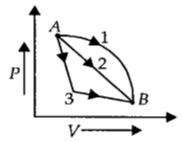
An ideal gas goes from state $A$ to state $B$ via three different processes as indicated in the $P-V$ diagram. If $Q_1, Q_2, Q_3$ indicate the heat absorbed by the gas along the three processes and $\Delta U_1, \Delta U_2, \Delta U_3$ 
indicate the change in internal energy along the three processes respectively, then 
Two identical spheres move in opposite directions with speeds $v_1$ and $v_2$ and pass behind an opaque screen, where they may either cross without touching (Event $1$) or make an elastic head-on collision (Event $2$)
A damped harmonic oscillator has a frequency of $5$ oscillations per second. The amplitude drops to half its value for every $10$ oscillations. The time it will take to drop to $\frac{1}{1000}$ of the original amplitude is close to .... $s$
A whistle of frequency $500 Hz$ tied to the end of a string of length $1.2 m$ revolves at $400 \,rev/min$. A listener standing some distance away in the plane of rotation of whistle hears frequencies in the range (speed of sound $= 340 m/s$)
The dimensions of couple are