MCQ
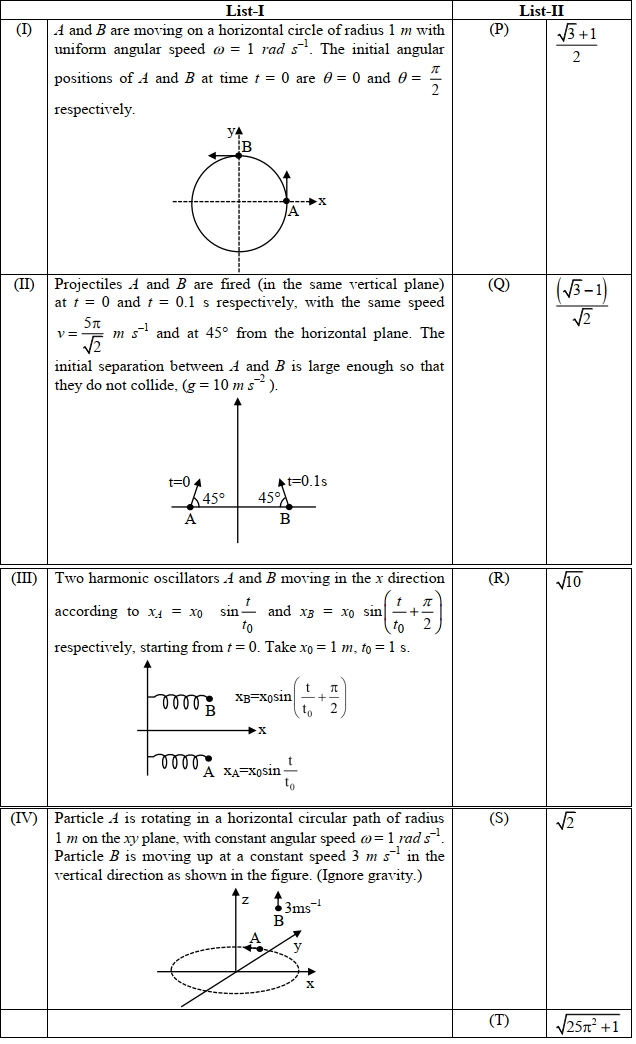
$List I$ describes four systems, each with two particles $A$ and $B$ in relative motion as shown in figure. $List II$ gives possible magnitudes of then relative velocities (in $ms ^{-1}$ ) at time $t=\frac{\pi}{3} s$.

Which one of the following options is correct?
  • A
    $I \rightarrow R , II \rightarrow T , III \rightarrow P , IV \rightarrow S$
  • B
    $I \rightarrow S , II \rightarrow P , III \rightarrow Q , IV \rightarrow R$
  • $I \rightarrow S , II \rightarrow T , III \rightarrow P , IV \rightarrow R$
  • D
    $I \rightarrow T, II \rightarrow P, III \rightarrow R , IV \rightarrow S$
Answer

Correct option: C.
$I \rightarrow S , II \rightarrow T , III \rightarrow P , IV \rightarrow R$
c
$(I)$ $v_{ BA }^2=v_A^2+v_{ B }^2-2 v_{A B} \cos \theta$

As $\omega_{\hat{A}}=\omega_{ B }, \theta=90^{\circ}$ remains constant.

Also, $v _{ A }= v _{ B }=1 m / s$

So, $v_{ BA }=\sqrt{2} m / s$

$(II)$ $\overrightarrow{ u }_{ A }=\frac{5 \pi}{2} \hat{ i }+\frac{5 \pi}{2} \hat{ j }$

$=\overrightarrow{ v }_A=\frac{5 \pi}{2} \hat{ i }+\left(\frac{5 \pi}{2}-10 \cdot \frac{\pi}{3}\right) \hat{ j }$

$=\frac{5 \pi}{2} \hat{ i }-\frac{5 \pi}{6} \hat{ j }$

$\overrightarrow{ u }_B=-\frac{5 \pi}{2} \hat{ i }+\frac{5 \pi}{2} \hat{ j }$

$\overrightarrow{ u }_{ B }=-\frac{5 \pi}{2} \hat{ i }-\left(\frac{5 \pi}{6}+1\right) \hat{ j }$

$\overrightarrow{ v }_{B . A}=-5 \pi \hat{ i }-\hat{ j }$

$v _{B A}=\sqrt{25 \pi^2+1}$

$(III)$ $x _{ A }=\sin t$

$v _{ A }=\cos t =\frac{1}{2} m / s$

$x _{ B }=\cos t$

$v _{ B }=-\sin t =-\frac{\sqrt{3}}{2} m / s$

$v _{ BA }=-\frac{\sqrt{3}}{2}-\frac{1}{2}$

$(IV)$ $\overrightarrow{ v }_{ A } \& \overrightarrow{ v }_{ B }$ are always perpendicular

So, $\left|\overrightarrow{ v }_{ BA }\right|=\sqrt{ v _{ A }^2+ v _B^2}=\sqrt{10} m / s$

Need a full question paper?

Generate a complete, print-ready paper with questions like this in minutes — across 16+ boards, with answer keys.

Start Generating Free

Similar questions

Resolving power of an electron microscope is greater than resolving power of an optical microscope because
A man in a balloon rising vertically with an acceleration of $4.9\,m/{\sec ^2}$ releases a ball $2$ sec after the balloon is let go from the ground. The greatest height above the ground reached by the ball is...........$m$ $(g = 9.8\,m/{\sec ^2})$
The venturi-meter works on :
A lorry and a car moving with the same $K.E.$ are brought to rest by applying the same retarding force, then
Which of the following do not require medium for transmission
Statement $-1$ : Path of the charge particle may be straight line in uniform magnetic field.
Statement $-2$ : Path of the charge particle is decided by the angle between its velocity and the magnetic force working on it
A force of $100 \,dynes$ acts on a mass of $5\, gram$ for $10\, sec$. The velocity produced is ......... $cm/sec$
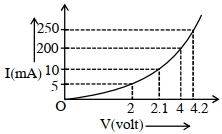
The $I-V$ characteristics of a $p - n$ junction diode in forward bias is shown in the figure. The ratio of dynamic resistance, corresponding to forward bias voltages of $2 \; V$ and $4 \; V$ respectively, is
Two stones of masses $m$ and $2\,m$ are whirled in horizontal circles, the heavier one in a radius $\frac{r}{2}$ and the lighter one in radius $r.$ The tangential speed of lighter stone is $n$ times that of the value of heavier stone when they experience same centripetal forces. The value of $n$ is
If the length of a pendulum is made $9$ times and mass of the bob is made $4$ times then the value of time period becomes