Question
List-$I$ shows different radioactive decay processes and List-$II$ provides possible emitted particles. Match each entry in List-$I$ with an appropriate entry from List-$II$, and choose the correct option.
List-$I$ List-$II$
($P$) ${ }_{92}^{238} U \rightarrow{ }_{91}^{234} \mathrm{~Pa}$ ($1$) one $\alpha$ particle and one $\beta^{+}$particle
($Q$) ${ }_{82}^{214} \mathrm{~Pb} \rightarrow{ }_{82}^{210} \mathrm{~Pb}$ ($2$) three $\beta^{-}$particles and one $\alpha$ particle
($R$) ${ }_{81}^{210} \mathrm{Tl} \rightarrow{ }_{82}^{206} \mathrm{~Pb}$ ($3$) two $\beta^{-}$particles and one $\alpha$ particle
($S$) ${ }_{91}^{228} \mathrm{~Pa} \rightarrow{ }_{88}^{224} \mathrm{Ra}$ ($4$) one $\alpha$ particle and one $\beta^{-}$particle
  ($5$) one $\alpha$ particle and two $\beta^{+}$particles

Answer

$\mathrm{Z}_1 Z^{A_4} \rightarrow Z_2 Y^{A_1}+N_{12} \mathrm{He}^4+N_{21} e^0+N_{3-1} e^0$

Conservation of charge

$\mathrm{Z}_1=\mathrm{Z}_2+2 \mathrm{~N}_1+\mathrm{N}_2-\mathrm{N}_3$    $. . . . . .(1)$

Conservation of nucleons.

$A_1=A_2+4 N_1$      $. . . . . (2)$

$N_1=\frac{A_1-A_2}{4}$

From ($i$) and ($ii$)

$\mathrm{N}_2-\mathrm{N}_3=\mathrm{Z}_1-\mathrm{Z}_2-\left(\frac{\mathrm{A}_1-\mathrm{A}_2}{2}\right)$

$(P)$

${ }_{92} \mathrm{U}^{238} \rightarrow{ }_{91} \mathrm{~Pa}^{234}$

$\mathrm{~N}_1=\frac{238-234}{4}=1 \rightarrow 1 \alpha$

$\mathrm{N}_2-\mathrm{N}_3=(92-91)-\left(\frac{4}{2}\right)=-1 \rightarrow 1 \beta^{-}(Q)$

${ }_{\mathrm{k} 2} \mathrm{~Pb}^{214} \rightarrow_{32} \mathrm{~Pb}^{210}$

$\mathrm{~N}_1=\frac{214-210}{4}=1 \rightarrow 1 \alpha$

$\mathrm{N}_2-\mathrm{N}_3=(82-82)-\left(\frac{4}{2}\right)=-2 \rightarrow 2\beta^{(\mathrm{R})}$

${ }_{81} T \ell^{210} \rightarrow{ }_{\mathrm{k} 2} \mathrm{~Pb}^{206}$

$\mathrm{~N}_1=\frac{210-206}{4}=1 \rightarrow 1 \alpha $

$\mathrm{N}_2-\mathrm{N}_3=(81-83)-\frac{4}{2}=-3 \rightarrow 3 \beta^{-}$

$(\mathrm{S})$

${ }_{91} \mathrm{~Pa}^{22 k} \rightarrow_{k 8} \mathrm{Ra}^{224}$

$\mathrm{~N}_1=\frac{228-224}{4}=1 \alpha$

$\mathrm{N}_2-\mathrm{N}_3=(91-88)-\frac{4}{2}=1 \beta^{+}$

Need a full question paper?

Generate a complete, print-ready paper with questions like this in minutes — across 16+ boards, with answer keys.

Start Generating Free

Similar questions

An engine pump is used to pump a liquid of density $\rho $ continuously through a pipe of cross-sectional area $A$. If the speed of flow of the liquid in the pipe is v, then the rate at which kinetic energy is being imparted to the liquid is
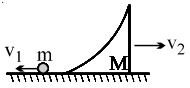
A particle of mass $m$ moving horizontally with $v_0$ strikes $a$ smooth wedge of mass $M$, as shown in figure. After collision, the ball starts moving up the inclined face of the wedge and rises to $a$ height $h$. Suppose the particle when reaches the horizontal surfaces, its velocity with respect to ground is $v_1$ and that of wedge is $v_2$. Choose the correct statement(s)
In the expression for time period $T$ of simple pendulum $T=2 \pi \sqrt{\frac{l}{g}}$, if the percentage error in time period $T$ and length $l$ are $2 \%$ and $2 \%$ respectively then percentage error in acceleration due to gravity $g$ is equal to ......... $\%$
An aluminium rod with Young's modulus $Y =7.0$ $\times 10^{10} N / m ^2$ undergoes elastic strain of $0.04 \%$. The energy per unit volume stored in the rod in SI unit is:
A telescope has an objective lens of focal length $150\,\,cm$ and an eyepiece of focal length $5 \,\,cm.$ If a $50\,\,m$ tall tower at a distance of $1\,\,km$ is observed through this telescope in normal setting, the angle formed by the image of the tower is $\theta $, then $\theta $ is close to.....$^o$
An iron bar of length $10\, m$ is heated from $0°C$ to $100°C.$ If the coefficient of linear thermal expansion of iron is $ 10 \times 10^{-6}{°C^{-1}}$, the increase in the length of bar is  .......... $cm$ 
Two lamps of luminous intensity of $8  Cd $ and $32  Cd$ respectively are lying at a distance of $1.2\, m$ from each other. Where should a screen be placed between two lamps such that its two faces are equally illuminated due to two sources
Statement$-I :$ To get a steady de output from the pulsating voltage received from a full wave rectifier we can connect a capacitor across the output parallel to the load ${R}_{{L}}$

Statement$-II :$ To get a steady de output from the pulsating voltage received from a full wave rectifier we can connect an inductor in series with ${R}_{{L}}$.

In the light of the above statements, choose the most appropriate answer from the options given below:

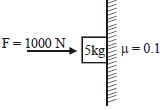
For the given figure, if block remains in equilibrium position then find frictional force between block and wall ........ $N$
Intensity level of a sound of intensity $I$ is $30\, dB$. The ratio $\frac{I}{{{I_0}}}$ is (Where ${I_0}$ is the threshold of hearing)