Question
List one difference and one similarity between gravitational and inertial mass.

Answer

Similarity-Both are equal. Difference-Gravitational mass is measured by using comparison of mass by force, but inertial mass measured by the acceleration caused by the force.

Need a full question paper?

Generate a complete, print-ready paper with questions like this in minutes — across 16+ boards, with answer keys.
Start Generating Free

Similar questions

One rupee kept on a revolving table. Why does the coin rise in the tangent direction?
A copper cube of mass $200\ g$ slides down on a rough inclined plane of inclination $37^{\circ}$ at a constant speed. Assume that any loss in mechanical energy goes into the copper block as thermal energy. Find the increase in the temperature of the block as it slides down through $60\ cm$ . Specific heat capacity of copper $=420 \mathrm{Jkg}^{-1} \mathrm{~K}^{-1}$.
Underline the correct alternative: The rate of change of total momentum of a many-particle system is proportional to the external force/ sum of the internal forces on the system.
The velocity of a particle is towards west at an instant. Its acceleration is not towards west, not towards east, not towards north and not towards south. Give an example of this type of motion.
A particle is in linear simple harmonic motion between two points, A and B, 10cm apart. Take the direction from A to B as the positive direction and give the signs of velocity, acceleration and force on the particle when it is:At the mid-point of AB going towards A.
What are the S.I. and C.G.S. units of heat? How are they related?
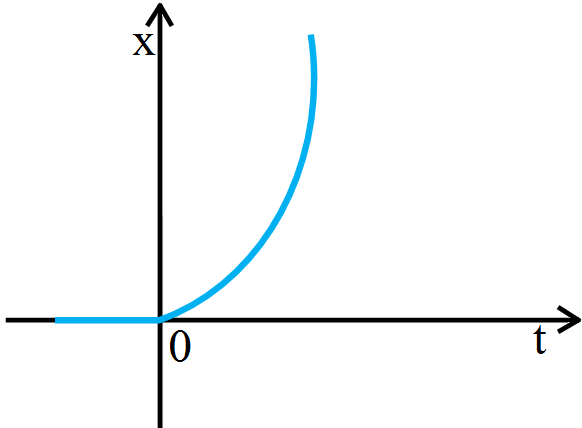
Shows the x-t plot of one-dimensional motion of a particle. Is it correct to say from the graph that the particle moves in a straight line for t < 0 and on a parabolic path for t > 0? If not, suggest a suitable physical context for this graph.
Acceleration produced in a freely falling body under the gravitational pull of earth is called __________.
Is the phenomenon of beats observable in case of two light waves of nearly equal frequencies?
An illuminated object is placed on the principal axis of a converging lens so that a real image is formed on the other side of the lens. If the object is shifted a little,