Question
List some adaptations found in desert plants to reduce transpiration.

Answer

(i) Leaves with thick cuticle - Some desert plants develop a thick waxy cuticle over the epidermis to reduce the loss of water by transpiration.
(ii) Reduced number of stomata - These plants have few stomata and concentrated on the underside of leaves to avoid direct sunlight.
(iii) Presence of epidermal hair - In some plants like cucurbits, leaf surface may be covered by thick coating of epidermal hairs to reduce transpiration.
(iv) Presence of sunken stomata - The stomata of leaves in dry environment sink into the leaf to reduce the surface area of the pores which further reduces rate of transpiration.
(v) Leaves modified into spines - In cactus, leaves are modified into spines to reduce surface area for transpiration, while their stem performs photosynthetic functions.

Need a full question paper?

Generate a complete, print-ready paper with questions like this in minutes — across 16+ boards, with answer keys.
Start Generating Free

Similar questions

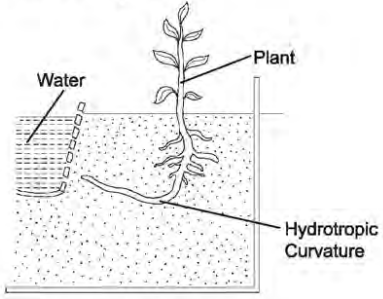
Look at the given picture and answer the questions:

Image
(i) Name the tropic movement shown by the seedling.
(ii) Name the stimulus responsible for this movement.
(iii) Define the process shown by the seedling.
Arrange and rewrite the terms in each group in the correct order so as to be in a logical sequence beginning with the term that is underlined.
(i) Cytokinesis, telophase, anaphase, metaphase
(ii) interphase, prophase, metaphase, anaphase
(iii) G1 phase, S phase, G2 phase, M phase
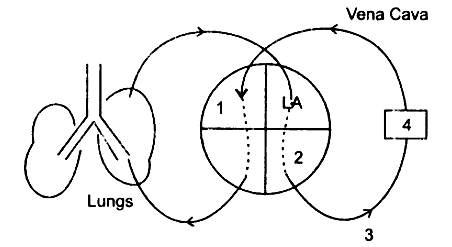
Given below is a schematic representation of the circulatory system in man. Study the same and answer the questions that follow:

(i) Label the parts 1 to 4 indicated in the diagram.
(ii) Give one difference between parts 1 and 2 based on:
(a) their structure
(b) the nature of blood flowing through them.
(iii) What is the specific name of the type of blood circulation that takes place between the heart and the lungs?
(iv) Name the valve found at the beginning of the part labeled 3.
Differentiate between the following:
Ethylene and Abscisic Acid
Give three exceptions to Mendel's laws.
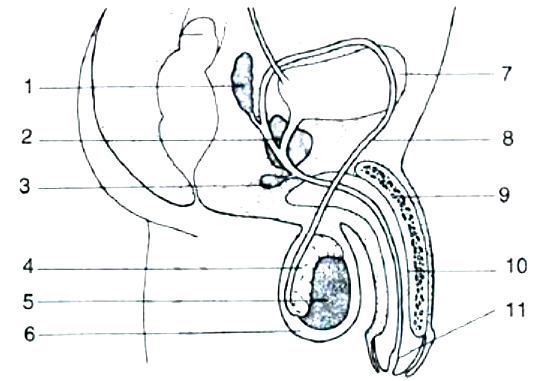
Given below is the schematic diagram of the sectional view of the human male reproductive system.
State the functions of the parts numbered 1, 2, 3, 5, 8 and 11.
Name the hormone produced by the following glands giving one function of each:
(i) Thyroid (ii) Pancreas (iii) Adrenal medulla
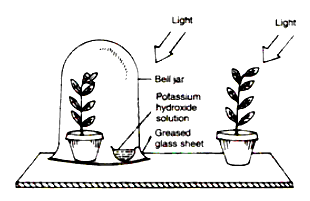
Two healthy green plants were placed in the dark for $24$ hours. They were then set up, as shown in the figure, for $4$ hours. Then a leaf was taken from each plant and
the chlorophyll was removed from the leaves:
( i) What is the next and final step in this experiment?
( ii ) What would be the results of the final step?
( iii ) Why was it necessary to grease the glass sheet?
( iv ) What hypothesis is being tested in this experiment?
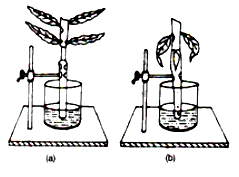
The diagram given below represents the results of an experiment conducted on two freshly taken leafy shoots of a herbaceous plant. The lower ends of the shoots dip in ordinary water.
(i) What is the aim of the experiment?
(ii) Some parts of the stem in both the shoots have been removed. Name the conducting tissue in shoot (a) and in shoot (b) that has been removed.
(iii) What are the results of this experiment?
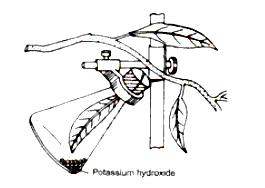
An experiment was set up as shown in the figure given below . The twig in the diagram was intact on the plant and it was as such in sunlight for a few hours .

(i) What is the aim of the above experiment ?
(ii) Why was potassium hydroxide placed inside the conical flask ?
(iii) What test would you perform on the leaf inside the flask?
(iv) What is the expected result of the above test ?
(v) Is it necessary to similarly test on outer leaf also ? Giva a reason .