Question
List the harmful effects caused by alcohol/ drug abuse.

Answer

Alcohol and drugs have several adverse effects on the individual, his family, and the society.

  1. Effects of alcohol:
  • Effects on the individual: Alcohol is injurious to the health of the individual. When an individual consumes excess alcohol, it causes damage to the liver and the central nervous system. As a result, other symptoms such as depression, fatigue, aggression, loss of weight and appetite may also be observed in the individual. Sometimes, extreme levels of alcohol consumption may also lead to heart failure, resulting coma and death. The immediate adverse effects of alcohol abuse are manifested in form of reckless bhehaviour, vandalism and voilence, Also, it is advisable for pregnant women to avoid alcohol as it may inhibit normal growth of the baby.
  • Effects on the family: Consumption of excess alcohol by any family member can have devastating effects on the family. It leads to several domestic problems such as quarrels, frustrations, insecurity, etc.

Effects of alcohol on society-

  1. Rash behaviour.
  2. Malicious mischief and violence.
  3. Disturbing social network.
  4. Loss of interest in social activities, loss of interests in hobbies, change in eating and sleeping habites etc.
  1. Effects of drugs: An individual who is addicted to drugs creates problems not only for himself but also for his family.
  • Effects on the addited individual: Drugs have an adverse effect on the central nervous system of an individual. This leads to the malfunctioning of several other organs of the body such as the kidney, liver, etc. The spread of HIV is most common in these individuals as they share common needles while injecting drugs in their body. Drugs have long-term side effects on both males and females. These side effects include increased aggressiveness, mood swings, and depression.
  • Effects on the family and society: A person addicted to drugs creates problems for his family and society. A person dependant on drugs becomes frustrated, irritated, and anti-social. At the time of drug addicted becomes mental and financial distress.

Need a full question paper?

Generate a complete, print-ready paper with questions like this in minutes — across 16+ boards, with answer keys.

Start Generating Free

Similar questions

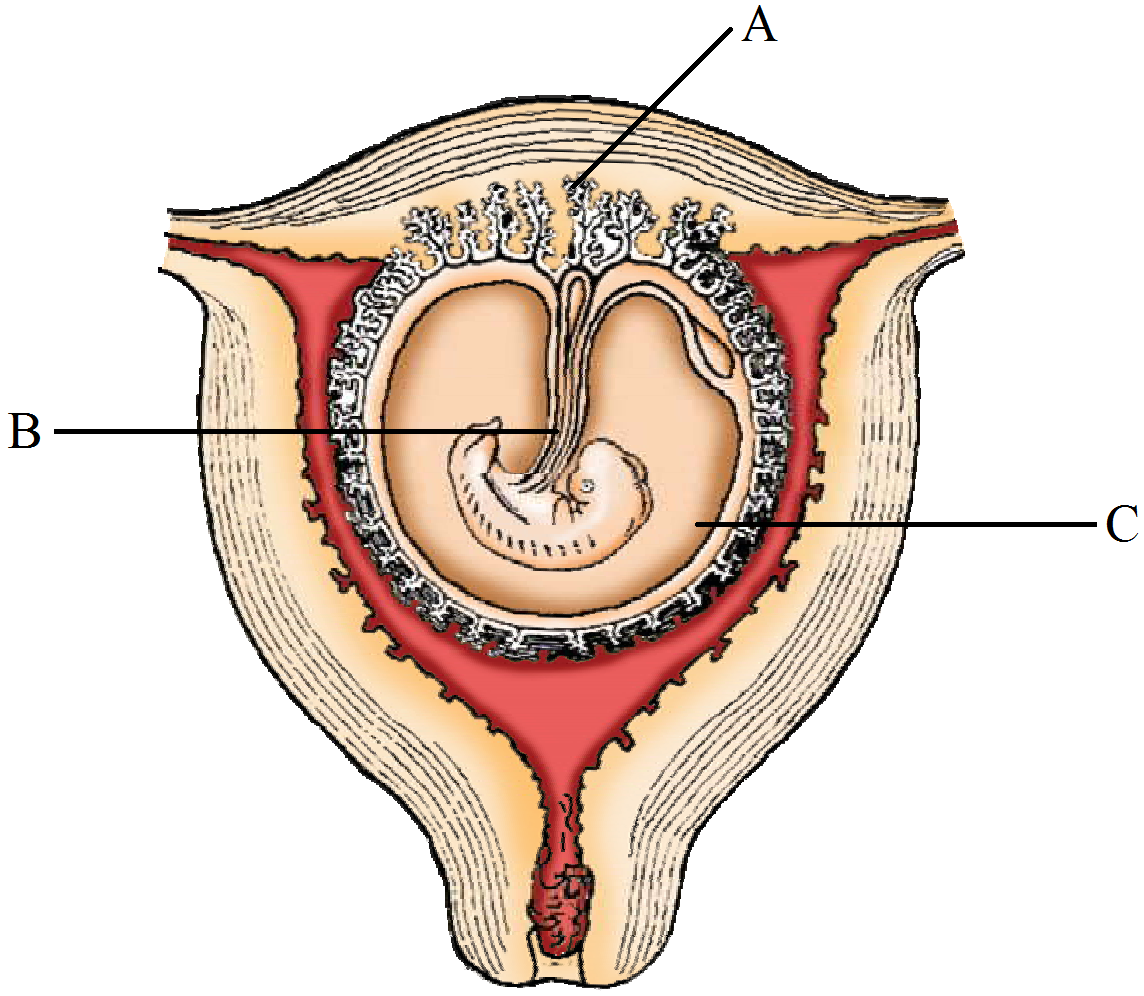
  1. Identify the parts labelled A, B and C in the diagram given.

  1. Draw a labelled diagram of a human blastocyst.
  2. What is parturition and is it induced at the end of pregnancy in a human female?
  1. Represent diagrammatically three kinds of age-pyramids for human populations.
  2. How does an age pyramid for human population at given point of time helps the policymakers in planning for future?
A bright student of class XI, under peer pressure started taking drugs. He started neglecting studies, misbehaving with parents and friends in school. The principal of school counselled him, but it had no effect. His parents took him to a rehabilitation center. After a few months, he came back recovered.
  1. What is drug abuse?
  2. Name some commonly abused drugs and their source.
  3. What should be the attitude of his parents after his return?
  4. What values did the principal reflect through his initiative?
What is malaria ? Write down reason, symptoms, prevention and treatment.###Write about the malaria fever, its causes, symp-toms, control and prevention.###Name the different species of plasmodium which species is responsible for malignant malaria?
What is called retrovirus? Show the replication of retrovirus with the help of diagram.
Describe the structure of a ribosome, taking into consideration, its role in protein synthesis.
Read the following and answer any four questions from (i) to (v) given below:

Stem cells hold the potential for manifold applications in biotechnology based next generation therapeutics. Scientists are trying to formulate better and more personalised treatment modalities against some seemingly irremediable diseases, by harnessing body's own stem cells and stem cell niche. Stem cells of different origin and level of potency are being investigated for tissue regeneration, treatment of bone defect, drug testing, gene therapy and cell based therapy for muscle damage, spinal cord injury, cancer therapy, etc. 'Tile properties of embryonic and adult stem cells to either self-renew or differentiate into multiple cell lineages make them an attractive source for cell therapies, tissue engineering and as model system for drug screening.

  1. Stem cells are widely used in medical research. Which property of stem cells makes them particularly useful in this research?
  1. They can be fused together to form a zygote.
  2. They can divide and eventually give rise to a whole organism.
  3. They can divide and be made to differentiate into various types of cell.
  4. They will continue to divide indefinitely.
  1. Stem cells can be divided into four main types. Which of the four types of stem cell can differentiate into a limited range of tissues?
  1. Adult stem cells.
  2. Embryonic stem cells.
  3. Fetal stem cells.
  4. Zygotic stem cells.
  1. Which feature of stem cells obtained from blood in the umbilical cord enables their use in the treatment of a variety of blood cancers?
  1. They can differentiate into bone marrow cells.
  2. They can differentiate into any cellular component of blood.
  3. They can replace blood stem cells affected by cancer.
  4. They are totipotent.
  1. The search for pluripotent stem cells is intense. The spennatogonium is the diploid precursor of haploid sperm in the development pathway of mouse gametes as shown below.
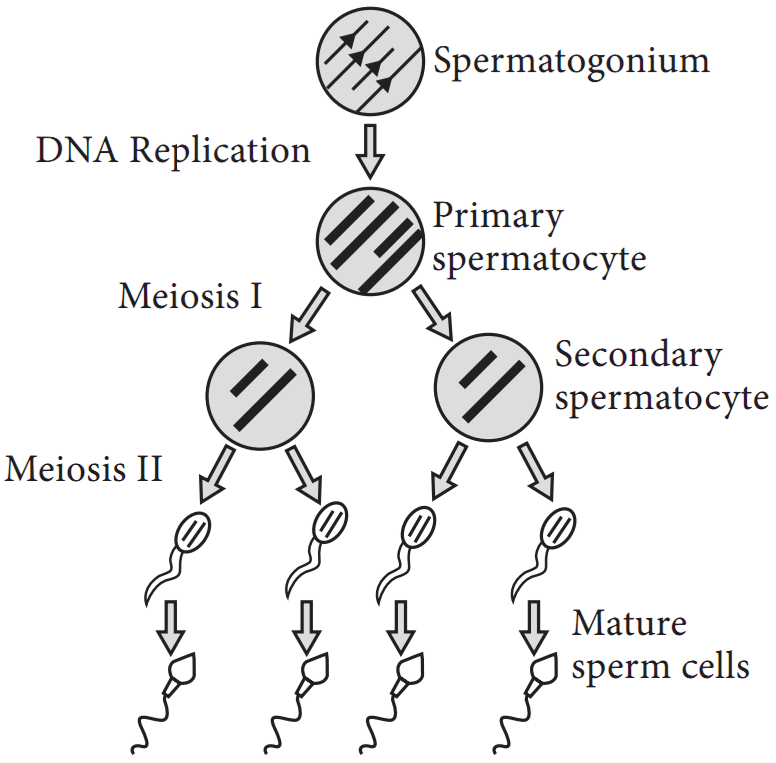
Scientists were interested to find out which stages of sperm development have stem cell capacity. Two experiments were carried out using sterile host males with testes that lacked germ cells. The results are shown in the table.

  Type of cells used Result
Experiment 1 Secondary spermatocytes were injected Fertility was not restored
Experiment 2 Spermatogonia were injected Fertility was restored for the rest of the mouse's life

What property of a stem cell is missing in the secondary spermatocytes?

  1. Specialisation.
  2. Self-renewal.
  3. Commitment.
  4. A proper stem-cell niche.
  1. Which feature of embryonic stem cells (ESCs) is illustrated below?
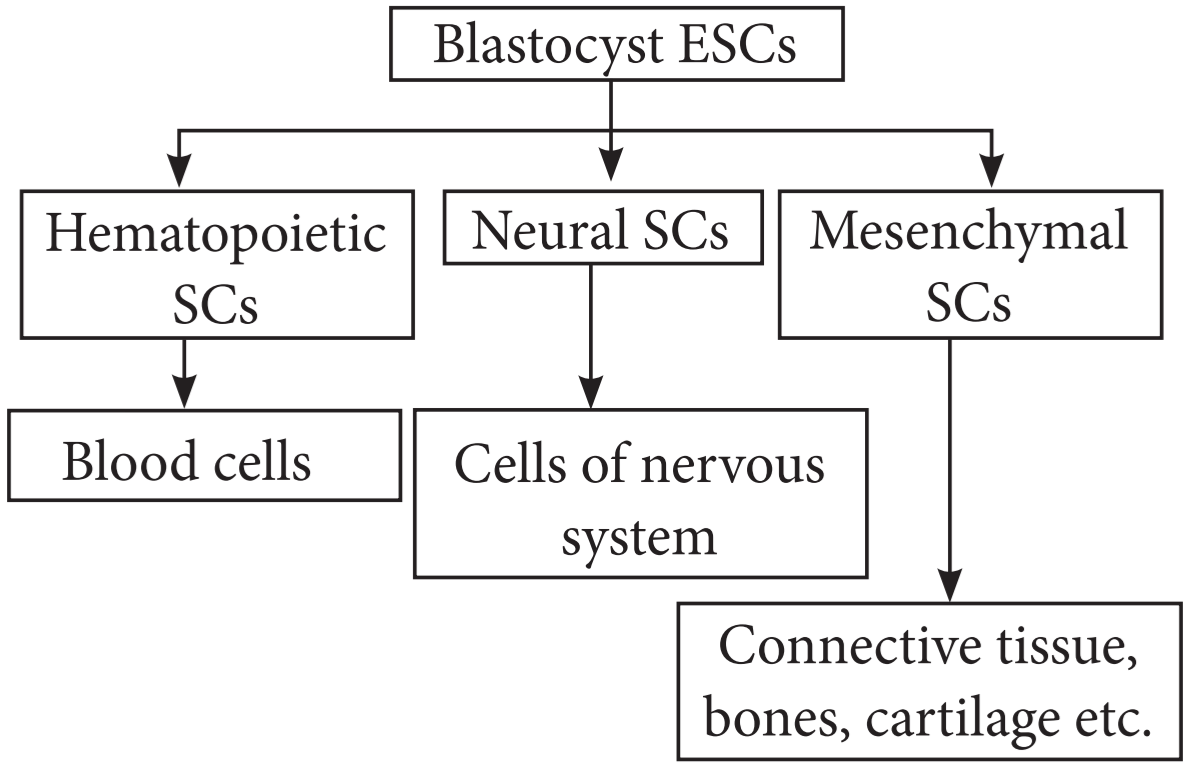
  1. ESCs are capable of dividing.
  2. ESCs are multipotent.
  3. ESCs are pluripotent.
  4. ES Cs show plasticity.
Differentiate between homology and analogy. Also discuss the homologous and vestigeal organs with example and how do they explain the evidence of evolution.
The biology teacher was explaining about restriction enzymes and came to a point explaining that these enzymes are extracted from bacteria and are called as molecular scissors. Varun got curious and asked some questions for more clarity on the concept to his teacher.
  1. From which part of microorganisms are restriction enzymes derived?
  2. Why are restriction enzymes called molecular scissors?
  3. What if some strands are needed to be cut from within. Would that lead to wastage of DNA?
  4. What values are shown by Varun?
Read the following and answer any four questions from (i) to (v) given below:
Apomixis is a mode of reproduction which does not involve formation of zygote through gametic fusion. In plants, apomixis commonly mimics sexual reproduction but produces seeds without fertilization. There are several methods of atomistic development in seeds. Thee two common ones are recurrent agamospermy and advective embryony.
  1. Apomixis is a type of reproduction in plants, in which?
  1. Fertilization does not take place.
  2. Male nucleus takes part in fertilization.
  3. Pollen fusion takes place.
  4. Generative nucleus takes part in fertilization.
  1. Which of the following statements is incorrect regarding recurrent agamospermy?
  1. It is the formation of seed that has an embryo formed without meiosis and syngamy.
  2. All the cells of embryo sac are diploid.
  3. An embryo develops directly from a diploid cell other than egg like that of nucleus and integument.
  4. None of these.
  1. Adventive embryony is found in:
  1. Citrus.
  2. Opuntia.
  3. Apple.
  4. Both (a) and (b).
  1. Formation of embryo directly from diploid egg without fertilization is called:
  1. Apospory.
  2. Diplospory.
  3. Polyembryony.
  4. Diploid parthenogenesis.
  1. If any somatic cell of sporophyte produces gametophyte without reduction division, it is called:
  1. Parthenogenesis.
  2. Apogamy.
  3. Apospory.
  4. Amphimixis.