Question
List the Salient Features of Human Genome

Answer

→ Some of the salient observations drawn from human genome project are as follows:
(i) The human genome contains 3164.7 million bp.
(ii) The average gene consists of 3000 bases, but sizes vary greatly, with the largest known human gene being dystrophin at 2.4 million bases.
(iii) The total number of genes is estimated at 30,000 - much lower than previous estimates of 80,000 to 1,40,000 genes. Almost all (99.9 per cent) nucleotide bases are exactly the same in all people.
(iv) The functions are unknown for over 50 per cent of the discovered genes.
(v) Less than 2 per cent of the genome codes for proteins.
(vi) Repeated sequences make up very large portion of the human genome.
(vii) Repetitive sequences are stretches of DNA sequences that are repeated many times, sometimes hundred to thousand times. They are thought to have no direct coding functions, but they shed light on chromosome structure, dynamics and evolution.
(viii) Chromosome 1 has most genes (2968), and the Y has the fewest (231).
(ix) Scientists have identified about 1.4 million locations where single-base DNA differences (SNPs - single nucleotide polymorphism, pronounced as 'snips') occur in humans. This information promises to revolutionise the processes of finding chromosomal locations for disease-associated sequences and tracing human history.
Need a full question paper?

Generate a complete, print-ready paper with questions like this in minutes — across 16+ boards, with answer keys.

Start Generating Free

Similar questions

Name two diseases each, which are transmitted in the following ways:
  1. Through contaminated food and water.
  2. Through insect vectors.
  3. Through the air/ droplet inhaled.
  1. What is meant by ecological succession? Explain how it occurs.
  2. What properties distinguish a pioneer community from a climax community?
Explain the pattern of inheritance of haemophilia in humans. Why is the possibility of a human female becoming a haemophilic extremely rare? Explain.
Describe the structure of a seminiferous tubule.
A village health worker was taking a session with women. She tells the women that one has to be very careful while using oral pills as method of birth control. Wrong usage can actually promote conception.
Analyse the statement and compare the merits and demerits of using oral pills and surgical methods of birth control.
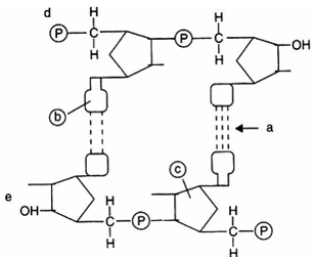
Study the given portion of double-stranded polynucleotide chain carefully. Identify a, b, c and the 5' end of the chain.
Image
Construct an ideal pyramid of energy when 1,000,000 joules of sunlight is available. Label all its trophic levels.
Draw a labelled sketch of sparged-stirred-tank bioreactor. Write its application.
A large number of married couples the world over are childless. It is shocking to know that in India the female partner is often blamed for the couple being childless.
  1. Why in your opinion the female partner is often blamed for such situations in India? Mention any two values that you as a biology student can promote to check this social evil.
  2. State any two reasons responsible for the cause of infertility.
  3. Suggest a technique that can help the couple to have a child where the problem is with the male partner.
Two parents Mr. X and Mrs. X and Mr. Y and Mrs. Y consider the same child as their respective children. Both Mr. and Mrs. A have blood group A, Mr. But the blood group of children is O. Tell whose child it could be and why?