Question
List the similarities and differences between aerobic and anaerobic respiration.

Answer

Similarity between aerobic and anaerobic respiration: In both aerobic and anaerobic respiration, the food is broken down to release energy. Differences between aerobic and anaerobic respiration:
Aerobic respiration
Anaerobic respiration
It is the process of breakdown of food in the presence of oxygen.
It is the process of breakdown of food in the absence of oxygen.
Its end products are $\mathrm{CO}_2$ and $\mathrm H_2O$.
End products of anaerobic respiration can be lactic acid or $\mathrm{CO}_2$ and alcohol.
It takes longer time to release energy.
It is a fast process as compared to aerobic respiration.
It produces large amount of energy.
It produces small amount of energy as compared to aerobic respiration.
Examples: It occurs in most plants and animals.
Examples: Yeast, bacteria, human muscle cells, etc. respire an aerobically.

Need a full question paper?

Generate a complete, print-ready paper with questions like this in minutes — across 16+ boards, with answer keys.
Start Generating Free

Similar questions

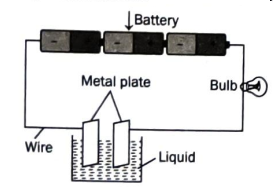
In the set up shown here, the bulb has lighted up.
Image

Which of the following statement about liquid is/are correct?
I. Liquid is a distilled water.
II. Liquid is a tap water.
III. Liquid is a good conductor of electricity.
(a) III only
(b) II only
(c) I and III only
(d) II and III only
How does the process of fertilisation take place in flowers?
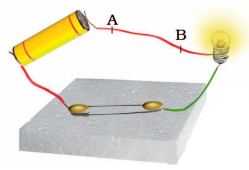
Draw the circuit diagram to represent the circuit shown in figure.

Image

Describe the method for replinishing the soils with minerals and other essential constituents used by plants growing in those soil by farmers.
Does transpiration serve any useful function in the plants? Explain.
State the differences between acids and bases.
Explain the difference between self-pollination and cross-pollination.
Fill in the blanks in the following statements using the words given in the box.
rusted, colourful, substance, chemical, physical, reversible, iron oxide, object
  1. Making sugar solution is a ____________ change.
  2. A physical change is generally____________.
  3. Grinding of wheat grain changes its size. It is a ____________ change.
  4. Iron benches kept in lawns and gardens get____________. It is a _________ change because a new _________ is formed.
Given below is a jumbled sequence of the processes involved in a waste water treatment plant. Arrange them in their correct sequence.
  1. Sludge is scraped out and skimmer removes the floating grease.
  2. Water is made to settle in a large tank with a slope in the middle.
  3. Large objects like plastic bags are removed by passing wastewater through bar screens.
  4. Sand, grit and pebbles are made to settle by decreasing the speed of incoming wastewater.
  5. Wastewater enters a grit and sand removal tank.
Discuss the role of non-metals in medical and agricultural fields.