Question
  1. List the three different allelic forms of gene ‘I’ in humans. Explain the different phenotypic expressions, controlled by these three forms.
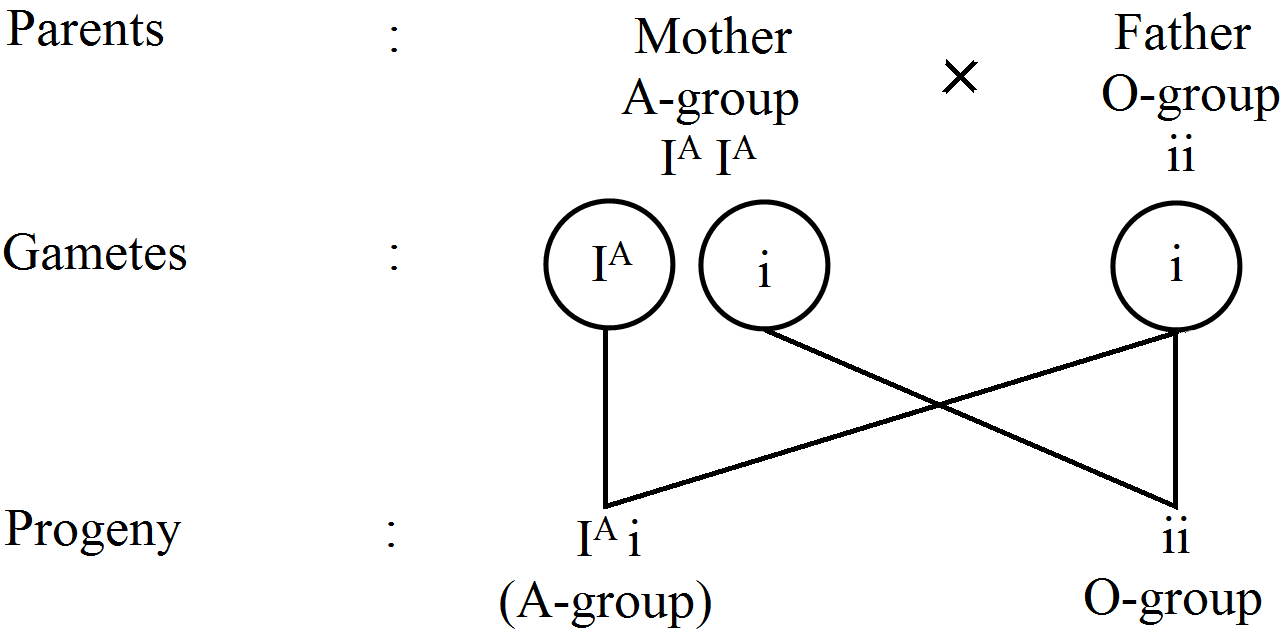
  2. A woman with blood group'A'marries a man with blood group 'O'. Discuss the possibilities of the inheritance of the blood groups in the following, starting with 'yes' or 'no' for each:
  1. They produce children with blood group ‘A’ only.
  2. They produce children, some with 'O' blood group and some with 'A' blood group.
Answer

  1. Inheritance of human blood-group character:
  • The gene for blood group character exists in three allelic forms, $I^A, I^B$ and i; it is a case of multiple allelism.
  • The phenotypes and genotypes of these alleles are as follows:
Blood group
Genotype(s)
A
$I^AI^A$ or $I^Ai$
B
$I^BI^B$ or $I^Bi$
AB
$I^AI^B$
O
ii
  • The alleles $I^A$ and $I^B$ are codominant and express themselves as blood group AB, when they are together.
  • Blood group O is homozygous recessive.
  1.  
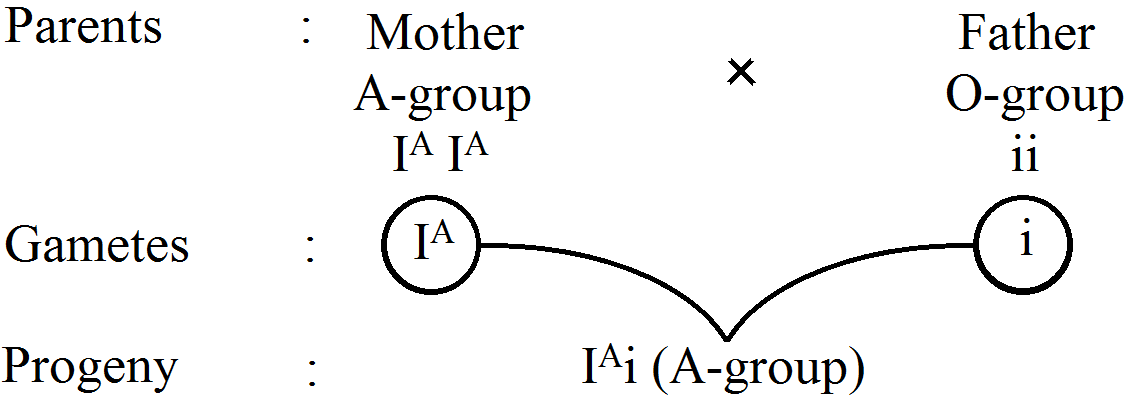
  1. Yes, when the woman is homozygous $(I^AI^A)$ for blood group A, the children can be with only blood group A,

Or
No, When the woman is heterozygous $(I^Ai)$ for blood group A, children will be of A group and O group.
  1. Yes, when the woman is heterozygous $(I^Ai)$ for blood group A, children can be with either blood group A or O (as in the cross above).
    Or
    No, when the woman is homozygous $(I^AI^A)$ for blood group A, the children can be with only blood group A (as in the first cross of (i) of this answer).

Need a full question paper?

Generate a complete, print-ready paper with questions like this in minutes — across 16+ boards, with answer keys.

Start Generating Free

Similar questions

Compare the life style of people living in the urban areas with those of rural areas and briefly describe how the life style affects their health.
In case of polyembryony, If one embryo develops from the synergid and another from the nucellus, which one is haploid and which is diploid? Describe polyembryony and also mention how can it be commercially exploited.
Answer the following questions:
During a cross involving true breeding red flowered and true breeding white flowered snapdragon plants, the $F_1$ progeny did not show any of the parental traits, while they reappeared in $F_2$ progenies. Explain the mechanism using Punnett Square.
Which element is responsible for causing soil salinity? At what concentration does the soil become saline?
What measures, as an individual, you would take to reduce environmental pollution?
Polymerase chain reaction (PCR) is a laboratory technique used to amplify DNA sequences. The method involves using short DNA sequences called primers to select the portion of the genome to be amplified. The temperature of the sample is repeatedly raised and lowered to help a DNA replication enzyme copy the target DNA sequence. The technique can produce a billion copies of the target sequence in just a few hours.
Image
i. List the three steps involved in Polymerase Chain Reaction (PCR).
ii. Name the source organism of Taq polymerase.
iii. Explain the specific role of this enzyme in PCR.
Name and describe the steps involved in the technique widely used in forensics that serves as the basis of paternity testing in case of disputes.
Compare the characteristic features of insect pollinated and wind pollinated flowers. Explain how the respective features assist in pollination.
During her tour to a renowned forest, Sakshi saw a highway being constructed, which passes through the middle of the forest. She was unhappy seeing that and on return, she contacted the local eco-club and approached the concerned department to stop the work.
  1. What would be the effect on biodiversity, if the highway is constructed?
  2. How forests are useful to mankind?
  3. What values of Sakshi reflect here?
Define a cistron. Giving examples differentiate between monocistronic and polyeistronic transcription unit.