MCQ
lncorrect statement
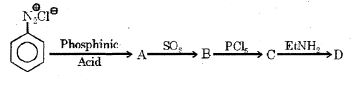
  • $D$ is insoluble in alkali
  • B
    $A$ is formed when phenol is heated with $Zn$ dust
  • C
    $B$ when treated with fuming $NaOH$ followed by acidification it is converted into phenol
  • D
    Compound $C$ having chlorine

Answer

Correct option: A.
$D$ is insoluble in alkali
a

Need a full question paper?

Generate a complete, print-ready paper with questions like this in minutes — across 16+ boards, with answer keys.

Start Generating Free

Similar questions

The oxidation number of $N$ in $N{H_4}Cl$ is
An organic compound of molecular formula ${C_4}{H_{10}}O$ does not react with sodium. With excess of $HI,$ it gives only one type of alkyl halide. The compound is
The reaction (figure) is known as
When ethyl alcohol and  $KI $ reacted in presence of $N{a_2}C{O_3},$ yellow crystals of...... are formed
When neopentyl alcohol is heated with an acid, it slowly converted into an $85: 15$ mixture of alkenes $A$ and $B$, respectively. What are these alkenes $?$
Match List - $I$ with List - $II$.

${List-I }$  ${(Reactants) }$

${List-II }$  ${ Products }$

($A$)Phenol, $\mathrm{Zn} / \Delta$

$(I)$ Salicylaldehyde

($B$)Phenol, $\mathrm{CHCl}_3, \mathrm{NaOH}, \mathrm{HCl}$

$(II)$ Salicylic acid

($C$)Phenol, $\mathrm{CO}_2, \mathrm{NaOH}, \mathrm{HCl}$

$(III)$ Benzene

($D$)Phenol, Conc. $\mathrm{HNO}_3$

$(IV)$ Picric acid

In which of the following option product gas $X$ and $Y$ (other than water vapour are same)
Which of the following relation represents correct relation between standard electrode potential and equilibrium constant ?

$I$.  $\log \,\,K\, = \,\frac{{nF{E^o}}}{{2.303\,RT}}$

$II$.  $K\, = \,{e^{\frac{{nF{E^o}}}{{RT}}}}$

$III$.  $\log \,\,K\, = -\,\frac{{nF{E^o}}}{{2.303\,RT}}$

$IV$.  $\log \,\,K\, = 0.4342\,\,\frac{{-nF{E^o}}}{{RT}}$

Choose the correct statement $(s)$.
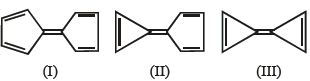
Consider the following compounds Which compound possesses highest dipole moment ?
The $\Delta S$ for the vaporisation of $1$ $mol$ of water is $88.3 $ $J/mole\, K$ . The value of $\Delta S$ for the condensation of $1 $ $mol$ of vapour will be.......$ J/mol\, K$