Question
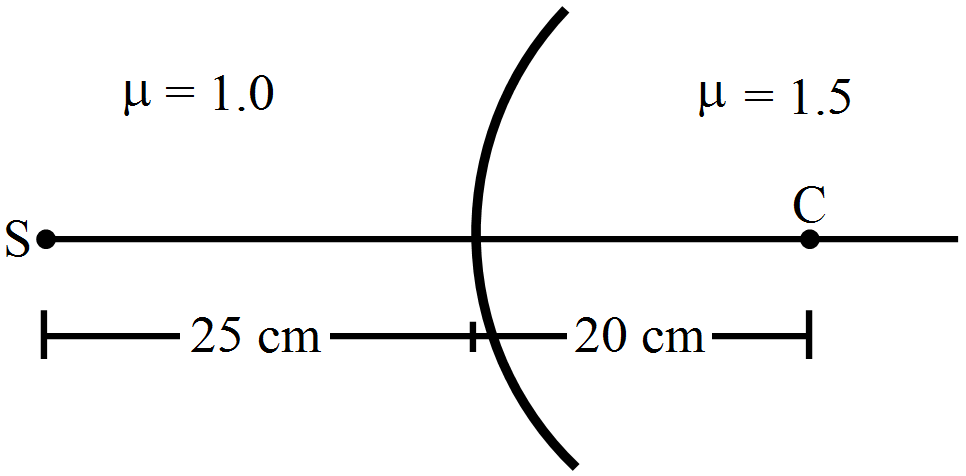
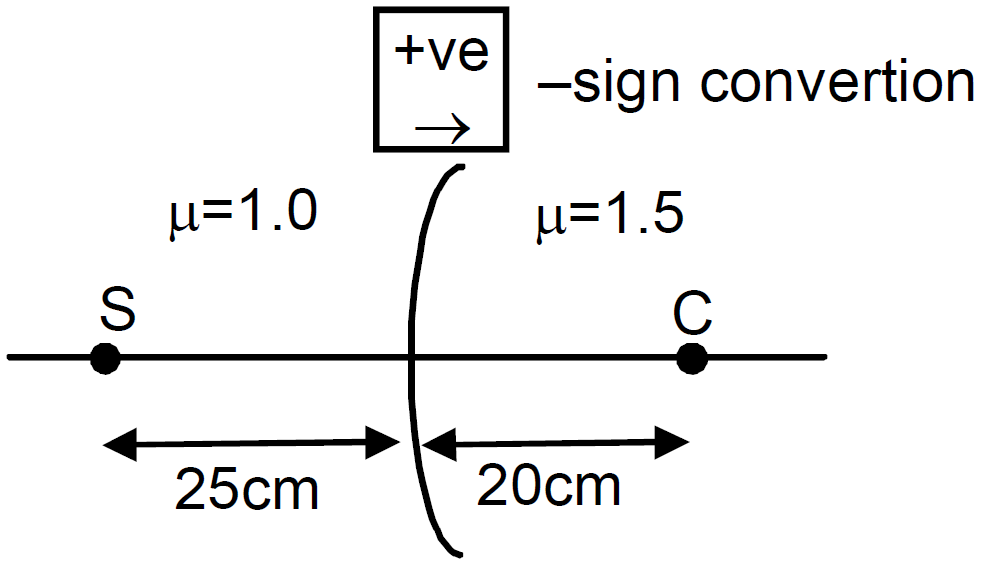
Locate the image formed by refraction in the situation shown in figure.

Answer

$\mu_1=1, \ \mu_2=1.5,$
R = 20cm (Radius of curvature), u = -25cm$\therefore \ \frac{\mu_2}{\text{v}}-\frac{\mu_1}{\text{u}}=\frac{\mu_2-\mu_1}{\text{R}}$
$\Rightarrow\frac{1.5}{\text{v}}=\frac{0.5}{20}-\frac{1}{25}=\frac{1}{40}-\frac{1}{25}=\frac{-3}{200}$
$\Rightarrow \ \text{v}=200\times0.5=-100\text{cm}.$
So, the image is 100cm from (P) the surface on the side of S.

Need a full question paper?

Generate a complete, print-ready paper with questions like this in minutes — across 16+ boards, with answer keys.
Start Generating Free

Similar questions

Given below are some examples of wave motion. State in each case if the motion is transverse, longitudinal or a combination of both.
  1. Motion of a kink in a long coil spring produced by displacing one end of the spring sideways.
  2. Wave produced in a cylinder containing water by moving its piston back and forth.
  3. Wave produced by a motorboat sailing in water.
  4. Ultrasonic waves in air produced by a vibrating crystal.
Angular momentum of a system is conserved if its M.I. is changed. Is its rotational K.E. also conserved?
Let x and a stand for distance. Is $\int\frac{\text{dx}}{\sqrt{\text{a}^2-\text{x}^2}}=\frac{1}{\text{a}}\sin^{-1}\frac{\text{a}}{\text{x}}$ dimensionally correct?
If $x = at^2 + bt + c$, where x is displacement as a function of time. Write the dimensions of a b and c.
A steel wire of original length 1m and cross-sectional area $4.00mm^2$ is clamped at the two ends so that it lies horizontally and without tension. If a load of $2.16kg$ is suspended from the middle point of the wire, what would be its vertical depression? Y of the steel = $2.0 \times 10^{11}N/m^2$ Take $g = 10m/s^2$​​​​​​​.
Density $\rho$ or a piece of an object of mass m and volume V is given by the formula $\rho=\frac{\text{m}}{\text{v}}$ If $\text{m}=(375.32\pm0.01)\text{g}$ and $\text{V}=(136.41\pm0.01)\text{cm}^3,$ find percentage error in $\rho.$
The number of electrons in an insulator is of the same order as the number of electrons in a conductor. What is then the basic difference between a conductor and an insulator?
A sphere of mass $20kg$ is suspended by a metal wire of unstretched length $4m$ and diameter $1mm$. When in equilibrium, there is a clear gap of $2mm$ between the sphere and the floor. The sphere is gently pushed aside so that the wire makes an angle $\theta$ with the vertical and is released. Find the maximum value of $\theta$ so that the sphere does not rub the floor. Young's modulus of the metal of the wire is $2.0 \times 10^{11}N/m^2$. Make appropriate approximations.
A hot gas emits radiation of wavelengths 46.0nm, 82.8nm and 103.5nm only. Assume that the atoms have only two excited states and the difference between consecutive energy levels decreases as energy is increased. Taking the energy of the highest energy state to be zero, find the energies of the ground state and the first excited state.
Sketch velocity-time graph in following situations:
i. $\mathrm{v}_0>0 ; \mathrm{a}<0 \mid \mathrm{al} \rightarrow$ constant
ii. $v_0<0 ; a>0|a| \rightarrow$ is increasing uniformly.
a : acceleration, $\mathrm{v}_0$ : initial velocity
OR
  1. Displacement$-$time graph of any object is shown in the figure:

Draw the velocity$-$time graph for this motion.
  1. What does the area under acceleration$-$time graph represent?