Question
Logarithmic differentiation is a powerful technique to differentiate functions of the form $\text{f}(\text{x})=[\text{u}(\text{x})]^{\text{v}(\text{x})},$ where both u(x) and v(x) are differentiable functions and f and u need to be positive functions.

Let function $\text{y}=\text{f}(\text{x})=(\text{u}(\text{x}))^{\text{v}(\text{x})},$ then $\text{y}'=\text{y}\Big[\frac{\text{v}(\text{x})}{\text{u}(\text{x})}\text{u}'(\text{x})+\text{v}'(\text{x})\cdot\log[\text{u}(\text{x})]\Big]$

On the basis of above information, answer the following questions.

  1. Differentiate xx w.r.t. x.
  1. $\text{x}^\text{x}(1+\log\text{x})$

  2. $\text{x}^\text{x}(1-\log\text{x})$

  3. $-\text{x}^\text{x}(1+\log\text{x})$

  4. $\text{x}^\text{x}\log\text{x}$

  1. Differentiate xx + a+ xa + aa w.r.t. x.
  1. $(1+\log\text{x})+(\text{a}^\text{x}\log\text{a}+\text{ax}^{\text{a}-1})$

  2. $\text{x}^\text{x}(1+\log\text{x})+\log\text{a}+\text{ax}^{\text{a}-1}$

  3. $\text{x}^\text{x}(1+\log\text{x})+\text{x}^\text{a}\log\text{x}+\text{ax}^{\text{a}-1}$

  4. $\text{x}^\text{x}(1+\log\text{x})+\text{a}^\text{x}\log\text{a}+\text{ax}^{\text{a}-1}$

  1. If $\text{x}=\text{e}^\frac{\text{x}}{\text{y}},$ then find $\frac{\text{dy}}{\text{dx}}.$

  1. $-\frac{(\text{x}+\text{y})}{\text{x}\log\text{x}}$

  2. $-\frac{(\text{x}-\text{y})}{\text{x}\log\text{x}}$

  3. $\frac{(\text{x}+\text{y})}{\text{x}\log\text{x}}$

  4. $\frac{\text{x}-\text{y}}{\text{x}\log\text{x}}$

  1. If y = (2 - x)3(3 + 2x)5, then find $\frac{\text{dy}}{\text{dx}}.$

  1. $(2-\text{x})^3(3+2\text{x})^5\Big[\frac{15}{3+2\text{x}}-\frac{8}{2-\text{x}}\Big]$

  2. $(2-\text{x})^3(3+2\text{x})^5\Big[\frac{15}{3+2\text{x}}+\frac{3}{2-\text{x}}\Big]$

  3. $(2-\text{x})^3(3+2\text{x})^5\Big[\frac{10}{3+2\text{x}}-\frac{3}{2-\text{x}}\Big]$

  4. $(2-\text{x})^3(3+2\text{x})^5\cdot\Big[\frac{10}{3+2\text{x}}+\frac{3}{2-\text{x}}\Big]$

  1. If $\text{y}=\text{x}^\text{x}\cdot\text{e}^{(2\text{x}+5)},$ then find $\frac{\text{dy}}{\text{dx}}.$

  1. $\text{x}^\text{x}\text{e}^{2\text{x}+5}$

  2. $\text{x}^\text{x}\text{e}^{2\text{x}+5}(3-\log\text{x})$

  3. $\text{x}^\text{x}\text{e}^{2\text{x}+5}(1-\log\text{x})$

  4. $\text{x}^\text{x}\text{e}^{2\text{x}+5}\cdot(3+\log\text{x})$
Answer

  1. (a) $\text{x}^\text{x}(1+\log\text{x})$

Solution:

Let $\text{y}=\text{x}^\text{x}\Rightarrow\log\text{y}=\text{x}\log\text{x}$

$\Rightarrow\frac{1}{\text{y}}\frac{\text{dy}}{\text{dx}}=\frac{\text{d}}{\text{dx}}(\text{x}\log\text{x})$

$\Rightarrow\frac{\text{dy}}{\text{dx}}=\text{x}^\text{x}[1\times\log\text{x}+\text{x}\times\frac{1}{\text{x}}]$

$=\text{x}^\text{x}[1+\log\text{x}]$

  1. (d) $\text{x}^\text{x}(1+\log\text{x})+\text{a}^\text{x}\log\text{a}+\text{ax}^{\text{a}-1}$

  1. (d) $\frac{\text{x}-\text{y}}{\text{x}\log\text{x}}$

Solution:

Given $\text{x}=\text{e}^\frac{\text{x}}{\text{y}}\Rightarrow\log\text{x}=\frac{\text{x}}{\text{y}}\log\text{e}\Rightarrow\text{y}\log\text{x}=\text{x}$

$\Rightarrow\text{y}\frac{1}{\text{x}}+(\log\text{x})\frac{\text{dy}}{\text{dx}}=1$

$\Rightarrow\frac{\text{dy}}{\text{dx}}=\Big(1-\frac{\text{y}}{\text{x}}\Big)\frac{1}{\log\text{x}}\Rightarrow\frac{1}{\text{x}\log\text{x}}(\text{x}-\text{y})$

  1. (c) $(2-\text{x})^3(3+2\text{x})^5\Big[\frac{10}{3+2\text{x}}-\frac{3}{2-\text{x}}\Big]$

Solution:

$\text{y}=(2-\text{x})^3(3+2\text{x})^5$

$\Rightarrow\log\text{y}=\log(2-\text{x})^3+\log(3+2\text{x})^5$

$=3\log(2-\text{x})+5\log(3+2\text{x})$

$\Rightarrow\frac{1}{\text{y}}\frac{\text{dy}}{\text{dx}}=\frac{3\times(-1)}{2-\text{x}}+\frac{5}{3+2\text{x}}\times(2)$

$\Rightarrow\frac{\text{dy}}{\text{dx}}=(2-\text{x})^3(3+2\text{x})^5\Big[\frac{10}{3+2\text{x}}-\frac{3}{2-\text{x}}\Big]$

  1. (d) $\text{x}^\text{x}\text{e}^{2\text{x}+5}\cdot(3+\log\text{x})$
Solution:

$\text{y}=\text{x}^\text{x}\cdot\text{e}^{(2\text{x}+5)}$

$\Rightarrow\log\text{y}=\text{x}\log\text{x}+(2\text{x}+5)$

$\Rightarrow\frac{1}{\text{y}}\cdot\frac{\text{dy}}{\text{dx}}=\Big(\text{x}\cdot\frac{1}{\text{x}}+\log\text{x}\Big)+2$

$\Rightarrow\frac{\text{dy}}{\text{dx}}=\text{x}^\text{x}\cdot\text{e}^{2\text{x}+5}\cdot(3+\log\text{x})$
Need a full question paper?

Generate a complete, print-ready paper with questions like this in minutes — across 16+ boards, with answer keys.

Start Generating Free

Similar questions

If the equation is of the form $\frac{\text{dy}}{\text{dx}}=\frac{\text{f(x, y)}}{\text{g(x, y)}}$or $\frac{\text{dy}}{\text{dx}}=\text{F}\Big(\frac{\text{y}}{\text{x}}\Big),$ where f(x, y), g(x, y) are homogeneous functions of the same degree in x and y, then put y = vx and $\frac{\text{dy}}{\text{dx}}=\text{v+x}\Big(\frac{\text{dv}}{\text{dx}}\Big),$ so that the dependent variable y is changed to another variable v and then apply variable separable method.
Based on the above information, answer the following questions.

  1. The general solution of $\text{x}^2\frac{\text{dy}}{\text{dx}}=\text{x}^2+\text{xy}+\text{y}^2$ is:
  1. $\tan^{-1}\frac{\text{x}}{\text{y}}=\log|\text{x}|+\text{c}$
  2. $\tan^{-1}\frac{\text{y}}{\text{x}}=\log|\text{x}|+\text{c}$
  3. $\text{y}=\text{x}\log|\text{x}|+\text{c}$
  4. $\text{x}=\text{y}\log|\text{y}|+\text{c}$
  1. Solution of the differential equation $2\text{xy}\frac{\text{dy}}{\text{dx}}=\text{x}^2+3\text{y}^2$ is:
  1. x3 + y2 = cx2
  2. $\frac{\text{x}^2}{2}+\frac{\text{y}^3}{3}=\text{y}^2+\text{c}$
  3. x2 + y3 = cx2
  4. x2 + y2 = cx3
  1. General solution of the differential equation (x2 + 3xy + y2) dx - x2 dy = 0 is:
  1. $\frac{\text{x+y}}{\text{y}}-\log\text{x = c}$
  2. $\frac{\text{x+y}}{\text{y}}+\log\text{x = c}$
  3. $\frac{\text{x}}{\text{x+y}}-\log\text{x = c}$
  4. $\frac{\text{x}}{\text{x+y}}+\log\text{x = c}$
  1. General solution of the differential equation $\frac{\text{dy}}{\text{dx}}=\frac{\text{y}}{\text{x}}\bigg\{\log\Big(\frac{\text{y}}{\text{x}}\Big)+1\bigg\}$ is:
  1. $\log(\text{xy})=\text{c}$
  2. $\log\text{y}=\text{cx}$
  3. $\log\frac{\text{y}}{\text{x}}=\text{cx}$
  4. $\log\text{x}=\text{cy}$
  1. Solution of the differential equation $\Big(\text{x}\frac{\text{dy}}{\text{dx}}-\text{y}\Big)\text{e}^\frac{\text{y}}{\text{x}}=\text{x}^2\ \cos\text{x}$ is:
  1. $\text{e}^\frac{\text{y}}{\text{x}}-\sin\text{x = c}$
  2. $\text{e}^\frac{\text{y}}{\text{x}}+\sin\text{x = c}$
  3. $\text{e}^\frac{\text{-y}}{\text{x}}-\sin\text{x = c}$
  4. $\text{e}^\frac{\text{-y}}{\text{x}}+\sin\text{x = c}$
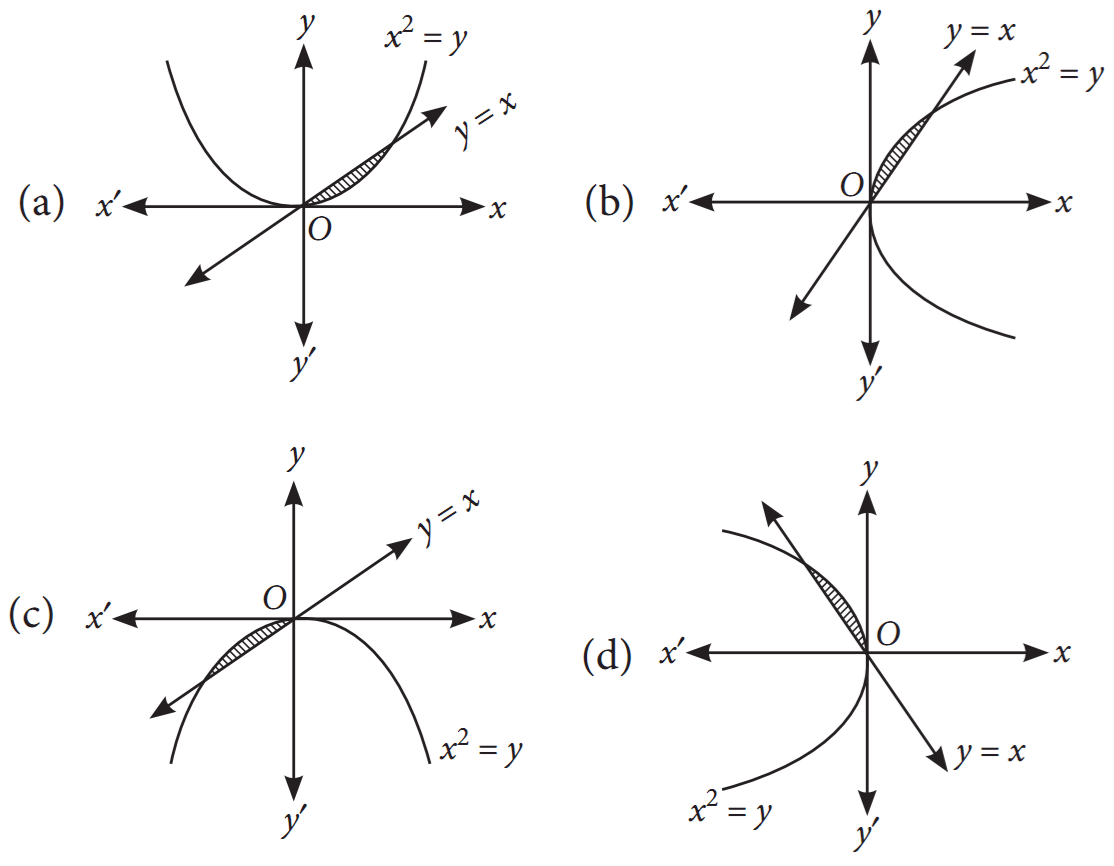
Consider the following equations of curves x2 = y and y = x.

On the basis of above information, answer the following questions.
  1. The point(s) of intersection of both the curves is (are).
  1. (0, 0)(2, 2)
  2. (0, 0)(1, 1)
  3. (0, 0)(-1, -1)
  4. (0, 0)(-2, -2)
  1. Area bounded by the curves is represented by which of the following graph?

  1. The value of the integral $\int\limits_{1}^{0}\text{x}\ \text{dx}$ is.
  1. $\frac{1}{4}$

  2. $\frac{1}{3}$

  3. $\frac{1}{2}$

  4. $1$

  1. The value of the integral $\int\limits_{0}^{1}\text{x}^2\ \text{dx}$ is.
  1. $\frac{1}{4}$

  2. $\frac{1}{3}$

  3. $\frac{1}{2}$

  4. $1$

  1. The value of area bounded by the curves x2 = y and x = y is.
  1. $\frac{1}{6}\text{ sq}.\text{unit}$

  2. $\frac{1}{3}\text{ sq}.\text{unit}$

  3. $\frac{1}{2}\text{ sq}.\text{unit}$

  4. ${1}\text{ sq}.\text{unit}$

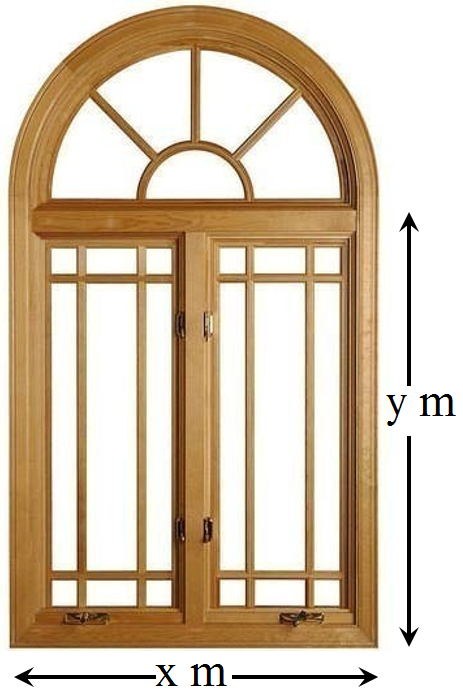
Rohan, a student of class XII, visited his uncle's flat with his father. He observe that the window of the house is in the form of a rectangle surmounted by a semicircular opening having perimeter 10m as shown in the figure.

Based on the above information, answer the following questions.

  1. If x and y represents the length and breadth of the rectangular region, then relation between x and y can be represented as.
  1. $\text{x}+\text{y}+\frac{\pi}{2}=10$
  2. $\text{x}+\text{2y}+\frac{\pi\text{x}}{2}=10$
  3. $\text{2x}+\text{2y}=10$
  4. $\text{x}+\text{2y}+\frac{\pi}{2}=10$
  1. The area (A) of the window can be given by.
  1. $\text{A}=\text{x}-\frac{\text{x}^3}{8}-\frac{\text{x}^2}{2}$
  2. $\text{A}=\text{5x}-\frac{\text{x}^2}{8}-\frac{\pi\text{x}^2}{8}$
  3. $\text{A}=\text{x}+\frac{\pi\text{x}^3}{8}-\frac{\text{3x}^2}{8}$
  4. $\text{A}=\text{5x}+\frac{\text{x}^3}{2}+\frac{\pi\text{x}^2}{8}$
  1. Rohan is interested in maximizing the area of the whole window, for this to happen, the value of x should be.
  1. $\frac{10}{2-\pi}$
  2. $\frac{20}{4-\pi}$
  3. $\frac{20}{4+\pi}$
  4. $\frac{10}{2+\pi}$
  1. Maximum area of the window is.
  1. $\frac{30}{4+\pi}$
  2. $\frac{30}{4-\pi}$
  3. $\frac{50}{4-\pi}$
  4. $\frac{50}{4+\pi}$
  1. For maximum value of A, the breadth of rectangular part of the window is.
  1. $\frac{10}{4+\pi}$
  2. $\frac{10}{4-\pi}$
  3. $\frac{20}{4+\pi}$
  4. $\frac{20}{4-\pi}$
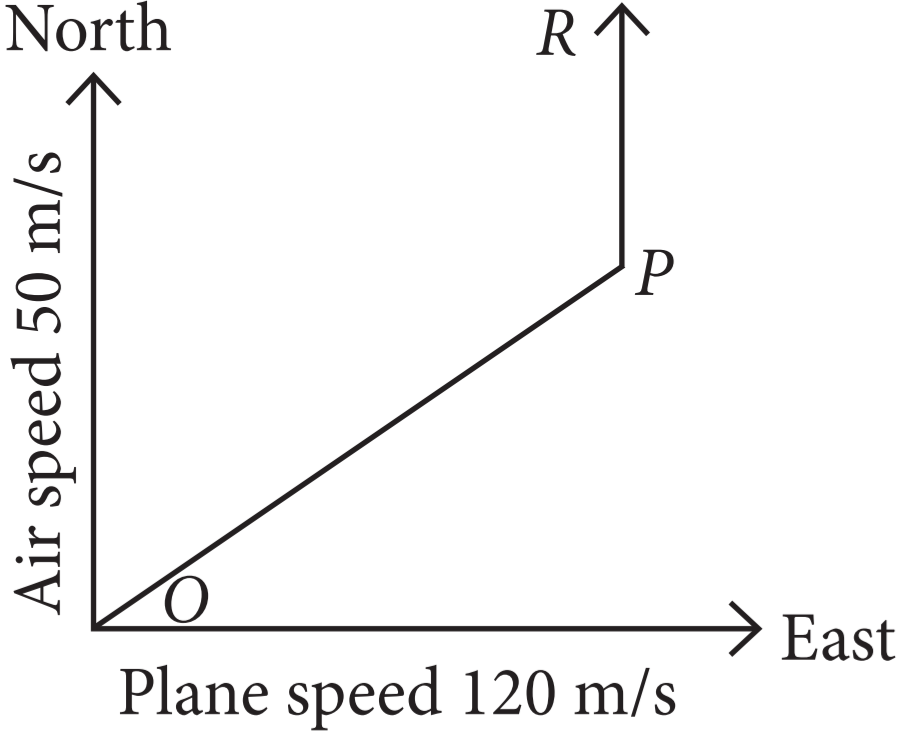
A plane started from airport situated at O with a velocity of 120m/s towards east. Air is blowing at a velocity of 50m/ s towards the north as shown in the figure.
The plane travelled 1hr in OP direction with the resultant velocity. From P to R the plane travelled 1hr keeping velocity of 120m/s and finally landed at R.

Based on the above information, answer the following questions.
  1. What is the resultant velocity from O to P?
  1. 100m/ s
  2. 130m/ s
  3. 126m/ s
  4. 180m/ s
  1. What is the direction of travel of plane from O to P with East?
  1. $\tan^{-1}\Big(\frac{5}{12}\Big)$
  2. $\tan^{-1}\Big(\frac{12}{3}\Big)$
  3. 50
  4. 80
  1. What is the displacement from O to P?
  1. 600km
  2. 468km
  3. 532km
  4. 500km
  1. What is the resultant velocity from P to R?
  1. 120m/ s
  2. 70m/ s
  3. 170m/ s
  4. 200m/ s
  1. What is the displacement from P to R?
  1. 450km
  2. 532km
  3. 610km
  4. 612km
On a holiday, a father gave a puzzle from a newspaper to his son Ravi and his daughter Priya. The probability of solving this specific puzzle independently by Ravi and Priya are $\frac{1}{4}$ and $\frac{1}{5}$ respectively.


Based on the above information, answer the following questions.

  1. The chance that both Ravi and Priya solved the puzzle, is:
  1. 10%
  2. 5%
  3. 20%
  4. 25%
  1. Probability that puzzle is solved by Ravi but not by Priya, is:
  1. $\frac{1}{2}$

  2. $\frac{1}{5}$

  3. $\frac{3}{5}$

  4. $\frac{1}{3}$

  1. Find the probability that puzzle is solved.
  1. $\frac{1}{2}$

  2. $\frac{1}{5}$

  3. $\frac{2}{5}$

  4. $\frac{5}{6}$

  1. Probability that exactly one of them solved the puzzle, is:
  1. $\frac{1}{30}$

  2. $\frac{1}{20}$

  3. $\frac{7}{20}$

  4. $\frac{3}{20}$

  1. Probability that none of them solved the puzzle, is:
  1. $\frac{1}{5}$

  2. $\frac{3}{5}$

  3. $\frac{2}{5}$

  4. None of these

If a relation between x and y is such that y cannot be expressed in terms of x, then y is called an implicit function of x. When a given relation expresses y as an implicit function of x and we want to find $\frac{\text{dy}}{\text{dx}},$ then we differentiate every term of the given relation w.r.t. x, remembering that a tenn in y is first differentiated w.r.t. y and then multiplied by $\frac{\text{dy}}{\text{dx}}.$
Based on the ab:ve information, find the value of $\frac{\text{dy}}{\text{dx}}$ in each of the following questions.
  1. x3 + x2y + xy2 + y3 = 81
  1. $\frac{(3\text{x}^2+2\text{xy}+\text{y}^2)}{\text{x}^2+2\text{xy}+3\text{y}^2}$
  2. $\frac{-(3\text{x}^2+2\text{xy}+\text{y}^2)}{\text{x}^2+2\text{xy}+3\text{y}^2}$
  3. $\frac{(3\text{x}^2+2\text{xy}-\text{y}^2)}{\text{x}^2-2\text{xy}+3\text{y}^2}$
  4. $\frac{3\text{x}^2+\text{xy}+\text{y}^2}{\text{x}^2+\text{xy}+3\text{y}^2}$
  1. xy = ex-y
  1. $\frac{\text{x}-\text{y}}{(1+\log\text{x})}$
  2. $\frac{\text{x}+\text{y}}{(1+\log\text{x})}$
  3. $\frac{\text{x}-\text{y}}{\text{x}(1+\log\text{x})}$
  4. $\frac{\text{x}+\text{y}}{\text{x}(1+\log\text{x})}$
  1. $\text{e}^{\sin\text{y}}=\text{xy}$
  1. $\frac{-\text{y}}{\text{x}(\text{y}\cos\text{y}-1)}$
  2. $\frac{\text{y}}{\text{y}\cos\text{y}-1}$
  3. $\frac{\text{y}}{\text{y}\cos\text{y}+1}$
  4. $\frac{\text{y}}{\text{x}(\text{y}\cos\text{y}-1)}$
  1. $\sin^2\text{x}+\cos^2\text{y}=1$
  1. $\frac{\sin2\text{y}}{\sin2\text{x}}$
  2. $-\frac{\sin2\text{x}}{\sin2\text{y}}$
  3. $-\frac{\sin2\text{y}}{\sin2\text{x}}$
  4. $\frac{\sin2\text{x}}{\sin2\text{y}}$
  1. $\text{y}=(\sqrt{\text{x}})^{\sqrt{\text{x}}^\sqrt{\text{x}}...\infty}$
  1. $\frac{-\text{y}^2}{\text{x}(2-\text{y}\log\text{x})}$
  2. $\frac{\text{y}^2}{2+\text{y}\log\text{x}}$
  3. $\frac{\text{y}^2}{\text{x}(2+\text{y}\log\text{x})}$
  4. $\frac{\text{y}^2}{\text{x}(2-\text{y}\log\text{x})}$
On a holiday, a father gave a puzzle from a newspaper to his son Ravi and his daughter Priya. The probability of solving this specific puzzle independently by Ravi and Priya are $\frac{1}{4}$ and $\frac{1}{5}$ respectively.


Based on the above information, answer the following questions.

  1. The chance that both Ravi and Priya solved the puzzle, is:
  1. 10%
  2. 5%
  3. 20%
  4. 25%
  1. Probability that puzzle is solved by Ravi but not by Priya, is:
  1. $\frac{1}{2}$

  2. $\frac{1}{5}$

  3. $\frac{3}{5}$

  4. $\frac{1}{3}$

  1. Find the probability that puzzle is solved.
  1. $\frac{1}{2}$

  2. $\frac{1}{5}$

  3. $\frac{2}{5}$

  4. $\frac{5}{6}$

  1. Probability that exactly one of them solved the puzzle, is:
  1. $\frac{1}{30}$

  2. $\frac{1}{20}$

  3. $\frac{7}{20}$

  4. $\frac{3}{20}$

  1. Probability that none of them solved the puzzle, is:
  1. $\frac{1}{5}$

  2. $\frac{3}{5}$

  3. $\frac{2}{5}$

  4. None of these

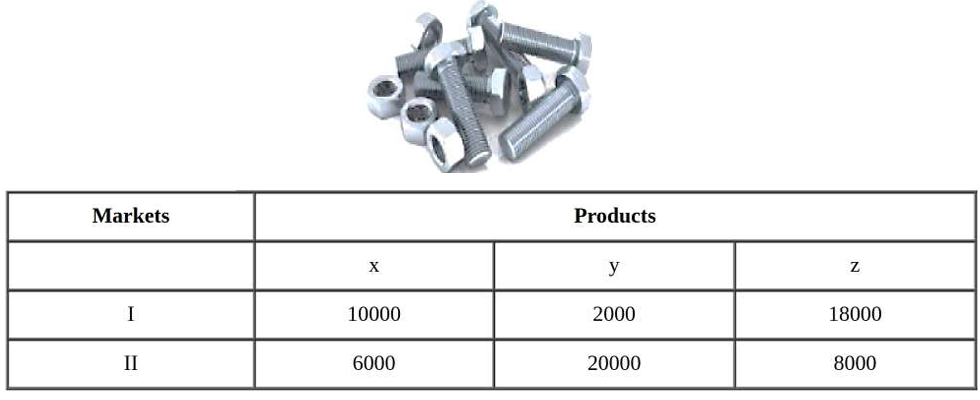
The nut and bolt manufacturing business has gained popularity due to the rapid Industrialization and introduction of the Capital-Intensive Techniques in the Industries that are used as the Industrial fasteners to connect various machines and structures. Mr. Suresh is in Manufacturing business of Nuts and bolts. He produces three types of bolts, $\mathrm{x}, \mathrm{y}$, and $\mathrm{z}$ which he sells in two markets. Annual sales (in ₹) indicated below:

Image

(i) If unit sales prices of $x, y$ and $z$ are $₹ 2.50$, ₹ 1.50 and $₹ 1.00$ respectively, then find the total revenue collected from Market-I \&II.

(ii) If the unit costs of the above three commodities are ₹2.00, ₹ 1.00 and 50 paise respectively, then find the cost price in Market I and Market II.

(iii) If the unit costs of the above three commodities are ₹2.00, ₹1.00 and 50 paise respectively, then find gross profit from both the markets.

OR

If matrix $\mathrm{A}=\left[a_{i j}\right]_{2 \times 2}$ where $\mathrm{a}_{\mathrm{ij}}=1$, if $\mathrm{i} \neq \mathrm{j}$ and $\mathrm{a}_{\mathrm{ij}}=0$, if $\mathrm{i}=\mathrm{j}$ then find $\mathrm{A}^2$.

To promote the making of toilets for women, an organisation tried to generate awareness through (i) house call (ii) emails and (iii) announcements. The cost for each mode per attempt is given below:

  1. ₹ 50
  2. ₹ 20
  3. ₹ 40
The number of attempts made in the villages X, Y and Z are given below:
  (i) (ii) (iii)
X 400 300 100
Y 300 250 75
Z 500 400 150
Also, the chance of making of toilets corresponding to one attempt of given modes is:
  1. 2%
  2. 4%
  3. 20%
Based on the above information, answer the following questions.
  1. The cost incurred by the organisation on village X is:
  1. ₹ 10000
  2. ₹ 15000
  3. ₹ 30000
  4. ₹ 20000
  1. The cost incurred by the organisation on village Y is:
  1. ₹ 25000
  2. ₹ 18000
  3. ₹ 23000
  4. ₹ 28000
  1. The cost incurred by the organisation on village Z is:
  1. ₹ 19000
  2. ₹ 39000
  3. ₹ 45000
  4. ₹ 50000
  1. The total number of toilets that can be expected after the promotion in village X, is:
  1. 20
  2. 30
  3. 40
  4. 50
  1. The total number of toilets that can be expected after the promotion in village Z, is
  1. 56
  2. 26
  3. 36
  4. 46
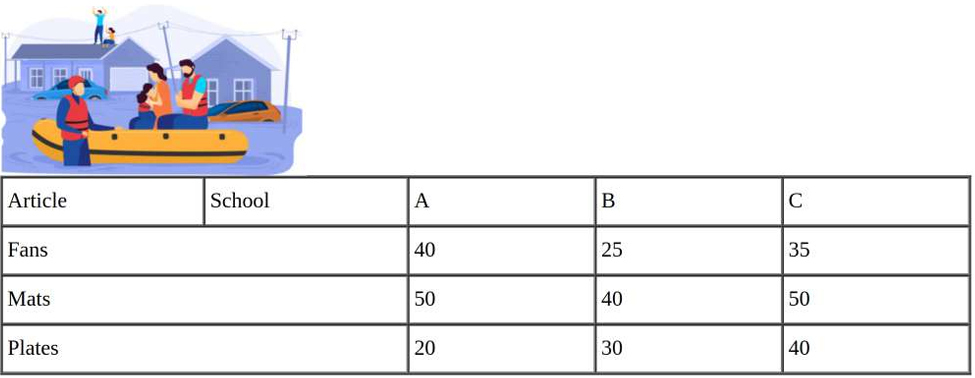
Three schools A, B and C organized a mela for collecting funds for helping the rehabilitation of flood victims. They sold handmade fans, mats, and plates from recycled material at a cost of ₹ 25 , ₹ 100 and ₹ 50 each. The number of articles sold by school A, B, C are given below.

Image

(i) Represent the sale of handmade fans, mats and plates by three schools A, B and C and the sale prices (in ₹) of given products per unit, in matrix form.

(ii) Find the funds collected by school A, B and C by selling the given articles.

(iii) If they increase the cost price of each unit by $20 \%$, then write the matrix representing new price.

OR

Find the total funds collected for the required purpose after $20 \%$ hike in price.