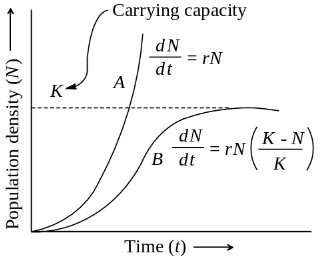
Correct option: A.$\frac{d N}{d t}=r N\left(\frac{K-N}{K}\right)$
a
$\frac{d N}{d t}=r N\left(\frac{K-N}{K}\right)$
Logistic Growth Model No population can continue to grow exponentially, as the resource availability become limiting at certain point of time. Logistic growth model have fixed carrying capacity
It is described by the equation $\frac{d N}{d t}=r N\left(\frac{K-N}{K}\right)$ Rate of change of population density
$N=$ Population density at time
$N=$ Population density
$r=$ Intrinsic rate of natural increase
$K=$ Carrying capacity
Population growth curve $A$ when resources are not limiting. Plot is exponential or geometrical curve $B$. When resources are limiting the growth, plot is logistic
' $K$ ' is carrying capacity