MCQ
Longitudinal waves cannot:
  • A
    Have a unique wavelength
  • B
    Transmit energy
  • C
    Have a unique wave velocity
  • Be polarized.

Answer

Correct option: D.
Be polarized.
A longitudinal wave has particle displacement along its direction of motion; thus, it cannot be polarised.

Need a full question paper?

Generate a complete, print-ready paper with questions like this in minutes — across 16+ boards, with answer keys.

Start Generating Free

Similar questions

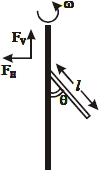
A uniform rod of length $'l'$ is pivoted at one of its ends on a vertical shaft of negligible radius When the shaft rotates at angular speed $\omega$ the rod makes an angle $\theta$ with it (see figure). To find $\theta$ equate the rate of change of angular momentum (direction going into the paper ) $\frac{ m \ell^{2}}{12} \omega^{2} \sin \theta \cos \theta$ about the centre of mass $(CM)$ to the torque provided by the horizontal and vertical forces $F_{H}$ and $F_{V}$ about the CM. The value of $\theta$ is then such that:
A particle of mass m is executing oscillations about the origin on the $X-$axis. Its potential energy is $U(x) = k{[x]^3}$, where $k$ is a positive constant. If the amplitude of oscillation is $a$, then its time period $T$ is
During propagation of a plane progressive mechanical wave:
A body of mass $1 kg$ begins to move under the action of a time dependent force $\vec{F}=\left(t \hat{i}+3 t^2 \hat{ j }\right) N$. where $\hat{i}$ and $\hat{j}$ are the unit vectors along $x$ and $y$ axis. The power developed by above force, at the time $t=2 s$. will be $..............W$.
A glass wind screen whose inclination with the vertical can be changed is mounted on a car. The car moves horizontally with a speed of $2\,\,m/s$. At what angle $\alpha$ with the vertical should the wind screen be placed so that the rain drops falling vertically downwards with velocity $6\,\, m/s$ strike the wind screen perpendicularly.
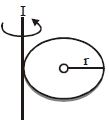
A solid sphere of radius $R$ has moment of inertia $I$ about its geometrical axis. It is melted into a disc of radius $r$ and thickness $t$. If it's moment of inertia about the tangential axis (which is perpendicular to plane of the disc), is also equal to $I,$ then the value of $r$ is equal to
One mole of a perfect gas in a cylinder fitted with a piston has a pressure $P,$ volume $V$ and temperature $T.$ If the temperature is increased by $1 \,K$ keeping pressure constant, the increase in volume is
The acceleration vector of a particle in uniform circular motion averaged over the cycle is a null vector. This statement is
A sliver wire has mass $(0.6 \pm 0.006) \; g$, radius $(0.5 \pm 0.005) \; mm$ and length $(4 \pm 0.04) \; cm$. The maximum percentage error in the measurement of its density will be $......\,\%$
If there were a smaller gravitational effect, which of the following forces do you think would alter in some respect