Question
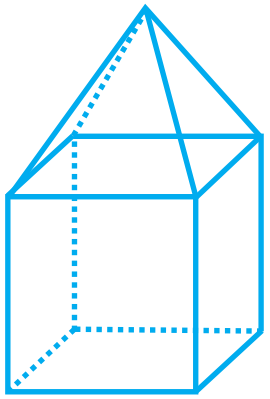
Look at the shapes given below and state these are polyhedra using Euler’s formula.

Answer

In the give figure, we have.Faces $(F) = 9$, verties $(v) = 9$ and edges $(E) = 16$
On putting these values in Euler's formula, we get.
$F + V - E = 2$
$\Rightarrow 9 + 9 - 16 = 2$
$\Rightarrow 18 - 16 = 2$
$\Rightarrow 2 = 2$
Hence, these valus do not satisfy the Euler's formula. So, it is a polyhedra.

Need a full question paper?

Generate a complete, print-ready paper with questions like this in minutes — across 16+ boards, with answer keys.
Start Generating Free

Similar questions

Using suitable identities, evaluate the following.
$(132)^2- (68)^2$
A recipe for a particular type of muffins requires $1$ cup of milk and $1.5$ cups of chocolates. Riya has $7.5$ cups of chocolates. If she is using the recipe as a guide, how many cups of milk will she need to prepare muffins?
Factorize of the following algebraic expression:$(2x - 3y)(a + b) + (3x - 2y)(a + b)$
Is 150 a perfect cube?
In the following pattern, fill in the missing numbers :
$\begin{array}{l}1^2 \times 2^2 \times 2^2=3^2 \\2^2 \times 3^2 \times 6^2=7^2 \\3^2 \times 4^2 \times 12^2=13^2 \\4^2 \times 5^2 \times 20^2=(\ )^2 \\9^2 \times 10^2 \times(\ )^2=(\ )^2\end{array}$
Find following products: $\Big(\frac{4\text{x}}{5}-\frac{5\text{y}}{3}\Big)\Big(\frac{4\text{x}}{5}+\frac{5\text{y}}{3}\Big)​​​​​​​$
Take four set-squares from your and your friend's Instrument boxes. Use different numbers of them to place side-by-side and obtain different trapeziums.
If the non-parallel sides of a trapezium are of equal length, we call it an Isosceles trapezium. Did you get an isosceles trapezium in any of your Investigations given above?
Last year, we hired 3 buses for the school trip. We had a total of 162 students and teachers who went on that trip and all the buses were full. This year we have 204 students. How many buses will we need? Will all the buses be full?
Find the cube root of each of the following natural numbers: $343$
Expand the following, using suitable identities.$\Big(\frac{2\text{x}}{3}-\frac{2}{3}\Big)\Big(\frac{2\text{x}}{3}+\frac{2\text{a}}{3}\Big)$