MCQ
Lucas test is used to distinguish between
- ✓${1^o},\,{2^o}$ and ${3^o}$ alcohols
- B${1^o},\,\,{2^o}$ and ${3^o}$ amines
- CAldehydes and ketones
- DAlkenes and alkynes
Lucas reagent is a solution of anhydrous zinc chloride in concentrated hydrochloric acid.
The Lucas test in alcohols is a test to differentiate between primary $\left(1^{\circ}\right)$, secondary $\left(2^{\circ}\right)$, and tertiary $\left(3^{\circ}\right)$ alcohols.
Tertiary alcohols react immediately with Lucas reagent.
Secondary alcohols react within $10-15$ minutes (depending on their solubility).
Primary alcohols do not react appreciably with Lucas reagent at room temperature.
Generate a complete, print-ready paper with questions like this in minutes — across 16+ boards, with answer keys.
$\begin{matrix}
O\,\,\,\,\,\,\,\,\,\,\,\,\,\,\,\,\,\,\,\,\,\,\,\,\,\,\,\,\,\,\,\,\,\,\,\,\,\, \\
||\,\,\,\,\,\,\,\,\,\,\,\,\,\,\,\,\,\,\,\,\,\,\,\,\,\,\,\,\,\,\,\,\,\,\,\,\,\,\,\, \\
C{{F}_{3}}\,C\,OH+C{{H}_{3}}\,CH\,C{{H}_{3}} \\
\,\,\,\,\,\,\,\,\,\,\,\,\,\,\,\,\,\,\,\,\,\,\,\,\,\,\,\,\,\,| \\
\,\,\,\,\,\,\,\,\,\,\,\,\,\,\,\,\,\,\,\,\,\,\,\,\,\,\,\,\,\,\,\,\,OH \\
\end{matrix}\xrightarrow{{{H}_{2}}S{{O}_{4}}}\begin{matrix}
O\,\,\,\,\,\,\,\,\,\,\,\,\,\,\,\,\,\,\,\,\,\,\,\,\,\,\,\,\,\,\, \\
||\,\,\,\,\,\,\,\,\,\,\,\,\,\,\,\,\,\,\,\,\,\,\,\,\,\,\,\,\,\,\,\,\, \\
C{{F}_{3}}\,C\,OCH\,C{{H}_{3}}+{{H}_{2}}O \\
|\,\,\,\,\,\,\,\,\,\,\,\, \,\,\,\, \\
C{{H}_{3}}\,\,\,\,\,\,\,\,\,\,\, \\
\end{matrix}$
Statement $-I :$ Retardation factor $\left( R _{ f }\right)$ can be measured in meter/centimeter.
Statement $-II :$ $R _{ f }$ value of a compound remains constant in all solvents.
Choose the most appropriate answer from the options given below
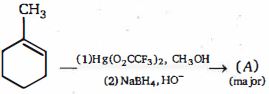
The compound $(D)$ is
$Mn^{2+} +2e- \rightarrow Mn;\, E^o = -1.18\,V$
$2(Mn^{3+} +e^- \rightarrow Mn^{2+} )\,;\,E^o=+1.51\,V$
The $E^o$ for $3Mn^{2+} \rightarrow Mn+ 2Mn^{3+}$ will be :