MCQ
"Lux" is a unit of
  • A
    Luminous intensity of a source
  • Illuminance on a surface
  • C
    Transmission coefficient of a surface
  • D
    Luminous efficiency of source of light

Answer

Correct option: B.
Illuminance on a surface

Need a full question paper?

Generate a complete, print-ready paper with questions like this in minutes — across 16+ boards, with answer keys.
Start Generating Free

Similar questions

Consider two hot bodies $B_1$ and $B_2$ which have temperatures $100^{\circ} \mathrm{C}$ and $80^{\circ} \mathrm{C}$ respectively at $t=0$. The temperature of the surroundings is $40^{\circ} \mathrm{C}$. The ratio of the respective rates of cooling $R_1$ and $R_2$ of these two bodies at $t=0$ will be
Which one of the following is a simple harmonic motion
A particle moves in a plane with constant acceleration in a direction different from the initial velocity. The path of the particle will be
If an ideal gas is compressed isothermally then
If $\gamma=2.5$ and volume is equal to $\frac{1}{8}$ times to the initial volume then pressure $P^{\prime}$ is equal to (Initial pressure $=P$ )
If $R_1$ and $R_2$ are respectively the filament resistances of a 200 watt bulb and 100 watt bulb designed to operate on the same voltage, then
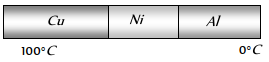
A composite metal bar of uniform section is made up of length 25 $\mathrm{cm}$ of copper, $10 \mathrm{~cm}$ of nickel and $15 \mathrm{~cm}$ of aluminium. Each part being in perfect thermal contact with the adjoining part. The copper end of the composite rod is maintained at $100^{\circ} \mathrm{C}$ and the aluminium end at $0^{\circ} \mathrm{C}$. The whole rod is covered with belt so that there is no heat loss occurs at the sides. If $K_{\mathrm{Cu}}=2 K_{A l}$ and $K_{A l}=3 K_{\mathrm{Ni}}$, then what will be the temperatures of $\mathrm{Cu}-\mathrm{Ni}$ and $N i-A l$ junctions respectively

Image

Which of the following is not a unit of energy
If the refractive indices of crown glass for red, yellow and violet colours are $1.5140,1.5170$ and $1.5318$ respectively and for flint glass these are $1.6434,1.6499$ and 1.6852 respectively, then the dispersive powers for crown and flint glass are respectively
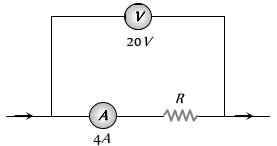
In the diagram shown, the reading of voltmeter is $20 \mathrm{~V}$ and that of ammeter is $4 A$. The value of $R$ should be (Consider given ammeter and voltmeter are not ideal)
Image