Question
Magnetic dipole moment of a rectangular loop is(a) Inversely proportional to current in loop(b) Inversely proportional to area of loop(c) Parallel to plane of loop and proportional to area of loop(d) Perpendicular to plane of loop and proportional to area of loop


Answer

(d) Perpendicular to plane of loop and proportional to area of loop

Need a full question paper?

Generate a complete, print-ready paper with questions like this in minutes — across 16+ boards, with answer keys.

Start Generating Free

Similar questions

In a cathode ray tube, what is the effect on the beam of particles if a hotter filament is used?
In order to forward bias a PN junction, the negative terminal of battery is connected to(a) P–side (b) Either P–side or N–side (c) N–side (d) None of these
   
   
If a 30 V, 90 W bulb is to be worked on a 120 V line, a resistance of how many ohms should be connected in series with the bulb (a) 10 ohm(b) 20 ohm(c) 30 ohm(d) 40 ohm
       
The mass defect per nucleon is called(a) Binding energy(b) Packing fraction(c) Ionisation energy(d) Excitation energy
       
Assertion  : The number of electrons in a P-type silicon semiconductor is less than the number of electrons in a pure silicon semiconductor at room temperature.
Reason      : It is due to law of mass action.(a) If both assertion and reason are true and the reason is the correct explanation of the assertion.(b) If both assertion and reason are true but reason is not the correct explanation of the assertion.(c) If assertion is true but reason is false.(d) If the assertion and reason both are false.


For a real object, which of the following can produced a real image          (a) Plane mirror(b) Concave lens(c) Convex mirror(d) Concave mirror
       
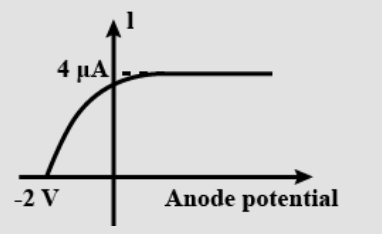
The graph shown below depicts plot of photocurrent versus anode potential for a cathode with 4 eV work function. The energy of the incident photon is:
Photon of 5.5 eV energy fall on the surface of the metal emitting photoelectrons of maximum kinetic energy 4.0 eV. The stopping voltage required for these electrons are(a) 5.5 V(b) 1.5V (c) 9.5V (d) 4.0V
       
Making a light wave vibrate in only one plane is known as:
When a coil of cross-sectional area A and number of turns N is rotated in a uniform magnetic field B with angular velocity $\omega$ then the maximum emf induced in the coil will be.