MCQ
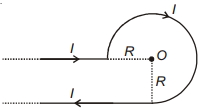
Magnetic field at the centre $O$ due to the given structure is
  • A
    $\frac{\mu_0 l}{4 R}\left[\frac{3}{2}+\frac{1}{\pi}\right] \odot$
  • B
    $\frac{\mu_0 I}{2 R}\left[3+\frac{1}{\pi}\right] \otimes$
  • $\frac{\mu_0 I}{4 R}\left[\frac{3}{2}+\frac{1}{\pi}\right] \otimes$
  • D
    $\frac{\mu_0 l}{4 R}\left[3+\frac{2}{\pi}\right] \odot$

Answer

Correct option: C.
$\frac{\mu_0 I}{4 R}\left[\frac{3}{2}+\frac{1}{\pi}\right] \otimes$
c
(c)

$B=B_{\text {due to circular arc }}+B_{\text {due to straight wires }}$

$=\frac{\mu_0 i}{2 R}\left(\frac{3 \pi}{2 \cdot(2 \pi)}\right)+\frac{\mu_0 i}{4 \pi R}$

$\Rightarrow B=\frac{\mu_0 i}{4 R}\left(\frac{3}{2}+\frac{1}{\pi}\right) \otimes$

Need a full question paper?

Generate a complete, print-ready paper with questions like this in minutes — across 16+ boards, with answer keys.

Start Generating Free

Similar questions

The anode voltage of a photocell is kept fixed. The wavelength $\lambda$, of the light falling on the cathode is gradually changed. The plate current $I$ of the photocell varies as follows
The Young's double slit interference experiment is performed using light consisting of 480 nm and 600 nm wavelengths to form interference patterns. The least number of the bright fringes of 480 nm light that are required for the first coincidence with the bright fringes formed by 600 nm light is :-
The mean free path and the average speed of oxygen molecules at 300 K and 1 atm are $3 \times 10^{-7} \mathrm{~m}$ and $600 \mathrm{~m} / \mathrm{s}$, respectively. Find the frequency of its collisions.
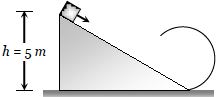
As per given figure to complete the circular loop what should be the radius if initial height is $5 \,m$ .......... $m$.
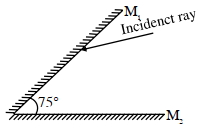
A light ray is incident, at an incident angle $\theta_{1}$, on the system of two plane mirrors $M_{1}$ and $M_{2}$ having an inclination angle $75^{\circ}$ between them (as shown in figure). After reflecting from mirror $M_{1}$ it gets reflected back by the mirror $M _{2}$ with an angle of reflection $30^{\circ}$. The total deviation of the ray will be $\dots$ degree.
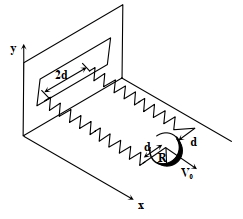
A uniform thin cylindrical disk of mass $\mathrm{M}$ and radius $\mathrm{R}$ is attached to two identical massless springs of spring constant $\mathrm{k}$ which are fixed to the wall as shown in the figure. The springs are attached to the axle of the disk symmetrically on either side at a distance $\mathrm{d}$ from its centre. The axle is massless and both the springs and the axle are in horizontal plane. The unstretched length of each spring is $L$. The disk is initially at its equilibrium position with its centre of mass $(CM)$ at a distance $L$ from the wall. The disk rolls without slipping with velocity $\overrightarrow{\mathrm{V}}_0=\mathrm{V}_0 \hat{\mathrm{i}}$. The coefficient of friction is $\mu$. Figure:$Image$

$1.$ The net external force acting on the disk when its centre of mass is at displacement $\mathrm{x}$ with respect to its equilibrium position is

$(A)$ $-\mathrm{kx}$ $(B)$ $-2 k x$ $(C)$ $-\frac{2 \mathrm{kx}}{3}$ $(D)$ $-\frac{4 k x}{3}$

$2.$ The centre of mass of the disk undergoes simple harmonic motion with angular frequency $\omega$ equal to

$(A)$ $\sqrt{\frac{k}{M}}$ $(B)$ $\sqrt{\frac{2 \mathrm{k}}{\mathrm{M}}}$ $(C)$ $\sqrt{\frac{2 \mathrm{k}}{3 \mathrm{M}}}$ $(D)$ $\sqrt{\frac{4 \mathrm{k}}{3 \mathrm{M}}}$

$3.$ The maximum value of $\mathrm{V}_0$ for which the disk will roll without slipping is

$(A)$ $\mu g \sqrt{\frac{\mathrm{M}}{\mathrm{k}}}$ $(B)$ $\mu g \sqrt{\frac{M}{2 k}}$ $(C)$ $\mu g \sqrt{\frac{3 M}{k}}$ $(D)$ $\mu g \sqrt{\frac{5 \mathrm{M}}{2 \mathrm{k}}}$

Give the answer question $1,2$ and $3.$
The binding energy per nucleon for ${ }_1^2 H$ and ${ }_2^4 He$ respectively are $1.1\; MeV$ and $7.1\; MeV$. The energy released in $MeV$ when two ${ }_1^2 H$ nuclei fuse to form ${ }_2^4 He$ is
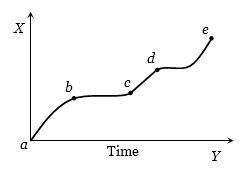
The displacement versus time graph for a body moving in a straight line is shown in figure. Which of the following regions represents the motion when no force is acting on the body
A particle is projected at angle $\theta$ with horizontal from ground. The slop $(m)$ of the trajectory of the particle varies with time $(t)$ as ...........
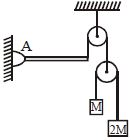
Consider the situation shown in the figure. Uniform rod of length $L$ can rotate freely about the hinge $A$ in vertical plane. Pulleys and string are light and frictionless. If therod remains horizontal at rest when the system is released then the mass of the rod is :