Question
Magnetic field does not cause deflection in:
  1. $\alpha-\text{rays}$
  2.  $\beta^+-\text{rays}$
  3.  $\beta^--\text{rays}$
  4.  $\gamma-\text{rays}$

Answer

  1. $\gamma-\text{rays}$

Explanation:

Magnetic force acts on a charged particle, due to which it deflects from its path. The magnitude of this force is measured as $\Big|\overrightarrow{\text{F}}\Big|=\Big|\text{q}\Big(\overrightarrow{\text{v}}\times\overrightarrow{\text{B}}\Big)\Big|.$

Here, q is the charge on the particle that is moving with speed v in a uniform magnetic field B.

Since alpha, beta-plus and beta-minus are charged particles, they suffer deflection due to the field applied. On the other hand, gamma rays are photons and due to zero charge, they do not suffer any deflection.
Need a full question paper?

Generate a complete, print-ready paper with questions like this in minutes — across 16+ boards, with answer keys.

Start Generating Free

Similar questions

(1): The dielectric medium between the plates of a parallel plate capacitor lowers the potential difference between the plates without a battery.
(2): The maximum electric field that a dielectric can withstand without causing it to break down is dielectric strength.

The plane faces of two identical plano-convex lenses each having focal length of 40 cm are pressed against each other to form a usual convex lens. The distance from this lens, at which an object must be placed to obtain a real, inverted image with magnification one is

(a) 80 cm

(b) 40 cm

(c) 20 cm

(d) 162 cm

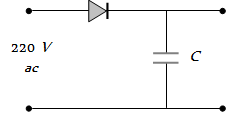
A diode is connected to 220 V (rms) ac in series with a capacitor as shown in figure. The voltage across the capacitor is

(a) 220 V

(b) 110 V

(c) 311.1 V

(d)  

When a piece of aluminium wire of finite length is drawn through a series of dies to reduce its diameter to half its original value, its resistance will become

(a) Two times

(b) Four times

(c) Eight times

(d) Sixteen times

A metallic particle having no net charge is placed near a finite metal plate carrying a positive charge. The electric force on the particle will be:
  1. Towards the plate.
  2. Away from the plate.
  3. Parallel to the plate.
  4. Zero.
Consider the following two statements regarding a linearly polarised, plane electromagnetic wave:
  1. The electric field and the magnetic field have equal average values.
  2. The electric energy and the magnetic energy have equal average values.
  1. Both A and B are true.
  2. A is false but B is true.
  3. B is false but A is true
  4. Both A and B are false.
The energy gap in glass at room temperature is:
A metallic rod of length $l$ is kept perpendicular to a magnetic field and it is rotated on a circular path with frequency $f$. The potential difference across the ends of the rod is :
Binding energy per nucleon for C12 is 7.68 MeV and for C13 is 7.74MeV. The energy required to remove a neutron from C13 is:
Displacement current is continuous: