MCQ
Magnetic field lines
  • do not intersect each other.
  • B
    intersect each other at $45^{\circ}$.
  • C
    intersect each other at $90^{\circ}$.
  • D
    intersect each other at $60^{\circ}$.

Answer

Correct option: A.
do not intersect each other.

Need a full question paper?

Generate a complete, print-ready paper with questions like this in minutes — across 16+ boards, with answer keys.
Start Generating Free

Similar questions

A 1.5 kg block is initially at rest on a horizontal frictionless surface when a horizontal force in the positive direction of X-axis is applied to the block. The force is given by $\overrightarrow{ F }=\left(4- x ^2\right) \hat{ i } N$,where x is in metre and the initial position of the block is x = 0 The maximum kinetic energy of the block between x = 0 and x = 2.0 m is
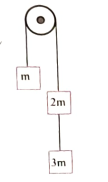
Three masses m, 2m and 3m are attached with light string passing over a fixed frictionless pulley as shown in the figure. The tension in the string between 2m and 3m is (g is acceleration due to gravity)
Image
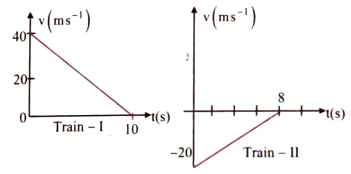
Two trains, which are moving along different tracks in opposite direction, are put on the same track by mistake. On noticing the mistake, when the trains are 300 m apart the drivers start slowing down the trains. The graphs given below show decrease in their velocities as function of time. The separation between the trains when both have stopped is
Image
The position of an object moving along x-axis is given by $x=a+b t^2$ where a = 8.5 m and b = 2.5 m and t is measured in second. If th object starts from t = 0, the velocity at t = 2 s is
Two cars P and Q start from a point at the same time in a straight line and their positions are represented by $x_p(t)=a t+b t^2$ and $x _{ Q }( t )= ft - t ^2.$ At what time have the same velocity?
If the velocity of sound in hydrogen is $1248 \ m/s,$ the velocity of sound in oxygen is $[$Given $: M_O = 32$ and $M_H = 2]$
When source of sound moves towards a stationary observer, the wavelength of sound received by him
Which of the following electromagnetic waves have the longest wavelength?
A particle moves from a point $(-2 \hat{ i }+5 \hat{ j })$ to $(4 \hat{j}+3 \hat{k})$ when a force of $(4 \hat{i}+3 \hat{j})$ N is applied. How much work has been done by the force?
A particle covers equal distances around a circular path in equal intervals of time. Which of the following quantities connected with the motion of the particle remains constant with time?