MCQ
Magnetic lines of force:
- AAre mere directions.
- BHave no physical reality.
- CCan be used to indicate the direction of the magnetic field at point.
- DAll the above are correct.
Explanation:
A pictorial representation of magnetic lines of force is very useful in visualizing the strength and direction of the magnetic field. The direction of magnetic lines of force is defined to be the direction in which the north end of a compass needle points. They have no physical existence.
Generate a complete, print-ready paper with questions like this in minutes — across 16+ boards, with answer keys.
If  and
and  are respectively, the electric permittivity and the magnetic permeability of free space, ε and μ the corresponding quantities in a medium, the refractive index of the medium is
|
(a) |
(b) |
(c) |
(d) |
Positive rays was discovered by
|
(a) Thomson |
(b) Goldstem |
(c) W. Crookes |
(d) Rutherford |
Which of the following (referred to a spherical mirror) do (does) not depend on whether the rays are paraxial or not?
3 identical bulbs are connected in series and these together dissipate a power P. If now the bulbs are connected in parallel, then the power dissipated will be
|
(a) |
(b) 3P |
(c) 9P |
(d) |
In a typical Wheatstone network, the resistances in cyclic order are A = 10 W, B = 5 W, C = 4 W and D = 4 W for the bridge to be balanced
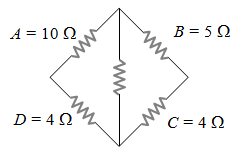
|
(a) 10 W should be connected in parallel with A |
|
(b) 10 W should be connected in series with A |
|
(c) 5 W should be connected in series with B |
|
(d) 5 W should be connected in parallel with B |
To make a PN junction conducting
|
(a) The value of forward bias should be more than the barrier potential |
|
(b) The value of forward bias should be less than the barrier potential |
|
(c) The value of reverse bias should be more than the barrier potential |
|
(d) The value of reverse bias should be less than the barrier potential |


