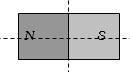
MCQ
Magnets cannot be made from which of the following substances
  • A
    Iron
  • B
    Nickel
  • Copper
  • D
    All of the above

Answer

Correct option: C.
Copper
c
(c) The substances which are not attracted by a magnet are called non-magnetic substances.

For example, wood, paper, water, copper, glass, gold, silver, etc, are non-magnetic substances.

Need a full question paper?

Generate a complete, print-ready paper with questions like this in minutes — across 16+ boards, with answer keys.

Start Generating Free

Similar questions

Assertion : Environmental damage has increased the amount of ozone in the atmosphere.

Reason : Increase of ozone increases the amount of ultraviolet radiation on earth.
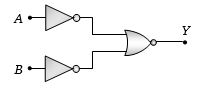
Which logic gate is represented by the following combination of logic gates
Time period for a magnet is $T$. If it is divided in four equal parts along its axis and perpendicular to its axis as shown then time period for each part will be
Dip angle in vertical plane at an angle ${\cos ^{ - 1}}\,\left( {\frac{1}{{\sqrt 2 }}} \right)$ from magnetic meridian is $60^o$, then actual dip at that place
In which case the thermal conductivity increases from left to right
The angle of polarisation for any medium is $60^o$, what will be critical angle for this
Sir $C.V.$ Raman was awarded Nobel Prize for his work connected with which of the following phenomenon of radiation
Assertion : If the half life of a radioactive substance is $40\, days$ then $25\%$ substance decay in $20\, days$

Reason : $N = {N_0}\,{\left( {\frac{1}{2}} \right)^n}$

where, $n = \frac{{{\rm{time\, elapsed}}}}{{{\rm{half \,life \,period}}}}$
Water rises upto a height $h$ in a capillary on the surface of earth in stationary condition. Value of $h$ increases if this tube is taken
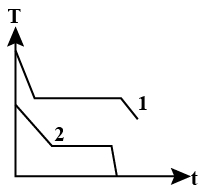
Two different liquids of same mass are kept in two identical vessels, which are placed in a freezer that extracts heat from them at the same rate causing each liquid to transform into a solid. The schematic figure below shows the temperature $T$ versus time $t$ plot for the two materials. We denote the specific heat in the liquid states to be $C_{L 1}$ and $C_{L 2}$ for materials 1 and 2, respectively and latent heats of fusion $U_1$ and $U_2$, respectively. Choose the correct option.