Question
Magnifying glass forms:

Answer

  1. Virtual Image
Explanation:
A magnifying lens is simply a convex lens and forms a magnified erect virtual image of objects.

Need a full question paper?

Generate a complete, print-ready paper with questions like this in minutes — across 16+ boards, with answer keys.
Start Generating Free

Similar questions

The current flowing in two coaxial coils in the same direction. On increasing the distance between the two, the electric current will(a)  Increase(b)  Decrease(c)  Remain unchanged(d)  The information is incomplete
   
   
The electric field E, current density J and conductivity s  of a conductor are related as(a) σ = E/j  (b) σ = j/E(c) σ = jE(d) σ = 1/jE
       
Characteristic of electromagnetic wave is shown by:
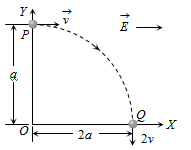
A particle of charge $+q$ and mass $m$ moving under the influence of a uniform electric field  $Eî$ and a uniform magnetic field $B \hat{k}$  follows trajectory from $P$ to $Q$ as shown in figure. The velocities at $P$ and $Q$ are $v^{\hat{1}}$ and -$-2 v^{\hat{\jmath}}$ respectively. Which of the following statement$(s)$ is/are correct
The S.I. unit of radioactivity is(a) Roentgen(b) Rutherford(c) Curie (d) Becqueral
       
The atomic number and mass number for a specimen are Z and A respectively. The number of neutrons in the atom will be :
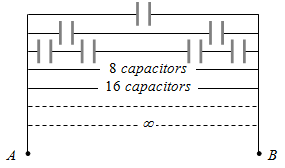
An infinite number of identical capacitors each of capacitance $1 \mu F$ are connected as in adjoining figure. Then the equivalent capacitance between $A$ and  $B$ is
The number of photo electrons emitted for light of a frequency $v\ ($higher than the threshold frequency $v_0​)$ is proportional to:
In Young’s double slit experiment the amplitudes of two sources are 3a and a respectively. The ratio of intensities of bright and dark fringes will be (a) 3 : 1   (b) 4 : 1(c) 2 : 1    (d)  9 : 1
       
A charge moving with velocity v in X-direction is subjected to a field of magnetic induction in the negative X-direction. As a result, the charge will(a) Remain unaffected(b) Start moving in a circular path Y-Z plane(c) Retard along X-axis(d) Move along a helical path around X-axis