MCQ
Main factor in increasing the population is
  • A
    More reproductive capacity
  • B
    Early marriage
  • Higher natality and lower mortality
  • D
    Suitable and favourable environment

Answer

Correct option: C.
Higher natality and lower mortality
c
(c) The excess of birth over deaths in a year per $1000$ in the population is called the growth rate. It is decrease in death rate and increase in birth rate which are two primary factor for the increase in human population.

Need a full question paper?

Generate a complete, print-ready paper with questions like this in minutes — across 16+ boards, with answer keys.

Start Generating Free

Similar questions

A sedentary sea anemone gets attached to the shell lining of hermit crab. The association is:
Cryptochoridism is a condition in which:
Which one is a hereditary disease?
The first restriction endonuclease type $II$ $...A..$, was isolated by Smith, Wilcox and Kelley from $...B...$ bacterium. It was formed to cut $DNA$ molecules at a particular point by recognizing a specific sequence of six base pairs, known as the $ ...C....$ Here $A, B$ and $C $can be
The number of sperms produced from $24$ secondary spermatocytes will be?
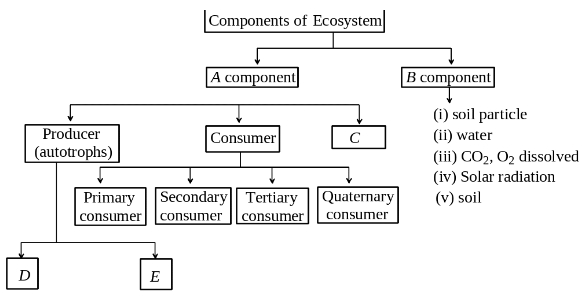
Study the diagram carefully and fill in the blanks

Choose the correct option for $A, B, C, D$ and $E$
 

Common $STD$ in India is
$I.$ Population evolve to maximise their reproductive fitness, also called Darwinian reproductive fitness (higher $r$ value), in the habitat in which they live

$II.$ The population growth rate $r$ is inversely related to generation time

$III.$ The housefly, which has a short life span and produces a large number of eggs, could be considered as a ' $K$ ' selected species

$IV.$ Under a particular set of selection pressures, organisms evolve towards the most efficient reproductive strategies

$V.$ Life history traits of organisms have evolved in relation to the constraints imposed by biotic and abiotic factors in their habitat Select the combination of correct statements

Which of the following is not a characteristic feature of insect pollinated flowers?
What would be the colour of flowers in $F_1$ progeny as a result of a cross between homozygous red and homozygous white-flowered Snapdragon